

AI Stocks Plunge on August 24: Nvidia, Alibaba and Memory Chips Fall as Market Awaits Fed Chair Warsh
2026/08/25 11:30:00
Introduction
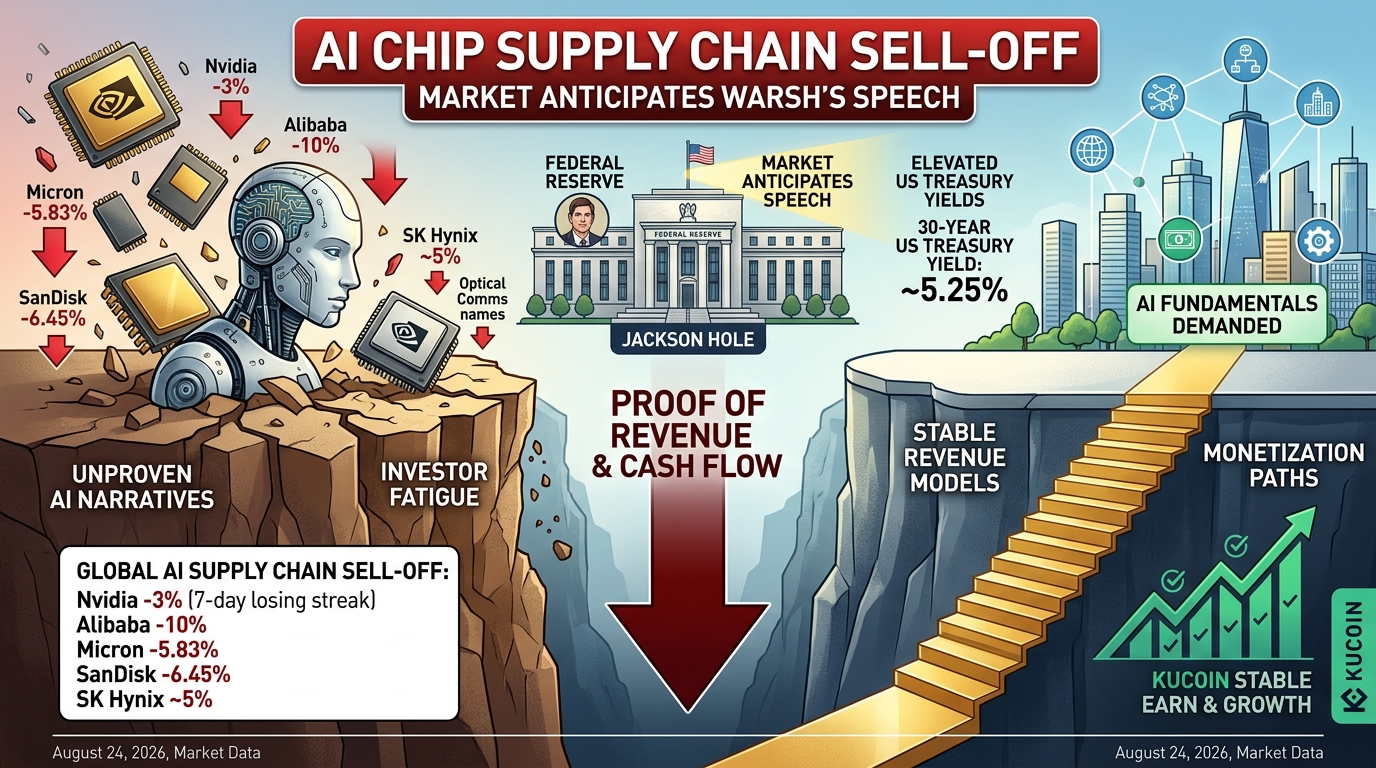
Investors woke up to sharp losses across AI-related equities after a session that punished both price hikes and fresh capital raises tied to artificial intelligence narratives. Nvidia shares dropped about 3 percent, extending a seven-day losing streak—the longest since 2022—while Alibaba’s Hong Kong-listed stock sank as much as 10 percent following its large share placement. Memory and optical communication names also retreated, with SanDisk falling roughly 6.45 percent, Micron 5.83 percent and SK Hynix around 5 percent, according to market data from August 24, 2026.
The sell-off highlights a clear shift: markets no longer reward pure AI storytelling without proof of revenue, cash flow and shareholder returns. Attention now turns to Federal Reserve Chair Kevin Warsh’s upcoming remarks at the Jackson Hole symposium this Friday for signals on inflation and policy direction.
Why Did Nvidia and Related AI Hardware Stocks Decline Despite Price Increases?
Nvidia’s roughly 3 percent drop on August 24, 2026, marked its seventh consecutive decline and reflected investor worries that higher server prices could pressure downstream demand rather than signal strength. Reports indicated Nvidia planned to raise prices by more than 15 percent next year on servers equipped with its AI chips due to rising memory costs. In previous cycles such announcements often lifted the entire supply chain. This time the reaction centered on concerns about uncontrolled hardware costs and delayed returns on AI infrastructure spending.
Memory chip makers felt the pressure most acutely. SanDisk shares fell 6.45 percent, Micron declined 5.83 percent and SK Hynix dropped about 5 percent in the same session, based on trading data from that day. These names had previously surged on any positive AI narrative. The current pullback shows markets treating upstream price power as a double-edged signal: it may protect margins for some suppliers while raising fears that hyperscalers and cloud providers will slow capital expenditure if total ownership costs rise too quickly.
Alibaba’s decision to raise approximately HK$80 billion (about US$10.2 billion) through a Hong Kong share placement triggered an immediate double-digit percentage decline in its local shares. The company priced 710 million new shares at HK$112.70, representing a notable discount to the prior close, and stated that 100 percent of net proceeds would fund full-stack AI capabilities, including infrastructure, chips and models. This marked Alibaba’s first such equity raise since its 2019 Hong Kong listing and represented a full commitment to the AI build-out.
Hong Kong trading saw the stock fall as much as 10 percent before stabilizing closer to the placement discount. Leadership responded with share purchases: Chairman Joe Tsai and CEO Eddie Wu together bought roughly HK$120 million of stock, according to exchange filings. The purchases helped limit further downside in the U.S.-listed shares but did not reverse the initial market verdict.
The reaction reveals investor fatigue with AI capital raises that prioritize long-term vision over near-term financial discipline. Earlier in 2026 many market participants accepted heavy spending with limited focus on profits or cash flow. Current conditions demand clearer paths to revenue growth, positive free cash flow and capital returns such as buybacks or dividends. Alibaba’s recent quarterly results, which showed a sharp profit decline linked to elevated AI investment, reinforced those concerns.
What Role Did Macro Factors Play in the Broader Market Weakness?
Elevated U.S. Treasury yields added another layer of pressure on risk assets. The 30-year Treasury yield hovered near 5.23–5.25 percent on August 24, 2026, remaining at multi-year highs despite official comments. U.S. Treasury officials indicated willingness to use funds from the Treasury General Account to purchase longer-dated securities in an effort to ease yields. Market participants quickly noted that usable balances fall well short of headline figures once routine operations and debt servicing needs are considered.
Yields dipped briefly after the comments then rebounded, leaving the 30-year rate still elevated. Higher long-term rates increase discount rates applied to future AI cash flows and raise the cost of capital for infrastructure projects. This environment makes pure growth narratives harder to sustain and amplifies scrutiny of companies that continue to expand without delivering commensurate returns to shareholders.
Fiscal concerns compound the issue. Persistent deficits and the need to refinance large volumes of debt keep term premiums elevated. Only the Federal Reserve can ultimately anchor inflation expectations, which is why attention has shifted decisively to the central bank’s next communication.
Why Is the Market Focused on Fed Chair Kevin Warsh’s Jackson Hole Speech?
Kevin Warsh, who assumed the Fed chair role in May 2026, is scheduled to deliver a keynote address at the Jackson Hole Economic Policy Symposium on Friday. Since taking office, he has offered limited forward guidance, making any remarks especially influential. Markets seek clarity on how the central bank will respond to inflation that has remained above the 2 percent target and to ongoing fiscal challenges.
Warsh has previously indicated a preference for discussing broader principles rather than short-term policy signals. Investors, however, want concrete insight into whether the Fed views current conditions as requiring tighter policy, patient observation or eventual accommodation. Treasury actions can adjust the maturity structure of debt, yet only the Fed can shape inflation expectations that underpin long-term yields and equity valuations.
The speech arrives at a moment when AI-related equities already face valuation pressure. Any indication that rates will stay higher for longer could further compress multiples on growth stocks, while a more balanced tone might stabilize sentiment. Traders are therefore positioning cautiously ahead of the event.
How Has Investor Appetite for AI Narratives Evolved in 2026?
Market behavior has shifted from accepting large spending and ambitious projections toward demanding measurable progress. In the first half of the year many AI-linked names rose on infrastructure plans alone. Recent sessions show that price increases and equity raises now trigger questions about cost control, return on invested capital and shareholder returns.
Companies that announce higher prices or new funding for AI capacity must now demonstrate that the incremental investment will generate cash rather than simply expand capacity. Memory and networking suppliers, once reliable beneficiaries of every positive headline, face the same scrutiny. The result is greater differentiation: firms with proven monetization paths hold up better than those still in pure investment mode.
This evolution does not signal the end of AI investment. It signals a higher bar for capital allocation and communication. Investors increasingly reward disciplined execution and transparent metrics over expansive storytelling.
KuCoin Offers A More Stable Option in A Volatile Market
If you worry about the frequent ups and downs in the market, and pursue a more stable option to earn money passively, KuCoin is the right place to come:
-
Simple Earn: Deposit and withdraw tokens anytime, earning stable returns.
-
Kucoin Earn: Earn stable profits with professional asset management.
-
Hold to Earn: Earn rewards by holding assets in Funding, Trading, Margin, Futures, Mining, and Unified Accounts.
-
Staking: Unlock the earning potential of on-chain assets.
-
Advanced Investments: Advanced Investments offer a variety of structured products to help your money grow in any market.
-
Shark Fin: Principal Protection and Guaranteed Gains
-
Dual Investment: Buy low and sell high with transparent return calculations.
-
Snowball: High yields, with price protection.
-
Discount Buy: Buy crypto at discount prices.
-
KCS Loyalty: Level up to enjoy exclusive perks by staking ≥ 1 KCS.
-
KuCoin Wealth: Discover future value and begin your smart investing journey.
-
KCS Benefits: Hold and stake KCS to access benefits across the platform.
-
KCS Staking 2.0: Participate in KCS on-chain governance to earn yield.

Conclusion
Overnight trading delivered a clear message: AI-related stocks that raise prices or raise capital no longer receive automatic support. Nvidia’s multi-day slide, Alibaba’s sharp reaction to its share placement and declines across memory names illustrate the market’s preference for concrete financial results over narrative expansion. Macro factors, particularly elevated long-term Treasury yields, amplified the pressure by raising the cost of capital and discount rates applied to future growth.
Attention now centers on Federal Reserve Chair Kevin Warsh’s Jackson Hole address. His comments will help shape expectations for inflation management and the policy path at a time when fiscal and monetary conditions remain complex. The broader lesson is that capital continues to flow toward AI infrastructure, yet it now demands clearer evidence of returns, cash generation and disciplined capital allocation.
Investors should continue monitoring earnings reports, capital expenditure updates and central bank communication for the next signals. Conditions can shift quickly, and careful analysis of both company-level fundamentals and the macro backdrop remains essential.
FAQs
What caused Nvidia’s seven-day losing streak?
Nvidia’s streak reflected pre-earnings caution combined with concerns that planned server price increases of more than 15 percent could slow customer spending rather than boost near-term demand.
Why did Alibaba’s stock fall after the share placement?
The placement introduced dilution and signaled continued heavy AI spending at a time when investors prefer evidence of improving profitability and cash flow over further capital raises.
How are higher Treasury yields affecting tech stocks?
Elevated long-term yields raise discount rates on future cash flows and increase financing costs, which weighs particularly on high-growth, capital-intensive sectors such as AI infrastructure.
What should investors watch for in Warsh’s Jackson Hole speech?
Markets will focus on any comments regarding inflation persistence, the appropriate stance of monetary policy and the Fed’s willingness to act independently of fiscal developments.
Disclaimer: This article is for informational purposes only and does not constitute financial, legal, or investment advice. Always conduct your own research before interacting with digital assets.