

Why Did World Liberty Financial Emerge as a "DeFi for the People" Experiment?

What happens when the most powerful political brand in the United States collides head-on with decentralized finance? World Liberty Financial (WLFI) was born from exactly that collision — and its story has become one of crypto's most contested experiments. Launched in late 2024 by the Trump family and associates, WLFI positioned itself as a movement to "democratize access to DeFi" for everyday people. Within just 18 months, it minted a stablecoin worth over $4 billion in market capitalization, signed sovereign-nation payment deals, and hosted a 400-person finance summit at Mar-a-Lago. Yet it also attracted lawsuits, congressional probes, and serious questions about whether "DeFi for the people" was ever really the point.
What Is World Liberty Financial, and Why Was It Framed as a People's DeFi Movement?
World Liberty Financial positioned itself from day one as a mission-driven protocol. According to its official company description, WLFI is "a pioneering decentralized finance (DeFi) protocol and governance platform dedicated to empowering individuals through transparent, accessible, and secure financial solutions" — a platform that "seeks to democratize access to DeFi by creating user-friendly tools that bring the benefits of decentralized finance to a broader audience."
The framing was deliberate. DeFi has long been criticized for being inaccessible — technical interfaces, smart contract risks, and opaque tokenomics lock out the average retail investor. WLFI's founders, including Zachary Folkman, Chase Herro, and the Witkoff brothers, claimed they would fix this. Donald Trump was listed as "Chief Crypto Advocate," his son Barron as the project's "DeFi visionary," and Eric Trump and Donald Trump Jr. each held the title "Web3 Ambassador."
The "people's DeFi" pitch was politically potent. Trump had campaigned on a pro-crypto platform, promising to reverse restrictive digital asset policies and make the U.S. a global crypto hub. WLFI was the financial vehicle to back that rhetoric with action — or so the narrative went.
The USD1 Stablecoin: The Engine Behind the Experiment
How USD1 Became the Protocol's Core Product
The clearest evidence of WLFI's institutional ambitions is its stablecoin, USD1. Launched in March 2025 and pegged 1:1 to the U.S. dollar, USD1 is backed entirely by short-term U.S. government treasuries, dollar deposits, and cash equivalents — with custody handled by BitGo Trust Company.
According to Coinbase data as of late April 2026, USD1 has reached a market capitalization of approximately $4.08 billion, with a 24-hour trading volume of around $1.55 billion. That growth — from zero to over $4 billion in roughly a year — is among the fastest scaling trajectories for any stablecoin in crypto history.
The stablecoin now operates across Ethereum, BNB Chain, Solana, Tron, and Aptos, using Chainlink's Cross-Chain Interoperability Protocol (CCIP) for secure cross-chain transfers. As reported by CoinMarketCap (April 2026), on-chain data showed $25 million minted and $3 million burned in a single day in mid-April 2026 — activity managed through BitGo Mint, a regulated institutional minting service.
The Abu Dhabi and Pakistan Deals That Reshaped the Narrative
If USD1 was supposed to serve "the people," its biggest early wins told a very different story.
According to Wikipedia's updated entry (cross-referenced in February 2026 New York Times reporting), MGX — an Abu Dhabi state-backed company led by UAE national security advisor Tahnoun bin Zayed Al Nahyan — used $2 billion in USD1 to fund its investment in Binance. That single transaction instantly established USD1 as a stablecoin trusted by sovereign-level actors.
Then came Pakistan. According to Wikipedia's most current entry, in January 2026 Pakistan signed an agreement with SC Financial Technologies, a WLF-affiliated company, to explore using USD1 for cross-border payments — marking one of the first public integrations of a private stablecoin into a nation's regulated digital payment system.
These weren't retail-facing wins. They were geopolitical ones — and they fundamentally blurred the "DeFi for the people" narrative.
WLFI Markets: Turning Governance Into a Lending Protocol
How WLFI Entered Active DeFi Infrastructure
On January 12, 2026, World Liberty Financial launched WLFI Markets — its first live DeFi application, built on the Dolomite protocol. As reported by CoinDesk, the platform enables users to supply and borrow digital assets on-chain, starting with USD1 as the primary asset. Supported collateral includes WLFI governance tokens, ETH, cbBTC, USDC, and USDT.
According to CoinDesk at the time of launch, USD1's circulating supply had surpassed $3.4 billion. Co-founder Zak Folkman described WLFI Markets as "the first of several products planned over the next 18 months," framing it as proof that USD1 had "exceeded every expectation."
A USD1 Points Program was also introduced to reward liquidity providers — a classic DeFi incentive mechanic. On paper, this looked like a genuine move toward open, permissionless financial participation.
The Controversy That Followed
The lending platform quickly became a source of crisis. As reported by CoinDesk, WLFI borrowed roughly $75 million in stablecoins against its own WLFI governance tokens on Dolomite — pushing the USD1 lending pool to near-100% utilization and effectively trapping other depositors who could not withdraw their funds.
The WLFI token fell 12% to its lowest level since its 2025 launch as a result. Critics pointed out that using one's own governance token as collateral to drain a liquidity pool was the exact kind of centralized, self-serving behavior that DeFi was built to prevent. The team's public response — that it would "simply supply more collateral" if prices moved against it — did not reassure the market.
The Governance Contradiction: Centralization vs. Decentralization
Token Control and the Blacklisting Function
The most damaging challenge to WLFI's "people's DeFi" identity came not from markets, but from its own code.
As reported by BanklessTimes (April 22, 2026), TRON founder Justin Sun filed a federal lawsuit in California alleging that WLFI secretly added a "blacklisting" function to the WLFI token contract in 2025 — giving the team unilateral power to freeze, restrict, or confiscate any holder's tokens without a vote, prior notice, or disclosed cause. Sun alleges that WLFI used this function to freeze approximately 2.9 billion of his WLFI tokens, worth roughly $900 million, in order to pressure him for additional capital.
Sun's suit, according to BanklessTimes, also alleges wrongful token freeze, fraudulent misrepresentation, and an "illegal scheme to seize property." WLFI's founders dismissed the suit as "meritless."
The irony is sharp: a platform that marketed itself on decentralization allegedly built in a centralized override that let insiders confiscate tokens without community consent — the antithesis of open DeFi governance.
Token Distribution and Insider Control
According to Arkham Intelligence's analysis (February 2026), the WLFI leadership and advisory team holds approximately 33.5 billion WLFI tokens, with 22.5 billion designated for the Trump family entity alone. The Trump family receives 75% of net proceeds from token sales and a share of stablecoin profits. By December 2025, the Trump family had profited approximately $1 billion from the venture while holding roughly $3 billion worth of unsold tokens, according to Wikipedia's updated entry.
A governance proposal released on April 15, 2026, according to CoinMarketCap, proposed altering vesting for 62.28 billion locked WLFI tokens — allowing insiders to opt into a new 2-year cliff plus 3-year linear schedule, with a 10% burn of their allocation. This could remove up to 4.52 billion tokens from circulation, which some analysts viewed as a positive signal for long-term holders.
Institutional Ambition: World Liberty Forum and the Banking License
Mar-a-Lago as a DeFi Summit Venue
In February 2026, WLFI hosted the World Liberty Forum — an invitation-only event at Mar-a-Lago that drew nearly 400 participants. According to WLFI's own press release (February 2026), confirmed speakers included executives from Goldman Sachs and Franklin Templeton, alongside regulatory officials. The forum was explicitly designed to drive institutional adoption of USD1 and shape fintech policy.
This was not grassroots DeFi. This was Wall Street with a blockchain wrapper.
Filing for a National Banking Charter
In January 2026, according to Arkham Intelligence's research (February 2026), a new subsidiary — World Liberty Trust — filed an application for a national banking charter in the U.S. The Wall Street Journal reported that the charter "would allow World Liberty Trust to issue and safeguard USD1." If successful, this would blur the line between a decentralized protocol and a federally regulated financial institution — which critics argue is exactly the contradiction WLFI embodies.
Meanwhile, according to Wikipedia, the UAE royal family secured a 49% stake in WLFI for $500 million — a deal that was not publicly disclosed at the time, sparking a congressional probe by the House Select Committee in February 2026. Legal experts cited in media reporting described the arrangement as a potential violation of the emoluments clause of the U.S. Constitution.
For traders curious about WLFI governance tokens, KuCoin offers a direct and accessible entry point. Whether you're looking to hold USD1 as a dollar-pegged asset within a DeFi portfolio, trade WLFI's governance token as a speculative play on the protocol's future, or simply monitor price action as the Justin Sun lawsuit and token unlock proposals develop — KuCoin's spot and futures markets give you the flexibility to act on your own research.
Buy World Liberty Financial (WLFI) on KuCoin in Four Simple Steps
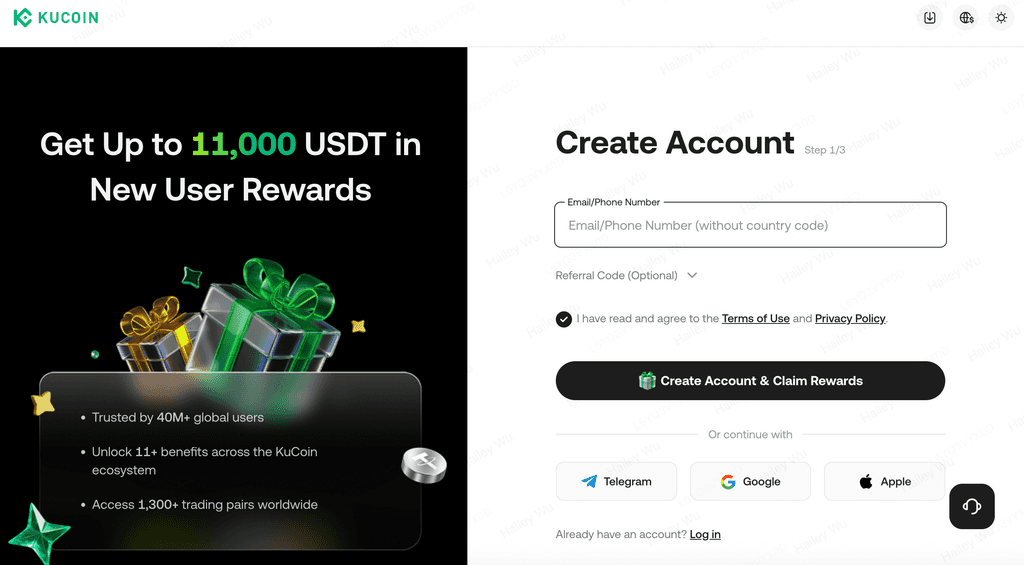
Step 1: Create Your Free KuCoin Account
Sign up on KuCoin with your email address/mobile phone number and country of residence, and create a strong password to secure your account.
Step 2: Secure Your Account
Ensure stronger protection of your account by setting Google 2FA code, anti-phishing code, and trading password.
Step 3: Verify Your Account
Verify your identity by entering your personal information and uploading a valid Photo ID.
Step 4: Add a Payment Method
Add a credit/debit card or bank account after verifying your KuCoin account.
Step 5: Buy World Liberty Financial (WLFI)
Use a variety of payment options to buy World Liberty Financial on KuCoin. We'll show you how.
Conclusion
World Liberty Financial emerged as a "DeFi for the people" experiment through a combination of political branding, genuine protocol ambition, and aggressive market positioning. It launched a stablecoin — USD1 — that now holds over $4 billion in market cap and has secured sovereign-level partnerships with Abu Dhabi and Pakistan. It built a live DeFi lending platform and filed for a national banking charter, signaling serious institutional intent.
But the contradictions are real and well-documented. The Trump family's 75% revenue cut from token sales, the alleged hidden blacklisting function in the WLFI contract, the near-insolvency of its Dolomite lending position in April 2026, and the undisclosed UAE stake deal all paint a picture of a project that talks decentralization while practicing centralization.
Whether WLFI ultimately succeeds as a DeFi innovation or is remembered as a politically branded financial vehicle depends heavily on how its legal crises resolve and whether its governance proposals — including the April 2026 vesting reform — restore market confidence. For now, it remains one of the most closely watched, most controversial, and most politically entangled experiments in the history of decentralized finance.
FAQs
What is the WLFI governance token used for?
WLFI is a governance token that gives holders voting rights on protocol upgrades, fee structures, and token unlock schedules. It is also used as collateral on WLFI Markets, the protocol's Dolomite-based lending platform. However, because 80% of tokens remain locked after two years, active governance participation remains limited to a small group of insiders.
Is USD1 regulated and audited?
Yes. USD1 is fully backed by U.S. government treasuries, dollar deposits, and cash equivalents, custodied through BitGo Trust Company — a federally chartered trust bank. According to WLFI's official website (current as of April 2026), USD1 undergoes monthly third-party attestation reports to verify reserves. It also recently became one of the first stablecoins supported on BitGo Mint, an institutional-grade minting service launched in April 2026.
What is the World Swap platform announced by WLFI?
World Swap is a foreign exchange and remittance platform announced at the Consensus conference in Hong Kong in February 2026. It is designed to connect users to global debit cards and bank accounts, essentially bridging DeFi liquidity with traditional payment rails. It is often described as a "TradFi-with-DeFi-branding" product and has not yet fully launched as of April 2026.
How does WLFI's debit card program work?
According to CoinMarketCap's USD1 tracker (April 2026), WLFI co-founders announced a debit card pilot program designed to let users spend crypto assets including USD1 in daily life, with planned integration into Apple Pay. The program was originally targeted for Q4 2025 or Q1 2026 but appears to have been delayed. Full launch details, including merchant acceptance terms and regulatory approvals, have not yet been publicly disclosed.
What is the AgentPay feature on WLFI's platform?
AgentPay is a developer-facing SDK that enables AI agents to make payments, hold funds, and move money across chains using USD1 — with built-in policy enforcement and human approval gates. As shown on the official WLFI website (April 2026), it supports configurable per-transaction and daily spending limits. This feature positions WLFI at the intersection of agentic AI and DeFi payments infrastructure — a niche that could become significantly more relevant as AI-powered financial automation grows.
Disclaimer: This article is for informational purposes only and does not constitute financial or investment advice. Cryptocurrency investments carry significant risk. Always conduct your own research before trading.