

What Is STRC by MicroStrategy?
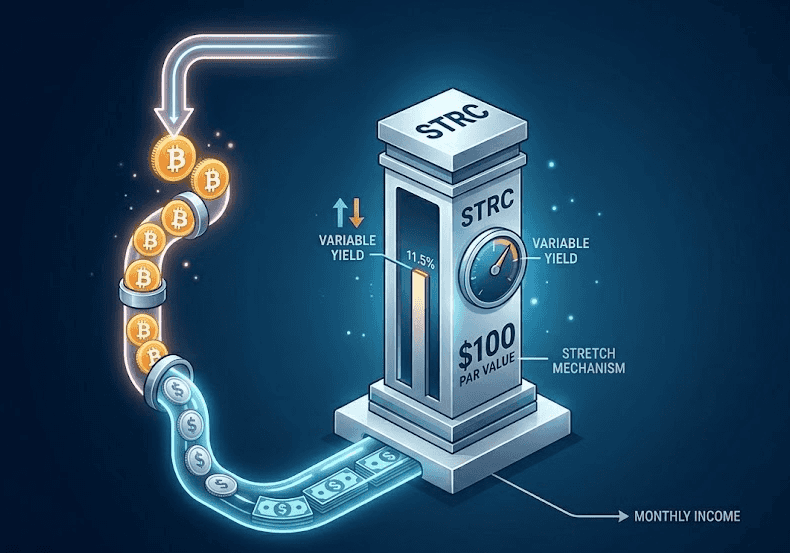
In the rapidly evolving intersection of decentralized finance and institutional treasury management, MicroStrategy has once again broken the mold with the introduction of STRC. As the world’s largest corporate holder of Bitcoin, the company’s shift toward a multi-tiered capital structure represents a sophisticated evolution in how equity markets interact with digital assets, offering a new paradigm for yield-seeking investors.
This comprehensive guide explores the mechanics of STRC and how MicroStrategy is leveraging this unique preferred stock to redefine the "Bitcoin Standard" for global capital markets and institutional portfolios.
Key Takeaways
-
Definition: STRC (Variable Rate Series A Perpetual Stretch Preferred Stock) is a fixed-income-like equity instrument issued by Strategy Inc. (MicroStrategy).
-
Yield Focus: It is designed to provide monthly cash dividends (currently targeted at 11.50% as of early 2026) rather than pure price appreciation.
-
Stability: Unlike the volatile $MSTR$ common stock, STRC utilizes a "stretch" mechanism to maintain a market price near its $100 par value.
-
Strategic Purpose: The capital raised through STRC issuances is primarily used to acquire additional Bitcoin, increasing the company's "Bitcoin per share" metrics.
-
Risk Profile: It sits above common equity in the liquidation stack but remains subject to the company's overall creditworthiness and Bitcoin's long-term value.
What is STRC? Definition and Core Identity
At its core, STRC is a specialized class of preferred stock that functions as a bridge between traditional corporate finance and the volatile world of cryptocurrency. While most investors are familiar with MicroStrategy through its common stock ($MSTR), STRC offers a different value proposition: predictable income backed by a massive Bitcoin treasury.
The "Stretch" Concept: Bridging Traditional Finance and Bitcoin
The "Stretch" in STRC refers to the instrument's ability to stretch its dividend yield to meet market demand. In traditional finance, preferred stocks often have fixed rates that can lead to significant price swings if interest rates change. STRC "stretches" its monthly dividend rate to ensure that the trading price stays as close to $100 as possible. This creates a "digital credit" instrument that allows traditional income investors to benefit from the growth of the Bitcoin ecosystem without enduring the 60%–80% drawdowns common in the underlying asset.
STRC vs. MSTR: Understanding the Difference Between Preferred and Common Shares
To understand STRC, one must distinguish it from the standard MicroStrategy common stock ($MSTR):
-
$MSTR (Common Stock): Represents residual ownership. It has no dividend, is highly volatile, and acts as a leveraged play on the price of Bitcoin.
-
$STRC (Preferred Stock): Represents a "senior" claim on assets. It pays a high monthly dividend but does not participate in the exponential upside of Bitcoin's price.
Investors choose STRC when they want "Bitcoin-adjacent" yield, whereas they choose MSTR when they want "Bitcoin-amplified" capital gains.
The Role of Strategy Inc.: Why MicroStrategy Rebranded its Capital Structure
In late 2025, MicroStrategy transitioned its corporate identity to Strategy Inc. to reflect its status as a Bitcoin development company. This rebranding was not merely cosmetic; it signaled the launch of a sophisticated capital engine. STRC is a pillar of this new identity, allowing the company to issue "software-like" financial products that attract different types of capital—ranging from pension funds seeking yield to retail investors looking for monthly cash flow.
Technical Mechanics: How STRC Maintains Stability and Yield
The brilliance of STRC lies in its technical design, which balances the company's need for permanent capital with the investor's need for price stability.
The Variable Rate Engine: How Monthly Dividend Adjustments Work
Unlike traditional bonds with fixed coupons, STRC features a Variable Rate Engine. Each month, the board of directors evaluates the market price of STRC. If the shares are trading at $98 (below par), the dividend rate is increased (e.g., from 11% to 11.5%) to incentivize buyers. Conversely, if the price climbs to $102, the rate can be "stretched" downward. This creates a self-correcting feedback loop that prioritizes price stability for the holder.
Par Value Protection: The Mechanism Keeping STRC Near $100
The target for STRC is always the $100 par value. By maintaining this peg, MicroStrategy provides a "safe haven" within the crypto-equity space. The protection comes from:
-
Yield Adjustments: The primary lever for price control.
-
Liquidity Provision: The company’s ability to buy back shares if they trade at a significant discount.
-
Institutional Demand: Large-scale buyers use STRC as a high-yield cash alternative, providing deep buy-side liquidity at the $100 level.
Perpetual Nature: Why There Is No Maturity Date for STRC
STRC is "perpetual," meaning MicroStrategy is never obligated to return the principal to the investor by a specific date. For the company, this is "forever capital"—they can keep the cash and hold the Bitcoin indefinitely. For the investor, liquidity is found by selling the shares on the NASDAQ exchange, rather than waiting for a bond to mature.
The Strategic Vision: Building a Bitcoin Capital Market
Under the leadership of Michael Saylor, MicroStrategy is not just buying Bitcoin; it is creating a secondary market for Bitcoin-backed securities.
-
Yield Generation: STRC allows the company to arbitrage the difference between the cost of capital (the dividend) and the historical appreciation of Bitcoin.
-
Market Expansion: By offering different risk/reward profiles (STRK for growth, STRC for income), they capture a wider net of global capital.
-
Institutional On-ramps: STRC provides a compliant, SEC-registered way for traditional institutions to earn yield derived from the "Bitcoin Standard."
Capital Recycling: Using STRC to Fuel Bitcoin Acquisitions
The process is a virtuous cycle: MicroStrategy issues STRC to the public, receives USD, and immediately converts that USD into Bitcoin. Because Bitcoin has historically appreciated at a rate higher than the 11% dividend cost of STRC, the company effectively grows its treasury "for free" over long time horizons, while the STRC holders receive their steady cash payments.
The Triple-Tier Model: Comparing STRK, STRC, and MSTR
To dominate the crypto-equity market, Strategy Inc. utilizes three distinct instruments:
-
STRK (Strike): Convertible preferred stock with a lower dividend but the option to convert into common stock.
-
STRC (Stretch): Non-convertible, high-yield perpetual preferred stock focused on income.
-
MSTR: The core common equity for maximum Bitcoin exposure.
Michael Saylor’s "Digital Credit" Philosophy: Low Volatility, High Income
Saylor has frequently argued that the world lacks a "high-yield digital-gold-backed currency." STRC is his answer. It functions as a form of digital credit—it is backed by the most pristine collateral on earth (Bitcoin) but pays out in the currency people use for daily expenses (USD).
Investor Considerations: Risk, Reward, and Liquidity
Investing in STRC requires a nuanced understanding of the risks associated with MicroStrategy and the broader digital asset market.
Dividend Safety: Assessing the Sustainability of 11%+ Yields
An 11.5% yield is significantly higher than the average S&P 500 dividend or even high-yield "junk" bonds. The safety of this dividend depends on MicroStrategy's ability to maintain its Bitcoin treasury. If Bitcoin’s price were to crash and stay low for years, the company’s ability to raise further capital or sell Bitcoin to cover dividends could be challenged. However, with a massive "LTV" (Loan-to-Value) cushion, the dividends are currently considered robust by market analysts.
Liquidation Preference: Where STRC Sits in the Capital Stack
In the event of a corporate bankruptcy, the order of payment is:
-
Secured Debt/Bondholders
-
STRC / STRK Preferred Shareholders
-
$MSTR Common Shareholders
-
This means STRC holders have a safer position than $MSTR holders. They must be paid in full before common shareholders receive a penny.
Market Sensitivity: How Bitcoin’s Price Impacts STRC Stability
While STRC is designed to be stable, it is not immune to extreme market "black swan" events. If Bitcoin drops 50% in a week, STRC may temporarily trade below its $100 par value due to panic. However, because the dividend adjusts monthly, the price typically recovers much faster than the underlying crypto assets.
Conclusion
The emergence of STRC marks a pivotal moment in the maturity of the digital asset class, proving that MicroStrategy is no longer just a software company, but a premier financial laboratory. By combining the high-yield characteristics of preferred equity with the structural strength of a Bitcoin-backed balance sheet, STRC provides a unique "middle ground" for investors who believe in the future of Bitcoin but cannot stomach the extreme volatility of direct ownership. As Strategy Inc. continues to expand its "Bitcoin Capital Market," STRC stands as a testament to how traditional financial engineering can be repurposed to serve the needs of a new, decentralized economy.
FAQ
What is the current dividend yield of STRC?
As of April 2026, the dividend yield for STRC is approximately 11.50%. This rate is variable and is adjusted monthly by the MicroStrategy (Strategy Inc.) board to ensure the stock trades near its $100 par value.
Can I convert STRC into MSTR common stock?
No, STRC is a non-convertible preferred stock. If you are looking for an instrument that can be converted into common shares, you should look into STRK (Strike), which is the convertible version of Strategy Inc.'s preferred offerings.
How often does STRC pay dividends?
STRC pays dividends on a monthly basis in cash. This frequent payout schedule is designed to attract income-focused investors who require regular cash flow, such as retirees or managed income funds.
Is STRC safer than buying Bitcoin directly?
From a volatility perspective, yes. STRC is designed to stay near $100, whereas Bitcoin can fluctuate 10% or more in a single day. However, STRC carries "platform risk"—you are relying on MicroStrategy to manage its treasury effectively.
Where can I buy STRC?
STRC is a publicly traded security listed on the NASDAQ. You can purchase it through any traditional brokerage account or crypto-integrated trading platform that supports US equities.