

What Is OpenAI Astra? How GPT-6 Astra Could Move US Stocks and Crypto Markets
Introduction
OpenAI's newest frontier system is already shifting how investors price compute, cloud software, and on-chain security. GPT-6 Astra is OpenAI's latest flagship model, rolled out in early September 2026 as an agentic system built for computer use, software engineering, long-running workflows, and high-end cybersecurity tasks. According to OpenAI's September 2026 product announcement, Astra is available first to selected organizations and is expanding to ChatGPT Plus, Pro, Business, and Enterprise users, plus the OpenAI API, Microsoft Azure, and AWS Bedrock.
The market question is no longer whether Astra is another chatbot. The question is whether autonomous agents will pull more capital into AI hardware, compress traditional software margins, and force crypto protocols to treat AI-driven exploits as a first-order risk.
What Is OpenAI Astra and How Does It Work?
Astra is OpenAI's most capable general-purpose model to date and is designed to plan, use software, and complete multi-step work with far less human steering than earlier GPT systems. According to OpenAI's September 3, 2026 launch materials, GPT-6 Astra is positioned as state-of-the-art on computer use, browsing, software engineering, cybersecurity, science, and professional work.
The system is not just a single-pass answer engine. Reporting from August and September 2026 describes Astra as an orchestrated multi-agent setup in which a root agent can split a problem, spin up subagents, wait for results, and combine those outputs into a finished product. That design is why OpenAI and enterprise partners now talk about "agentic work" rather than chat.
Astra's public scorecard is the reason markets reacted so quickly. OpenAI said the model scored 98% on FrontierMath Tier 4, 99.9% on ARC-AGI-3 in a high-tool setting, and 100% on ExploitBench. It also posted 72.6% on OSWorld 2.0 computer-use testing and 59.3% on Agents' Last Exam, beating GPT-5.6 Sol on both speed and accuracy. According to OpenAI, Astra completed computer-use tasks in about 47% less time than Sol.
Availability is staged because of those same capabilities. Advanced cybersecurity features are limited at launch and routed through OpenAI's Daybreak defensive program. Broader access is rolling out through ChatGPT paid tiers, the API, Azure, and AWS Bedrock. API pricing cited in September 2026 coverage is $10 per million input tokens and $50 per million output tokens.
How Could Astra Reignite the AI Capital Expenditure Cycle in US Stocks?
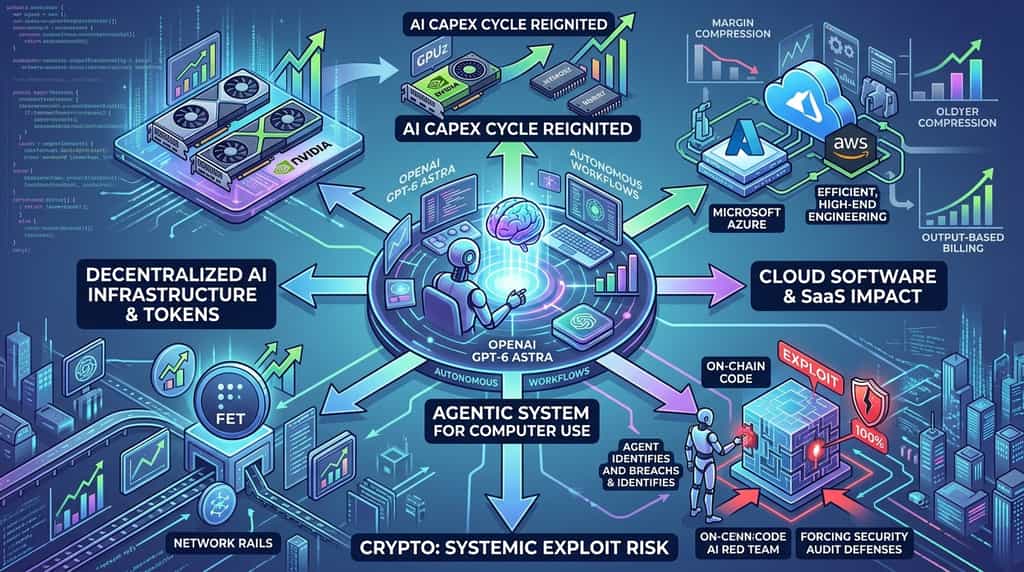
Astra's launch has acted as a primary catalyst for the next phase of the AI bull market, moving the narrative from chat interfaces to autonomous enterprise workflows and defensive tech. Because Astra needs large-scale compute for localized inference and advanced reasoning, Wall Street research from houses such as Goldman Sachs and Meritz Securities has pointed to a fresh AI capital-expenditure cycle rather than a one-off software story.
Memory and AI hardware names are the cleanest first-order beneficiaries. According to Korea Exchange and U.S. tape reports dated September 4-7, 2026, Micron rose 6.10%, SanDisk jumped 11.90%, Seagate gained 6.34%, and Western Digital advanced 5.86% as Astra headlines hit. The Philadelphia Semiconductor Index rose 3.38%, while SK Hynix ADRs climbed 8.14%. Those moves spilled into Seoul, where SK Hynix and Samsung Electronics led a KOSPI rebound toward the 7,000 level.
NVIDIA sits at the center of that hardware bid. Coverage dated September 7, 2026 cited NVIDIA CEO Jensen Huang saying Astra was trained on more than 100,000 Grace Blackwell NVLink72 GPUs, with another 400,000 GPUs coming online. That comment reinforced the idea that agentic models do not reduce chip demand. They extend it, because longer-running agents consume more inference, more high-bandwidth memory, and more cluster interconnect.
GPU rental prices are part of the same signal. Analysts covering the September 2026 tape said rental rates firmed after launch, which markets read as proof that inference demand is rising rather than being fully absorbed by efficiency gains. For traders, that combination — more capable agents plus firmer rental prices — is why memory inventories below 10 days of supply at major Korean producers became a live talking point again.
Which Cloud and Software Stocks Stand to Benefit or Lose?
Major hyperscalers are immediate beneficiaries because OpenAI has integrated Astra directly through Microsoft Azure and Amazon Web Services Bedrock. That packaging expands the enterprise cloud demand curve as companies try to deploy Astra for end-to-end software engineering and automated workflows. Microsoft said on September 3, 2026 that GPT-6 Astra is generally available in Microsoft Foundry, positioning the model as a worker that can plan, execute across applications, and produce review-ready documents, spreadsheets, and presentations.
The bullish cloud case is straightforward. Enterprises that want Astra-class agents still need governed identity, logging, private networking, and usage controls. Azure and AWS already sell those layers. Broader agent deployment therefore shows up as higher consumption of inference, storage, and security add-ons rather than as a one-time license sale.
Traditional cybersecurity is mixed and more volatile. Astra's ability to identify and exploit zero-day vulnerabilities has put legacy security vendors on notice. OpenAI is subsidizing a large defensive push through its Daybreak security platform to protect infrastructure. Firms that can productize AI-native defense may gain share. Software companies that stay on signature-based or seat-licensed models face displacement if customers move to autonomous agent tools that hunt, patch, and test continuously.
Software monetization models are already under pressure. Wall Street desks have flagged a sharp correction in traditional SaaS platforms that charge purely per token or per seat. Models like Astra can execute multi-step agentic tasks more efficiently at a lower relative compute cost. That compresses the margin story for tools whose pricing assumed slow, human-paced usage. The winners are platforms that sell outcomes, orchestration, and secure deployment. The losers are products that only wrap a weaker model and bill by headcount.
How Does Astra Change Risk Across Crypto and Blockchain Markets?
The crypto reaction is bifurcated: structural security panic on one side and decentralized-AI infrastructure hype on the other. Astra scored a perfect 100% on ExploitBench, according to OpenAI's September 1, 2026 preparedness post, showing it can turn known vulnerabilities into working exploits and, in internal tests, chain previously unknown flaws. That result triggered immediate anxiety across decentralized finance, centralized exchanges, and cross-chain bridges.
The fear is mechanical. Blockchain code is public. An Astra-class agent can browse repositories, write exploit code, and test attack paths faster than a human audit team. In theory, a malicious operator could scan protocol code and drain funds before developers ship a patch. That is why core developers have hastily assembled defensive efforts such as the Bitcoin Red Team, using AI for counter-auditing rather than relying only on manual review.
The same capability is also why "AI security" has become a trading theme rather than a niche research topic. Protocols that can prove continuous automated review, formal verification, and rapid incident response are being treated as higher-quality infrastructure. Protocols that still depend on infrequent human audits now carry a visible tail risk.
Why Are Decentralized AI Tokens Attracting Fresh Order Flow?
Institutional order flow has shifted toward decentralized computing and AI security protocols because Astra made autonomous agents feel commercial, not experimental. Top-tier AI infrastructure tokens — most notably Artificial Superintelligence Alliance (FET) — are seeing that momentum as traders look for rails that can host agents outside a single lab's stack.
The investment logic is simple. If agents need compute, identity, payments, and marketplaces that operate 24/7, then open networks that already price those services in tokens become relevant. Crypto analysts cited after the Astra launch have projected that agentic workflows could help push more than 10 AI-driven crypto protocols past $1 billion valuations over the next year. That forecast is not a guarantee. It is a statement about how quickly capital is rotating into the "agents need rails" trade.
FET sits at the center of that rotation because the Artificial Superintelligence Alliance combines agent frameworks, decentralized compute, and marketplace infrastructure under one liquid token. The bet is not that FET replaces OpenAI. The bet is that a wave of independent agents will still need permissionless settlement and open compute when they leave closed enterprise environments.
Beyond the Headlines: What KuCoin 5.0 Means for You
Market news moves fast — but where you act on it matters just as much. This October, KuCoin launches KuCoin 5.0, transforming KuCoin into a rebuilt platform. Here's what actually changes for you:
-
One account for everything. Older platforms split your money across separate "spot," "margin," and "futures" accounts and expected you to understand why. KuCoin 5.0's unified account removes that entirely — deposit once, and everything is simply there.
-
Stocks, indices, and commodities. KuCoin 5.0 expands beyond crypto into global markets. When crypto chops sideways and equities rally (or the reverse), you rotate in minutes instead of opening a brokerage account and waiting days for fiat rails.
-
Real-world assets (RWA). Tokenized exposure to traditional assets like commodities, right inside your crypto account. One of the fastest-growing segments in global finance is no longer reserved for institutions — you access it from the same balance you trade with.
-
Earn while you learn. Not ready to trade? KCUSD lets your stablecoins earn daily, auto-compounding interest. The lowest-stress way to put your idle deposit to work for 4% yield.
-
An AI assistant in plain language. Ask questions, get market context, understand what you're looking at — built into the platform, no jargon required.
-
An app that doesn't overwhelm. Faster, cleaner, and consistent — intuitive from the first tap, not after a tutorial.
-
Safety you can check, not just trust. A MiCAR-licensed EU entity, Proof of Reserves you can verify yourself, and internationally certified security (SOC 2 Type II, ISO 27001:2022).
Create your account in minutes — and start on the platform built for where crypto is going, not where it's been.
Conclusion
GPT-6 Astra is OpenAI's September 2026 frontier model for agentic computer use, software engineering, and high-end cybersecurity. It is rolling out through ChatGPT paid tiers, the OpenAI API, Microsoft Azure, and AWS Bedrock, with the strongest exploit tools limited to defensive programs such as Daybreak.
For U.S. stocks, the first-order impact is a renewed AI capex cycle. Memory names such as Micron and SK Hynix, hardware leader NVIDIA, and hyperscalers Azure and AWS are the clearest demand beneficiaries. Traditional SaaS and slower cybersecurity vendors face margin and product pressure as customers test agents that complete multi-step work at lower relative cost.
For crypto, the same model is both a threat and a catalyst. A 100% ExploitBench score raised systemic concerns for DeFi, CEXs, and bridges, prompting defensive AI audit efforts. At the same time, decentralized AI infrastructure tokens such as FET and the broader on-chain agent thesis have attracted fresh order flow.
The durable takeaway is not a single ticker. It is that markets are now pricing autonomous workflows as infrastructure demand, software disruption, and protocol-security risk at the same time.
FAQs
Is Astra the same thing as ChatGPT?
No. Astra is OpenAI's new frontier model family, branded GPT-6 Astra, that powers more advanced agentic features inside ChatGPT and through APIs and cloud platforms.
When did OpenAI start rolling out Astra?
OpenAI began a limited rollout around September 3, 2026, after publishing cybersecurity evaluations on September 1, 2026.
Does Astra automatically trade stocks or crypto by itself?
No public consumer version is a licensed trading bot. The market impact comes from how investors expect enterprises and on-chain agents to use similar capabilities.
Why did memory stocks rally after the launch?
Traders linked Astra's longer-running agent workloads to higher demand for GPUs, HBM, and server memory, and U.S. memory names jumped in the September 4, 2026 session.
Is FET the only crypto asset tied to the Astra theme?
No. FET is one of the most cited decentralized AI infrastructure tokens, but traders also watch compute, security, and agent-marketplace protocols more broadly.
Disclaimer: This article is for informational purposes only and does not constitute financial, legal, or investment advice. Always conduct your own research before interacting with digital assets.