

What Circle’s Arc Mainnet Means: The “Economic OS” for Internet Money and Its Potential Impact on CRCL Stock
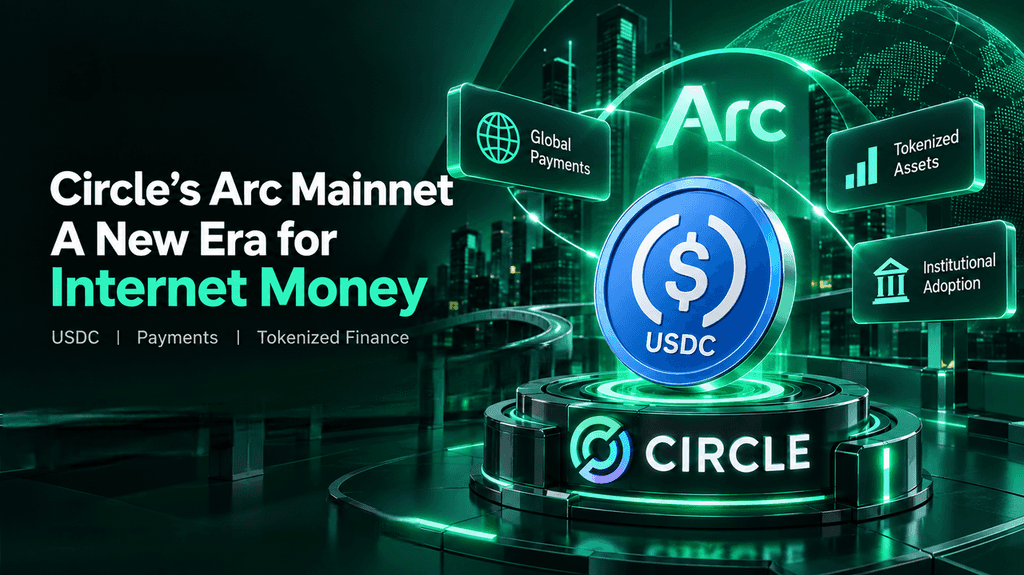
Circle has officially launched the Arc mainnet, moving its stablecoin strategy beyond USDC issuance and deeper into blockchain-based financial infrastructure. Described as an “Economic OS” for internet money, Arc is a purpose-built Layer 1 network designed to support stablecoin payments, foreign exchange, tokenized assets, institutional settlement and emerging use cases such as AI-powered transactions. By building a network around digital-dollar settlement, Circle is trying to create infrastructure that can serve both crypto-native applications and traditional financial institutions.
The launch could become important for both the wider USDC ecosystem and investors following Circle Internet Group, which trades under the ticker CRCL. Arc gives Circle its own settlement layer at a time when stablecoins are becoming more closely integrated with payments, capital markets and tokenized finance. It also gives Circle more control over the infrastructure connecting its existing products and future financial services. However, the impact on Circle’s revenue and share price will depend on whether the network generates sustained USDC demand, institutional activity and new commercial revenue rather than simply high transaction counts.
What Is Circle’s Arc Mainnet and Why Is It Called the “Economic OS” for Internet Money?
Circle’s Arc mainnet is a purpose-built Layer 1 blockchain designed for stablecoin payments, foreign exchange, tokenized assets, capital markets and other forms of internet-based finance. The public mainnet launched on September 16, 2026, marking an important expansion of Circle’s infrastructure beyond issuing USDC. Arc is EVM-compatible, supports deterministic sub-second finality and uses USDC for transaction fees, giving businesses and developers a blockchain environment focused specifically on moving and settling digital money. Its financial focus distinguishes Arc from networks designed primarily as broad platforms for every type of decentralized application.
Why Arc Is Called an “Economic OS”
Circle describes Arc as an “Economic OS” for the internet because the network is designed to provide a common financial infrastructure layer for payments, digital assets and blockchain-based applications. Much like a traditional operating system connects software and services, Arc aims to connect stablecoins, foreign exchange, payments, lending, trading and tokenized assets within one interoperable environment. The concept is intended to make different forms of digital financial activity work together without requiring every business to construct its own settlement network.
The idea is to make blockchain-based finance easier to use at scale without requiring businesses to build separate infrastructure for every financial function. Arc connects with Circle products including USDC, EURC, Circle Payments Network, StableFX, CCTP and Gateway, creating a broader ecosystem where money and tokenized assets can move across applications and supported blockchain networks. If these services become closely integrated, Arc could act as a shared settlement layer connecting payments, liquidity and digital assets across different parts of the financial system.
How Circle Arc Mainnet Is Built for Stablecoin Finance
Arc differs from many general-purpose blockchains because its core design is focused on predictable financial settlement. One important feature is the use of USDC as the network’s gas asset, allowing transaction costs to be paid in a dollar-denominated stablecoin instead of a separate volatile cryptocurrency. Combined with fast finality and EVM compatibility, this structure is intended to make Arc more practical for developers, businesses and financial institutions. Predictable costs may be particularly useful for companies processing large numbers of payments where changing gas-token prices can complicate budgeting and treasury management.
Key features of the Circle Arc blockchain include:
-
USDC-denominated transaction fees, making network costs easier to understand.
-
Deterministic sub-second finality for faster settlement of financial transactions.
-
EVM compatibility, allowing Ethereum-based applications and developer tools to work with Arc.
-
Support for stablecoin payments, foreign exchange and tokenized assets.
-
Integration with Circle infrastructure for moving liquidity across different blockchain networks.
Arc Mainnet’s Role in Institutional and Internet Finance
Arc launched with more than 100 applications and over 100 institutional and ecosystem participants, while USDC circulation had already exceeded $74 billion. Readers following changes in circulating supply and market capitalization can track current USDC market data as stablecoin adoption develops. The broader Arc ecosystem includes major financial and payments companies such as BlackRock, Visa, Mastercard, DTCC and Standard Chartered, highlighting Circle’s ambition to position the network as infrastructure for both traditional financial institutions and blockchain-native applications.
The network is also being developed around emerging areas such as tokenized real-world assets, cross-border payments and AI-agent transactions. These markets could increase demand for blockchain infrastructure capable of handling payments and asset settlement continuously rather than only during conventional banking hours. Its long-term success, however, will depend on real usage rather than launch announcements alone. Growth in Arc transaction activity, USDC adoption, institutional integrations, tokenized asset volume and payment settlement will ultimately show whether Circle can turn its “Economic OS” concept into a widely used financial network.
How Arc Mainnet Could Expand USDC, Payments and Tokenized Finance
Arc’s significance for Circle may ultimately depend less on the blockchain itself and more on whether it increases the amount of financial activity built around USDC. By giving payments companies, financial institutions and developers a dedicated settlement environment, Arc could create additional use cases for stablecoins across cross-border transfers, foreign exchange, tokenized assets and automated financial transactions. The broader opportunity is to move USDC from being mainly a digital dollar used within crypto markets toward a settlement asset used across a wider range of financial services.
How Arc Could Increase USDC Usage and Circulation
Arc could strengthen demand for USDC by making the stablecoin useful across a wider range of financial transactions rather than limiting it mainly to crypto trading and transfers. Businesses using Arc for settlement may need USDC for payments, liquidity management, application balances and transaction fees, potentially increasing the amount of USDC held and moved across the network. Greater utility could also encourage institutions to maintain USDC liquidity specifically for financial activity occurring on Arc.
The opportunity becomes more important as stablecoins move further into mainstream financial infrastructure. Circle reported more than $74 billion of USDC in circulation around Arc’s mainnet launch, providing Arc with an existing liquidity base rather than requiring the network to build a monetary ecosystem from zero. A large existing stablecoin supply could make it easier for developers and businesses to integrate Arc into applications where digital-dollar liquidity is already needed. Still, higher Arc activity would only become financially meaningful for Circle if it leads to sustained USDC demand rather than short-lived transaction growth.
Cross-Border Payments and FX Could Become a Major Arc Use Case
International payments remain one of the clearest potential applications for Arc. Traditional cross-border transfers can involve several banks, currency conversions and settlement systems, while stablecoins can move value across blockchain networks continuously. The broader shift toward cross-border blockchain settlement provides context for how networks such as Arc could be used to move digital money between businesses and financial institutions across different markets. Faster settlement could become particularly relevant for companies managing international suppliers, treasury operations or payments across multiple currencies.
Several developments could become particularly important as adoption grows:
-
StableFX could support exchanges between multiple fiat-backed stablecoins and expand digital foreign-exchange settlement.
-
Circle Payments Network could connect financial institutions and payment providers using stablecoins for international transfers.
-
Businesses could potentially settle transactions outside conventional banking hours through blockchain-based infrastructure.
-
Additional fiat-backed stablecoins could broaden Arc beyond dollar-only activity and support more global currency flows.
The commercial impact will depend on actual transaction volume and institutional participation. A large number of integrations may attract attention at launch, but recurring payment flows and deep liquidity will provide stronger evidence that Arc is developing a durable position in cross-border finance. Investors may therefore want to focus on real settlement volume, active institutional users and repeat transactions rather than partnership announcements alone.
Tokenized Assets Could Expand Arc Beyond Payments
Arc is also positioned to support tokenized finance, where traditional assets such as funds, securities, deposits or other financial instruments are represented on blockchain networks. The growth of real-world asset tokenization is particularly relevant because institutions increasingly need infrastructure that can combine digital asset issuance with settlement, liquidity and regulated forms of digital money. A network designed around stablecoins could potentially make it easier to pair tokenized assets with a familiar dollar-denominated settlement mechanism.
If tokenized assets gain traction on Arc, USDC could serve as a settlement asset between investors, institutions and blockchain-based markets. That could create activity beyond ordinary stablecoin transfers, including asset issuance, trading, collateral management and settlement. It may also deepen liquidity if tokenized financial products and stablecoins operate within the same ecosystem. However, growth in tokenized finance will depend heavily on regulation, institutional demand and whether financial firms choose Arc over competing blockchain infrastructure.
For Circle, successful tokenization could gradually broaden Arc from a payment network into a more complete financial-market infrastructure layer. Important indicators will include the value of tokenized assets issued on Arc, institutional transaction volumes, USDC liquidity and the number of financial products that progress from pilot programs into regular commercial use. Continued growth across several of these metrics would provide stronger evidence that Arc is supporting economic activity rather than simply attracting experimental projects.
How Circle’s Arc Mainnet Could Affect CRCL Stock and Future Revenue
For investors, the key question is not simply whether Arc attracts users, but whether that activity eventually improves Circle’s financial performance. CRCL stock is currently closely tied to USDC growth, reserve income and interest rates, so Arc’s longer-term value could come from increasing stablecoin demand while helping Circle develop additional sources of revenue. The impact is unlikely to appear immediately, and investors will need to distinguish network adoption from actual earnings growth. Quarterly financial results will be especially important in determining whether Arc begins contributing materially to Circle’s business.
USDC Growth Could Strengthen Circle’s Core Revenue Base
Circle currently earns most of its revenue from income generated on the reserves backing USDC. In the second quarter of 2026, reserve income represented about 95% of total revenue, making the amount of USDC in circulation a major driver of the company’s financial results. If Arc encourages businesses, institutions and applications to hold and use more USDC, a larger circulating supply could increase the reserve assets from which Circle earns income. Sustained growth would therefore matter more financially than temporary increases in blockchain activity.
The relationship is not automatic, however. Reserve revenue also depends heavily on prevailing interest rates. Circle reported that growth in average USDC circulation helped reserve income in Q2 2026, while lower reserve yields offset part of that benefit. A period of declining rates could therefore reduce the earnings generated from each dollar of reserve assets even while USDC adoption continues to increase. Investors evaluating the potential Arc impact on CRCL stock therefore need to watch both USDC adoption and the interest-rate environment rather than focusing on network activity alone.
Arc Could Help Circle Diversify Beyond Reserve Income
One of the more important long-term opportunities is whether Arc can help Circle become less dependent on interest earned from USDC reserves. A broader ecosystem could create room for revenue from financial infrastructure, payment services, foreign-exchange products and other enterprise tools built around the network. That could gradually give Circle a more diversified business model than one driven primarily by stablecoin balances and short-term interest rates. Revenue diversification could become particularly important during periods when lower interest rates place pressure on reserve income.
Several indicators could show whether this transition is beginning to work:
-
Growth in non-reserve revenue as a share of Circle’s total revenue.
-
Rising institutional settlement and transaction volumes connected with Arc.
-
Greater adoption of Circle’s payment and financial infrastructure by businesses.
-
New recurring fees or commercial services that are less dependent on reserve yields.
These measures may ultimately matter more for shareholders than headline blockchain transaction counts because they show whether Arc activity is translating into sustainable commercial revenue. Investors may also watch margins and operating expenses to determine whether new revenue streams are large enough to justify the investment required to expand Arc.
What Arc Adoption Could Mean for CRCL Stock
Arc could strengthen Circle’s long-term growth profile if the network leads to durable increases in USDC circulation, commercial activity and institutional adoption. In that scenario, investors may increasingly evaluate Circle not only as a stablecoin issuer but also as a broader provider of internet-based financial infrastructure. That could change which business metrics receive the most attention when investors assess Circle’s performance. Any effect on CRCL’s valuation would still depend on measurable revenue, margins and adoption rather than the mainnet launch itself.
Important risks remain. Arc faces competition from established blockchain networks, regulatory developments could influence adoption, and declining interest rates could pressure Circle’s reserve income even if USDC supply continues expanding. The network will also need to convert institutional interest into regular commercial usage while attracting developers and sufficient liquidity. For that reason, CRCL stock performance should not be linked directly to Arc transaction growth alone. Investors will need to monitor Circle’s quarterly revenue mix, USDC circulation, Arc-related commercial activity, institutional adoption and operating expenses to judge whether the network is creating meaningful economic value.
Conclusion
The Circle Arc mainnet launch represents a significant expansion of Circle’s strategy beyond issuing USDC. By combining stablecoin settlement, cross-border payments, foreign exchange, tokenized finance and institutional infrastructure on a purpose-built Layer 1 network, Arc gives Circle another potential route for increasing the role of USDC across the internet economy. It could also strengthen the connection between Circle’s stablecoin business and a wider ecosystem of financial products, developers and institutions.
For CRCL investors, however, Arc should be viewed as a long-term business development rather than an immediate share-price catalyst. The most important evidence will come from sustained USDC growth, payment and settlement volumes, tokenized assets, institutional adoption and Circle’s ability to build meaningful non-reserve revenue. Investors will also need to consider interest rates, operating costs and competition when evaluating Arc’s financial contribution. If Arc succeeds in turning these activities into recurring commercial demand, it could become increasingly important to Circle’s future growth. If adoption remains limited, the economic impact may be much smaller than the technology’s ambitions suggest.
🔥 Beyond the Headlines: What KuCoin 5.0 Means for You
Market news moves fast — but where you act on it matters just as much. This October, KuCoin launches KuCoin 5.0, transforming KuCoin into a rebuilt platform. Here's what actually changes for you:
-
One account for everything. Older platforms split your money across separate "spot," "margin," and "futures" accounts and expected you to understand why. KuCoin 5.0's unified account removes that entirely — deposit once, and everything is simply there.
-
Stocks, indices, and commodities. KuCoin 5.0 expands beyond crypto into global markets. When crypto chops sideways and equities rally (or the reverse), you rotate in minutes instead of opening a brokerage account and waiting days for fiat rails.
-
Real-world assets (RWA). Tokenized exposure to traditional assets like commodities, right inside your crypto account. One of the fastest-growing segments in global finance is no longer reserved for institutions — you access it from the same balance you trade with.
-
Earn while you learn. Not ready to trade? KCUSD lets your stablecoins earn daily, auto-compounding interest. The lowest-stress way to put your idle deposit to work for 4% yield.
-
An AI assistant in plain language. Ask questions, get market context, understand what you're looking at — built into the platform, no jargon required.
-
An app that doesn't overwhelm. Faster, cleaner, and consistent — intuitive from the first tap, not after a tutorial.
-
Safety you can check, not just trust. A MiCAR-licensed EU entity, Proof of Reserves you can verify yourself, and internationally certified security (SOC 2 Type II, ISO 27001:2022).
Create your account in minutes — and start on the platform built for where crypto is going, not where it's been.
FAQs
Does Arc have its own cryptocurrency?
Circle has created an ARC token supply through a genesis mint, but that does not mean ARC is publicly available for trading. The token could eventually play a role in network security, governance or utility if Arc develops toward a Proof-of-Stake model.
Can investors buy the ARC token now?
There is currently no confirmed public ARC token launch for general investors. A genesis mint is a network event and should not be confused with an exchange listing or public token sale. Investors should be cautious about unofficial cryptocurrencies using the ARC or Arc name.
Is CRCL stock the same as investing in the Arc blockchain?
No. CRCL represents ownership in Circle Internet Group, while Arc is a blockchain network developed by Circle. Owning CRCL provides exposure to Circle’s wider business, including USDC and financial infrastructure, but it does not provide direct ownership of Arc or ARC tokens.
How is Arc different from Ethereum?
Ethereum is a broad smart-contract network supporting many types of decentralized applications. Arc is more specifically focused on stablecoins, financial settlement and institutional use cases. Arc remains EVM-compatible, allowing it to benefit from many tools and development standards used within the Ethereum ecosystem.
Disclaimer
The information provided on this page may originate from third-party sources and does not necessarily represent the views or opinions of KuCoin. This content is intended solely for general informational purposes and should not be considered financial, investment, or professional advice. KuCoin does not guarantee the accuracy, completeness, or reliability of the information, and is not responsible for any errors, omissions, or outcomes resulting from its use. Investing in digital assets carries inherent risks. Please carefully evaluate your risk tolerance and financial situation before making any investment decisions. For further details, please consult KuCoin’s Terms of Use and Risk Disclosure.