

US-Iran Peace Deal Set to Ignite AI Stocks as Strait of Hormuz Reopens
2026/06/15 20:01:03
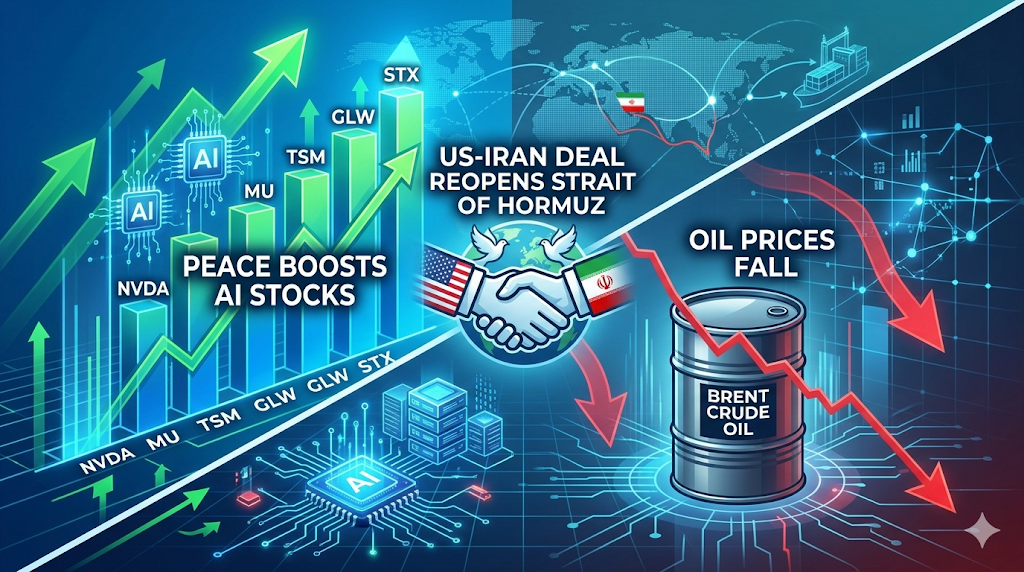
Introduction
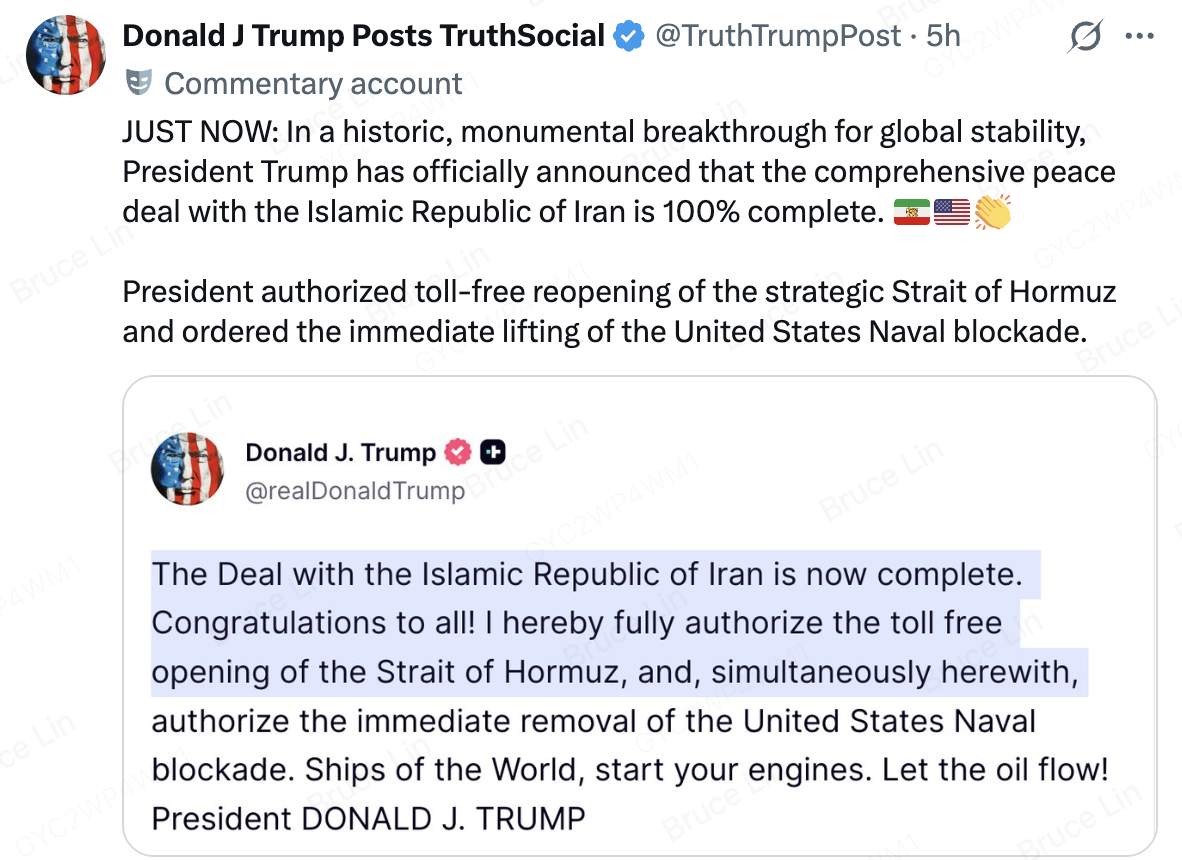
Artificial intelligence stocks may be on the verge of a major relief rally. On June 14, 2026, President Donald Trump confirmed via social media that a US-Iran peace deal was complete, with a formal signing ceremony scheduled for June 19 in Switzerland. The agreement includes reopening the Strait of Hormuz -- the chokepoint through which roughly 20% of global oil flows -- and releasing $24 billion in frozen Iranian assets.
Oil prices immediately tumbled, with Brent crude falling 3.9% to $83.89 per barrel and WTI dropping 4.8% to $80.80, according to market data from the June 14 session. This sharp decline in energy costs could remove a major risk premium that has weighed on growth equities for months, positioning AI stocks for a potential surge when US markets open.
What Does the US-Iran Peace Deal Include?
The agreement centers on a 14-point memorandum of understanding that addresses multiple flashpoints between Washington and Tehran. According to details published by Iranian state media outlet Mehr News Agency on June 14, the deal covers a permanent ceasefire across all fronts including Lebanon, a complete lifting of the naval blockade on Iran within 30 days, and the reopening of the Strait of Hormuz to international shipping without any toll system.
Key provisions include a US commitment not to interfere in Iran's internal affairs and a pledge to withdraw forces from Iran's immediate vicinity. The deal also establishes a $300 billion reconstruction plan funded by the United States and its allies, and sets a 60-day window for final negotiations on Iran's nuclear program. During this interim period, $24 billion in frozen Iranian assets will be released, with half made available before final talks even begin.
Crucially, the deal explicitly removes Iran's missile program and support for regional resistance groups from the agenda -- two issues that have historically derailed previous negotiations. A supervision mechanism will monitor compliance, and the final agreement is expected to be ratified by a United Nations Security Council resolution.
The unresolved nuclear question remains the most significant uncertainty. As noted in a June 14 analysis by NBC News, enrichment limits and stockpile disposition have been deferred to subsequent technical negotiations. This means the current agreement functions primarily as a ceasefire and shipping access framework rather than a comprehensive settlement.
Why Would a Peace Deal Boost AI Stocks?
The mechanism connecting Middle East peace to AI stock performance operates through three interconnected channels: energy costs, inflation expectations, and risk premium removal.
Lower oil prices translate directly into reduced inflation expectations. When energy costs decline, central banks face less pressure to maintain elevated interest rates. Growth stocks -- particularly AI companies with valuations based on distant future cash flows -- are highly sensitive to discount rate changes. Based on Federal Reserve policy models, every 10-basis-point decline in long-term rate expectations can translate into meaningful multiple expansion for the tech sector.
The geopolitical risk premium that has hung over equities since the Strait of Hormuz closure in March 2026 may finally unwind. According to a June 9 report from Gulf News, AI stocks had already demonstrated this sensitivity when they rebounded sharply on ceasefire hopes, with Nasdaq 100 futures rising 0.7% and South Korea's chip-heavy Kospi index surging 8.2% in a single session. Brent crude fell 2% toward $92 per barrel during that same period, illustrating the tight inverse correlation between oil prices and tech stock performance.
The June 14 announcement produced the most dramatic oil price decline yet. WTI's 4.8% drop to $80.80 and Brent's 3.9% fall to $83.89 represent a substantial unwinding of the supply scarcity premium that had built up during months of restricted Hormuz access, based on data compiled by energy market analysts on June 14.
Interactive Brokers economist Jose Torres articulated this dynamic in a May 25 research note, stating that "a potential peace deal would materially strengthen business fundamentals and the economic outlook." His assessment reflects a broader consensus among macro strategists: sustained crude prices above $100 per barrel would have raised the risk of tighter central bank policy and renewed pressure on consumer spending, directly threatening the AI investment cycle.
Which AI Stocks Could Benefit Most?
The potential beneficiaries span multiple subsectors within the AI ecosystem, from semiconductor manufacturers to networking equipment providers and data storage companies.
Semiconductor and Memory Chips
Micron Technology (MU) represents perhaps the most direct exposure to the AI memory supercycle. The company crossed the $1 trillion market capitalization threshold in late May 2026 after a nearly 20% single-day surge driven by a favorable UBS analyst report connecting the company to AI-driven memory demand, according to a June 5 report from The Star. Pre-market data on June 15 showed MU trading up approximately 3%, suggesting institutional positioning ahead of the US market open.
Taiwan Semiconductor Manufacturing (TSM) serves as the foundational layer of the AI chip supply chain, manufacturing the advanced GPUs and custom accelerators that power data centers worldwide. According to a January 25 analysis from Goldman Sachs, TSM controls approximately 72% of the global pure foundry chip market. The company has guided for 30% revenue growth in 2026 and plans capital expenditures between $52 billion and $56 billion, representing a 25% increase from 2025 levels.
Nvidia (NVDA), which briefly reclaimed the $5 trillion market cap level in late April 2026 according to Yahoo Finance data, remains the dominant supplier of data center GPUs. The company's revenue growth rate accelerated to 73% in Q4 2025, and while it has underperformed some semiconductor peers in recent weeks, a broad risk-on rotation could provide tailwinds for the sector leader.
Networking and Optical Communications
The infrastructure connecting AI data centers represents another potential beneficiary group. Corning (GLW) saw particularly strong pre-market positioning on June 15, with 24-hour trading data showing a 4.26% advance. Lumentum (LITE), Applied Optoelectronics (AAOI), and Nokia (NOK) also showed positive pre-market movement according to data from trade.xyz and Binance cited by MarsBit on June 15.
These companies provide the optical fiber, transceivers, and networking equipment essential for the high-bandwidth interconnects that modern AI clusters require. As hyperscalers expand data center footprints, demand for optical networking infrastructure has grown in parallel.
Data Storage
SanDisk (SNDK) and Seagate Technology (STX) both demonstrated positive pre-market positioning on June 15, with SNDK advancing 3.09% to $2,058.93 and STX rising 2.52% according to trading data cited by MarsBit. AI training and inference workloads generate massive volumes of data that require high-capacity storage solutions, creating structural demand tailwinds independent of the geopolitical cycle.
The Pre-Market Signal
The pre-market movements observed on June 15 are significant because they represent the first opportunity for price discovery since Trump's June 14 announcement. While thin weekend liquidity can exaggerate price swings, the breadth of the advance -- spanning memory, networking, storage, and optical communications -- suggests a coordinated sector rotation rather than isolated stock-specific moves.
How Much AI Infrastructure Spending Is Fueling This Sector?
The potential geopolitical tailwind arrives atop already robust fundamental demand drivers. AI infrastructure spending forecasts for 2026 have been repeatedly revised upward, creating a supportive fundamental backdrop that could amplify any relief rally.
Goldman Sachs research from January 2026 projects that hyperscaler companies will spend more than $500 billion on AI capital expenditures this year, representing a $100 billion increase from 2025. Wedbush analyst Dan Ives, who covers the technology sector closely, expects Big Tech's combined capital spending to reach $550-600 billion in 2026, up from approximately $380 billion in 2025, according to a February 9 report.
Individual company commitments underscore the magnitude of this investment wave. Google parent Alphabet has forecast AI infrastructure spending of $180-190 billion, driven in part by the company's custom TPU chips, according to a May 19 report. Amazon has committed to $200 billion in capital expenditures. Microsoft's capital budget has risen alongside its Azure AI service expansion.
At the industry level, the Semiconductor Industry Association (SIA) reported global semiconductor sales of $791.7 billion in 2025 and projects 26% market growth in 2026, according to data cited by Benzinga on February 9. Gartner has projected global AI spending to exceed $2 trillion in 2026, up from approximately $1.5 trillion in 2025.
This spending is not speculative -- it reflects real capacity constraints. A June 4 CNN Brasil report highlighted warnings from US companies about memory chip shortages, while TSMC and Micron have both cited supply constraints in recent earnings calls. The semiconductor equipment market alone is projected to reach $145 billion in 2026, up from $133 billion in 2025, according to SEMI industry forecasts.
South Korea's export data provides perhaps the most concrete evidence of demand acceleration. The country's exports grew at the strongest annual rate in more than four decades during May 2026, hitting a record $87.75 billion, according to data referenced in a June 1 report from The Edge Malaysia. Semiconductor exports specifically reached $173.4 billion in 2025 -- a record high and an increase of more than 20% from the previous year.
What Are the Risks to This AI Rally?
Despite the compelling setup, multiple execution risks could derail the anticipated AI stock surge.
The peace deal itself remains fragile. A June 14 analysis from DiscoveryAlert outlined three scenarios: full implementation with rapid normalization, partial agreement with ongoing ambiguity, or complete collapse before signing. The third scenario -- involving Israeli military intervention, Supreme Leader non-approval, or breakdown in nuclear talks -- could send Brent crude back toward $125 per barrel and trigger a broad risk-off move across equities.
Israel's response represents a particularly acute wildcard. As noted in a June 14 report from NBC News, Israel's ability to conduct independent military operations against Iranian targets effectively gives it veto power over the deal's durability. If Israeli leadership views the agreement as insufficient on nuclear terms, unilateral military action could destabilize the ceasefire regardless of what Washington and Tehran have agreed.
The 60-day ceasefire expiration in mid-August 2026 creates a structural decision point. If nuclear talks fail to produce meaningful progress, re-escalation risk rises materially. Energy procurement teams and geopolitical risk analysts have identified this date as a key scenario trigger.
Even if the deal holds, AI stocks face valuation constraints. A June 9 analysis from Intellectia documented a $1.4 trillion selloff in AI semiconductor stocks earlier in the month, triggered by Broadcom's underwhelming earnings report and subsequent derating of the sector. As Saxo chief investment strategist Charu Chanana noted on June 5, "expectations had become extremely high, and even good numbers are no longer enough unless guidance keeps moving higher."
The helium supply crisis adds another layer of supply chain risk. According to a May 11 report, Iranian drone strikes on Qatar's Ras Laffan Industrial City -- which accounts for approximately one-third of global helium supply -- caused spot prices to double within weeks. TSMC alone consumes approximately 500,000 cubic feet of helium annually, and the company has begun actively monitoring inventory levels.
How to Trade AI Stocks on KuCoin
Investors looking to position for a potential AI stock surge can access multiple AI-related tokens and stocks through KuCoin's trading platform. The exchange offers spot trading for tokens tied to AI infrastructure companies, as well as derivative products for traders seeking leveraged exposure.
To get started, create a KuCoin account and complete identity verification. Navigate to the trading interface and search for AI-related tokens in the platform's comprehensive token directory. KuCoin's trading bots and grid trading features can help automate entry and exit strategies for traders looking to capture potential volatility around the June 19 signing ceremony and subsequent market reactions.
Now users can also participate in KuCoin's Campaign of Trading US Stock Perps:
-
For users reaching 100USDT trading volume, they can grab up to 380 USDT worth of airdrop positions in TSLA, APPL, and GOOGL.
-
After complete simple trading missions, users may unlock 100,000 USDT prize pool rewards in TSLA, AAPL, or GOOGL.

Conclusion
The confluence of a landmark US-Iran peace deal and unprecedented AI infrastructure spending creates a compelling setup for AI stocks as US markets prepare to open on June 15, 2026. The Strait of Hormuz reopening could drive oil prices lower, reducing inflation expectations and removing the geopolitical risk premium that has weighed on growth equities for months. Pre-market positioning in memory, networking, and storage stocks suggests institutional investors are already positioning for this rotation.
However, the deal's fragility demands caution. The 60-day ceasefire window, unresolved nuclear questions, and potential Israeli opposition all represent meaningful failure modes. Even under a successful implementation scenario, AI stocks face high valuation bars after years of explosive growth.
For investors, the key question is not whether AI stocks will react to the peace deal, but whether any subsequent rally can be sustained against a backdrop of record capital spending and supply-constrained demand. The fundamental drivers of AI infrastructure investment remain intact regardless of geopolitical developments, suggesting that any dip-buying opportunity created by deal-related volatility could attract long-term capital.
FAQs
What is the Strait of Hormuz and why does it matter for stocks?
The Strait of Hormuz is a narrow maritime passage connecting the Persian Gulf to the Gulf of Oman. Approximately 20% of the world's daily oil supply transits this route. When Iran closed the Strait in March 2026, Brent crude surged above $108 per barrel, raising inflation fears and pressuring growth stock valuations. The peace deal's provision to reopen the Strait without tolls could reverse these dynamics.
Have AI stocks already surged on the peace deal news?
As of the morning of June 15, 2026, US stock markets have not yet opened. However, pre-market and weekend trading data showed positive positioning in several AI-related names. Micron rose approximately 3% in thin pre-market trading, Corning advanced 4.26% over 24 hours, SanDisk gained 3.09%, and Seagate rose 2.52%. These moves occurred in limited liquidity conditions and may not reflect where stocks will trade when official US markets open.
Which AI stocks are most sensitive to oil price changes?
Growth stocks with high valuations based on distant future cash flows are most sensitive to oil-driven inflation expectations. Within the AI sector, semiconductor manufacturers like Nvidia, TSMC, and Micron; networking companies like Corning and Lumentum; and data storage providers like Seagate and SanDisk all showed inverse correlation with oil prices during recent ceasefire announcements.
When will the Strait of Hormuz actually reopen?
President Trump stated on June 14 that the Strait would open for oil transport on Friday, June 19, following the formal signing ceremony in Switzerland. However, logistics including vessel repositioning, war-risk insurance repricing, and port congestion management could delay a full return to normal shipping volumes for 30 to 90 days, according to tanker industry assessments cited on June 14.
What happens if the peace deal collapses?
A deal collapse before the June 19 signing or during the 60-day ceasefire window could trigger a rapid reversal. DiscoveryAlert's June 14 scenario analysis suggested Brent crude could test prior highs near $125 per barrel under a breakdown scenario, while global equity markets would face meaningful downside. The August 2026 expiration of the initial ceasefire represents the most critical decision point for assessing deal durability.