

US 30-Year Treasury Yield Crosses 5%: What It Means for Bitcoin and Crypto
2026/07/24 17:03:00
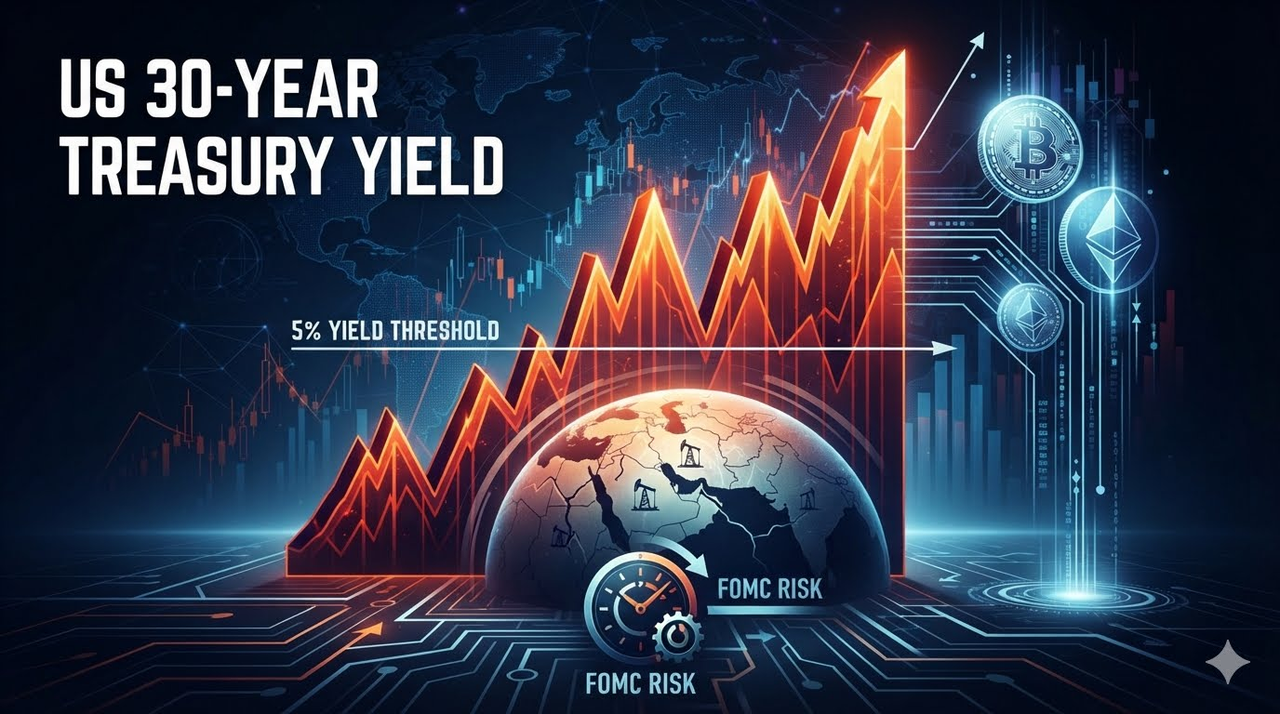
The global financial landscape experienced a notable shift as the US 30-Year Treasury yield rose above the critical 5% threshold, reaching around 5.15%. For decades, US long-duration government bonds have been deemed the ultimate "risk-free" asset, serving as the benchmark pricing anchor for global capital markets. When this anchor moves upward at a rapid pace, it impacts far beyond traditional stock and bond portfolios, crossing directly into the digital asset ecosystem.
The immediate catalyst for this bond market sell-off stems from a mix of geopolitical tensions in the Middle East and structural inflation fears. For cryptocurrency investors, the crossing of the 5% barrier is a significant realignment of global capital flows that impacts risk appetite, leverage costs, and liquidity across all major blockchain networks.
Bitcoin and altcoins are deeply intertwined with global liquidity cycles. When the 30-year bond yield rises, it alters the mathematical calculations used by fund managers to allocate capital to high-growth, high-risk assets. Understanding how this yield increase interacts with Middle Eastern energy disruptions and impending central bank policies is essential for any trader navigating the current market environment.
The Primary Drivers Behind the Bond Yield Increase
Middle East Oil Disruptions and Inflation Risks
The primary fundamental driver pushing long-term bond yields higher is the resurgence of supply-side inflation risks. Geopolitical friction in the Middle East escalated when Yemen's Houthi rebels carried out targeted attacks on two Saudi Arabian oil tankers traversing vital shipping lanes in the Red Sea.
This development created a new challenge in the regional maritime conflict, threatening to disrupt global energy logistics. In immediate response, Brent crude oil prices rallied, pushing toward the $100 per barrel mark.
Higher energy prices act as a direct cost on global production and shipping, renewing concerns over "secondary inflation", a scenario where CPI numbers accelerate after a period of cooling. Major European financial institutions, including Denmark's Danske Bank, swiftly revised their medium-term inflation models upward. Because fixed-income investors demand higher yields to compensate for the eroding purchasing power of future cash flows, the threat of sustained inflation caused long-term bond prices to decline, mechanically driving the 30-year yield past 5.15%.
The FOMC’s Policy Outlook: "Higher for Longer" Maintained
The sudden oil disruption has placed the Federal Open Market Committee (FOMC) in a challenging position ahead of its upcoming interest rate decision. Market participants had previously anticipated a steady, predictable pathway of interest rate cuts based on moderating labor data. However, the energy-driven inflation threat has altered those expectations.
As noted by major fixed-income asset managers, such as T. Rowe Price, the Federal Reserve is likely to respond to these renewed inflation risks by adopting a more restrictive stance. This could manifest as:
-
A reduction or complete removal of explicit dovish forward guidance.
-
An extension of the "higher for longer" interest rate framework deep into the coming quarters.
-
The reintroduction of potential rate hikes back onto the policy table if energy costs remain unanchored.
Anticipating a hawkish stance from the central bank, institutional bond holders initiated a significant wave of selling in long-dated Treasuries to avoid being caught on the wrong side of a prolonged high-interest-rate environment.
Liquidity Shifts: How Higher Yields Constrain Crypto Markets
The Cost of Capital and Risk-Free Rate Repricing
To comprehend why a 5.15% bond yield applies downward pressure on digital assets, one must look at the concept of the "equity risk premium" and the global cost of capital. When institutional allocators look at asset classes, they weigh the potential returns of a risky asset against the guaranteed return of a US government bond.
When the risk-free rate sits at 1% or 2%, capital naturally flows into high-beta assets like equities, technology stocks, and cryptocurrencies in search of meaningful yield. However, when the risk-free rate climbs past 5%, the mathematical hurdle for risk assets increases significantly. If an investor can lock in a secure 5.15% annual yield for three decades backed by the US government, their incentive to take on the volatility of the crypto market decreases. Consequently, institutional capital that might have otherwise entered the digital asset space is redirected into the sovereign debt market.
Stablecoin Velocities and DeFi Yield Compression
The increase in traditional yields also exerts structural pressure on the Decentralized Finance (DeFi) ecosystem, particularly affecting stablecoin utilization and Real-World Asset (RWA) protocols:
-
Yield Arbitrage Reversal: During low-interest eras, DeFi lending protocols offering 4% to 6% yields on stablecoins attracted billions in capital. With traditional Treasury bills and long bonds yielding over 5%, the yield spread between on-chain decentralized finance and off-chain safe-haven assets has effectively narrowed or inverted.
-
Stablecoin Outflows: Institutional capital has less incentive to keep millions in non-yielding stablecoins or low-yield DeFi pools when that liquidity can be converted back to fiat and deployed into yielding traditional instruments. This slows down the velocity of stablecoins on-chain, reducing the base liquidity available to support crypto token prices.
-
Altcoin and Meme Coin Vulnerability: Because altcoins and speculative meme coins rely heavily on excess market liquidity, they are typically the first assets to experience steep sell-offs when global financial conditions tighten.
Bitcoin's Dual Role: Risk-On Tech Asset vs. Digital Gold
The "Risk-On" Perspective: Correlating with High-Growth Tech
In the short-term market reaction, Bitcoin often exhibits a high statistical correlation with traditional risk assets, particularly high-growth technology equities. The increase in bond yields raises borrowing costs for corporations and heavily discounts the future cash flows of growth-oriented companies. This has triggered notable valuation adjustments among large-cap technology firms, such as Alphabet and other AI-centric entities, which are already facing scrutiny over massive capital expenditure budgets.
Because major quantitative trading desks and institutional algorithms categorize Bitcoin under the broad umbrella of "speculative technology and global liquidity proxies," any systemic sell-off in the Nasdaq or broader equity markets frequently triggers automated adjustments in Bitcoin. In these specific macro environments, Bitcoin behaves firmly as a "risk-on" asset, experiencing downward price volatility alongside traditional growth stocks.
The "Digital Gold" Thesis: A Hedge Against Sovereign Debt Concerns
Conversely, the structural shifts in the traditional bond market provide a compelling long-term thesis for Bitcoin as a non-sovereign safe-haven asset. The underlying cause of the bond market sell-off is not just inflation—it is also growing market anxiety regarding the sustainability of the US fiscal path. With the US national debt exceeding $39 trillion, high interest rates mean the government must allocate an increasingly large portion of its tax revenues simply to pay interest expenses.
This dynamic marks the return of active bond investors who sell off government debt to signal dissatisfaction with structural fiscal deficits. As traditional fiat currency systems face long-term debt sustainability questions, Bitcoin’s core characteristics become increasingly prominent:
-
Absolute Scarcity: A hard cap of 21 million coins ensures it cannot be devalued via monetary expansion.
-
Decentralization: Immune to direct political intervention or localized banking crises.
-
No Counterparty Risk: Unlike a government bond, which relies on the issuing nation's ability to tax and print money, Bitcoin exists as a self-sovereign digital ledger.
TradFi Bonds vs. Digital Gold: A Structural Comparison
| Feature | 30-Year US Treasury Bond | Bitcoin (Digital Gold) |
| Current Yield / Return Driver | Fixed 5.15% nominal yield; highly sensitive to inflation and Fed policy. | Capital appreciation driven by global adoption and liquidity cycles. |
| Supply Dynamics | Explicitly expansionary; dependent on fiscal deficits and issuance. | Programmatic scarcity; hard-capped at 21 million tokens. |
| Risk Profile | Theoretically zero default risk, but carries duration and purchasing power risk. | High price volatility; technical, security, and regulatory risks. |
| Role in Macro Environment | Traditional flight-to-safety asset, but loses value if inflation spikes. | Emerging non-sovereign alternative; independent of fiat debt structures. |
Short-Term vs. Long-Term Scenarios for the Crypto Market
Short-Term Outlook: Volatility and Liquidations Ahead of FOMC
As the market approaches the upcoming FOMC meeting, traders should prepare for elevated short-term volatility. The combination of an approaching policy decision and adjustments in the bond market typically forces leverage out of the system.
If the Federal Reserve explicitly confirms the market's fears by removing dovish language from its policy statement, a further increase in bond yields could follow. In such a scenario, highly leveraged long positions within the crypto derivatives market face a risk of liquidations. During these forced deleveraging events, even structurally sound digital assets can experience temporary price drawdowns as trading desks adjust for liquidity.
Long-Term Outlook: When Bond Yields Peak
Looking past the immediate macro anxiety, historical cycles suggest that an elevated long-term bond yield eventually triggers a reversal. When the 30-year Treasury yield stays above 5% for an extended duration, it applies pressure to key components of the real economy:
-
Real Estate Stagnation: It drives 30-year fixed mortgage rates toward 7.5% or 8%, freezing home-buying activity.
-
Banking System Stress: It inflicts unrealized losses on the balance sheets of commercial banks holding older, lower-yielding fixed-income assets.
-
Fiscal Distress: It drastically escalates the government’s cost of servicing its sovereign debt.
Eventually, these pressures force the Federal Reserve to intervene, either by cutting benchmark interest rates or implementing targeted liquidity injections (such as quantitative easing or bond-buying programs) to stabilize the financial infrastructure. Historically, the moment the central bank pivots from tightening to liquidity injection marks the macro bottom for risk assets, serving as the primary fuel for sustained cryptocurrency bull markets.
Conclusion & Actionable Strategies for Traders
The crossing of the US 30-Year Treasury yield above 5% is a notable macroeconomic event that demands a disciplined approach from digital asset investors. While the short-term impact manifests as a capital drain that challenges crypto market liquidity, the underlying fiscal pressures driving this bond sell-off reinforce the fundamental long-term case for decentralized, finite digital assets. Navigating this environment requires balancing immediate risk management with an eye on long-term macro trends.
Portfolio Adjustment Guide for Users
To manage risks and spot opportunities during this period of macro volatility, traders can consider several practical tactical approaches on the KuCoin platform:
-
Optimize Stablecoin Allocations: To protect capital against short-term market volatility ahead of the FOMC meeting, consider rotating a portion of high-beta altcoin exposure into stablecoins like USDT or USDC. These balances can be deployed into KuCoin Earn low-risk savings products to preserve capital while maintaining instant liquidity.
-
Utilize Dollar-Cost Averaging (DCA): Given that structural fiscal deficits support the long-term "digital gold" thesis for Bitcoin, utilizing the KuCoin Trading Bot to run an automated DCA strategy allows investors to build a spot BTC position steadily over time, smoothing out short-term price fluctuations.
-
De-Leverage Margined Positions: Avoid maintaining high leverage ratios on futures or margin accounts prior to major central bank announcements. The volatility induced by sudden bond market moves can trigger brief spikes in funding rates and price wicks that test liquidation prices.
Join KuCoin 9th Anniversary Trading Campaign
KuCoin is celebrating its 9th anniversary with a special platform campaign filled with exclusive rewards, trading activities, and limited-time offers. Don’t miss the chance to participate and enjoy the benefits as the exchange marks nine years of growth and innovation. Visit the official campaign page now:

FAQs
Why does a 5% US 30-year Treasury yield cause crypto prices to drop?
High risk-free yields make government bonds attractive to institutions. Capital flows out of volatile risk assets like crypto and back into traditional safe-havens, draining on-chain liquidity and depressing prices.
Is Bitcoin currently behaving as a safe-haven or a risk-on asset?
Short-term, Bitcoin correlates with high-growth tech stocks due to institutional algorithmic trading. Long-term, its programmatic scarcity aligns it with gold as a hedge against sovereign debt crises and inflation.
How does the Middle East oil shock directly affect the crypto market?
Rising oil prices trigger secondary inflation fears. This forces central banks to keep interest rates higher for longer, tightening global liquidity and reducing investors' appetite for speculative digital assets.
What will happen to altcoins if the bond yield stays above 5%?
Altcoins and meme coins are highly sensitive to macro liquidity. Sustained 5% yields compress DeFi returns, slow stablecoin inflows, and often lead to prolonged sell-offs in high-beta altcoins.
Will a high bond yield kill the Decentralized Finance (DeFi) ecosystem?
No, but it causes yield compression. When traditional bonds yield over 5%, the incentive for capital to remain in risky DeFi lending protocols decreases, driving capital migration back to TradFi.
Disclaimer
The information provided on this page may originate from third-party sources and does not necessarily represent the views or opinions of KuCoin. This content is intended solely for general informational purposes and should not be considered financial, investment, or professional advice. KuCoin does not guarantee the accuracy, completeness, or reliability of the information, and is not responsible for any errors, omissions, or outcomes resulting from its use. Investing in digital assets carries inherent risks. Please carefully evaluate your risk tolerance and financial situation before making any investment decisions. For further details, please consult KuCoin’s Terms of Use and Risk Disclosure.