

Top Crypto Sectors to Watch as the Market Prepares for a Bullish Reversal
Introduction
The broader crypto market has retraced around 50% from its 2025 highs. Bitcoin is hovering near $63,000, and the Altcoin Season Index sits stubbornly below the critical 25 threshold. On the surface, it looks like winter. But beneath the headline numbers, capital is not sitting idle—it is rotating into specific sectors with structural tailwinds that have nothing to do with macro sentiment.
While the overall market contracted, DeXe (DEXE) surged 363% year-to-date. Kite (KITE), an AI infrastructure token, rallied 165% YTD. Hyperliquid (HYPE) climbed 68% in the same period. These are not random pumps. They represent a clear pattern: in weak markets, money flows toward sectors with real user growth, institutional adoption, or transformative product launches.
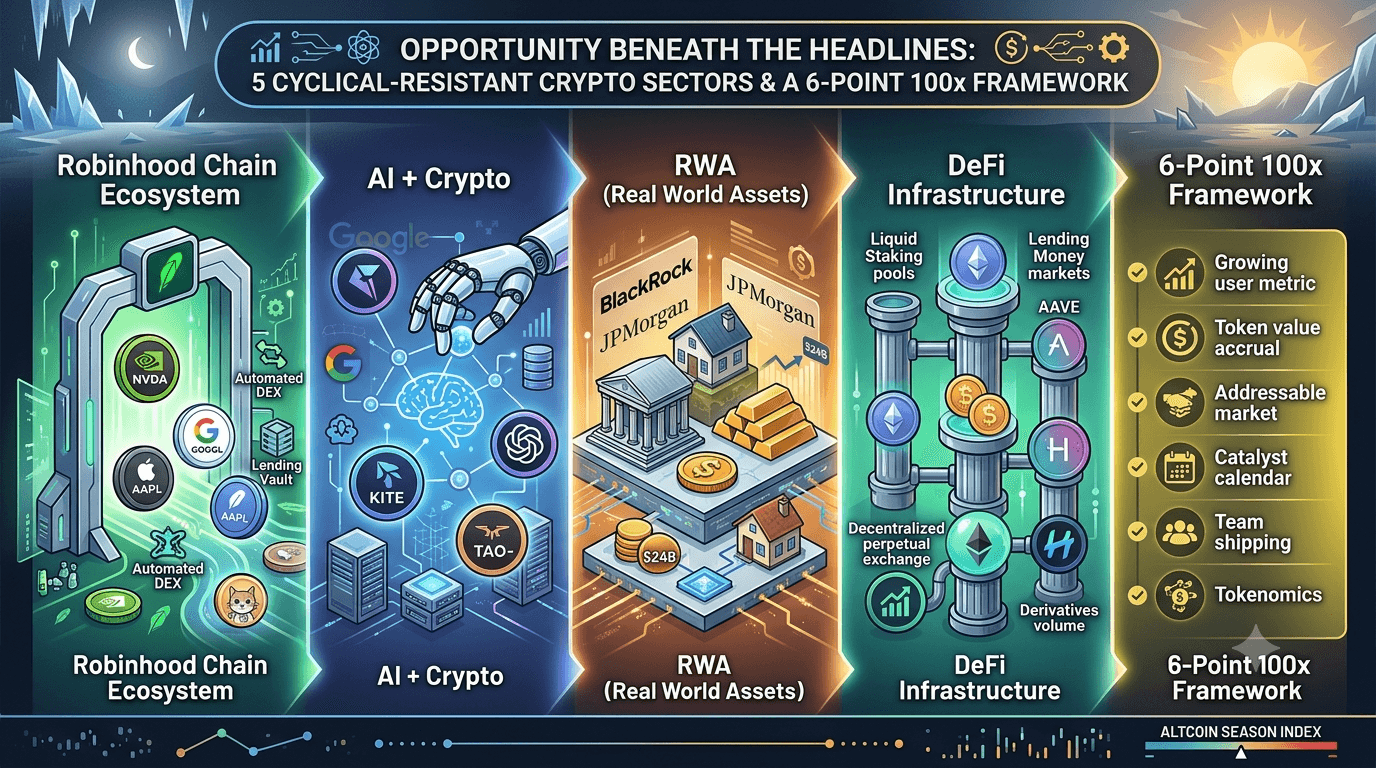
This article is for investors who believe the bottom is closer than the top—and want to know exactly where to look before the next cycle rewards early positioning. You will learn:
-
The 5 sectors attracting real capital flows right now, with specific tokens and data
-
Why Robinhood Chain became the hottest new ecosystem launch of 2026 within days of mainnet
-
How AI tokens are becoming the infrastructure layer for autonomous agents
-
The RWA megatrend that BlackRock, JPMorgan, and Fidelity are all building for
-
A 6-point framework for evaluating which assets have genuine 100x potential versus which are narrative traps
Robinhood Chain: The Hottest New Ecosystem Launch of 2026
On July 1, 2026, Robinhood officially launched the Robinhood Chain public mainnet—and the market responded immediately. Robinhood's stock jumped 8.35% that day and continued climbing to $113.53 by July 8, a 13% gain from June 30. But the real story is what happened on-chain.
Within four days of launch, Robinhood Chain had attracted roughly $50 million in TVL. That number is modest compared to mature chains, but the velocity is what matters. For a brand-new L2, four-day traction at that scale signals serious early-adopter interest. TVL continued to climb rapidly, surpassing $100 million within the first week.
Why Robinhood Chain Is Different from Every Other L2
Most new Layer 2s launch with a developer grant program and hope builders show up. Robinhood launched with something far more valuable: 23 million existing brokerage customers, regulatory relationships across multiple jurisdictions, and a live product that bridges TradFi assets directly onto the blockchain.
The core differentiator is stock tokens. Eligible users in over 120 countries can now trade tokenized versions of stocks like NVDA, GOOGL, and AAPL directly on-chain, 24/7, with settlement happening in seconds rather than T+2. These tokens can be deployed into lending pools, used as collateral, and composed into DeFi strategies—something impossible with traditional brokerage assets.
Key ecosystem partners live from day one:
|
Partner
|
Role on Robinhood Chain
|
|
Uniswap
|
Primary AMM and liquidity protocol
|
|
Chainlink
|
Official oracle for all stock token price feeds
|
|
dYdX (Arcus)
|
Decentralized perpetual and spot exchange for stock tokens
|
|
Lighter
|
ZK-powered perpetual and spot DEX with native wallet integration
|
|
Morpho
|
Lending vaults powering Robinhood Earn (7% APY on USDG)
|
|
Rialto
|
On-chain spot exchange for crypto, stocks, ETFs, and commodities
|
The CASHCAT Phenomenon: Culture Moves Faster Than Infrastructure
Here is what caught most analysts off guard. Robinhood spent a year marketing tokenized stocks as its flagship narrative. But the first breakout asset on the chain was CASHCAT—a meme coin referencing Robinhood's internal codename when it was founded.
Within 24 hours of going viral, CASHCAT surged 1,700% and reached a market cap above $120 million. Daily volume on the CASHCAT/WETH pair alone hit $28 million. Robinhood CEO Vlad Tenev himself acknowledged the meme on social media, adding fuel to the fire.
This matters for two reasons. First, it proves that retail attention and speculative energy are already flowing into the ecosystem. Second, it follows a pattern seen with every successful new chain launch: meme coins act as the initial traffic driver before serious DeFi infrastructure takes over. Solana had BONK. Base had BRETT. Robinhood Chain has CASHCAT.
How to track this sector:
|
Metric
|
Current Reading
|
What to Watch
|
|
Robinhood Chain TVL
|
~$50M (July 6)
|
Sustained growth above $200M signals ecosystem maturity
|
|
Stock token volume
|
Early days
|
24/7 trading volume vs. traditional Robinhood app volume
|
|
CASHCAT market cap
|
~$120M+
|
Retention of liquidity as other ecosystem tokens launch
|
|
New project launches
|
Weekly cohort
|
Number of native DeFi projects deploying on-chain
|
AI + Crypto: The Infrastructure Layer for Autonomous Agents
Artificial intelligence was one of the best-performing crypto sector in Q1 2026 on a relative basis. While all six major crypto sectors posted negative returns, Grayscale's AI-linked token index declined the least—and specific tokens within the sector delivered triple-digit gains.
The thesis is straightforward: AI agents need financial rails, and blockchain is the only infrastructure that gives them 24/7 uptime, programmable settlement, and cross-border reach. As autonomous agents begin handling real economic tasks—trading, staking, subscription management, and service payments—the protocols that power them will capture disproportionate value.
Top AI Crypto Tokens Outperforming in 2026
|
Token
|
Market Cap
|
YTD Performance
|
Key Catalyst
|
|
KITE
|
~$379M
|
+165%
|
Joined Google's Agent Payments protocol; AI-agent-specific L1
|
|
TAO (Bittensor)
|
$3.2–3.4B
|
+106% (30d)
|
128 subnets, largest decentralized LLM pre-training run to date
|
|
RNDR (Render)
|
~$2.0B
|
Strong relative
|
GPU compute demand from AI model training and inference
|
|
VIRTUAL
|
~$441M
|
Recovering from lows
|
Agent Commerce Protocol live on Arbitrum, XRP Ledger, BNB Chain
|
Kite (KITE) stands out as the breakout star. Purpose-built as a Layer 1 blockchain for AI agents, Kite offers native infrastructure for agent wallets, identity verification, and payment rails. In March 2026, Kite announced its integration into Google's Agent Payments protocol—a partnership that positions it at the center of how AI agents will transact in the near future. At a current price around $0.16 and a market cap under $400 million, KITE is priced like an early-stage infrastructure bet rather than a mature platform.
Bittensor (TAO) remains the category leader by market cap. With 128 specialized subnets spanning model training, inference, and agent deployment, TAO is building a decentralized marketplace for AI intelligence. A December 2025 halving event reduced daily emissions from 7,200 to 3,600 TAO, creating a supply squeeze as demand grows. Pending spot ETF filings from Grayscale and Bitwise could unlock institutional capital if approved.
Pro Tip: The intersection of AI and crypto is still in the infrastructure-building phase. The winners are unlikely to be AI "chatbot" tokens. Focus on protocols providing compute (RNDR, AKT), model marketplaces (TAO), and agent coordination layers (VIRTUAL, KITE)—the picks and shovels of the AI agent economy.
RWA (Real World Assets): The $24 Billion Megatrend Institutions Are Building
If there is one sector where the line between "crypto narrative" and "traditional finance adoption" has genuinely blurred, it is Real World Asset (RWA) tokenization. The numbers tell the story: tokenized RWAs grew from roughly $5.5 billion in early 2025 to over $24 billion by February 2026—a 266% annual growth rate.
This is not DeFi degens speculating on governance tokens. This is BlackRock, JPMorgan, Fidelity, Franklin Templeton, and the NYSE moving real assets onto the blockchain.
RWA Market Breakdown (2026)
|
Asset Category
|
Tokenized Value
|
Key Players
|
|
U.S. Treasuries
|
~$9.6B
|
BlackRock BUIDL ($1.7B), Ondo Finance
|
|
Tokenized commodities
|
~$7B (gold 70%)
|
Tether Gold (XAUt), Paxos Gold
|
|
Private credit & money markets
|
~$4B+
|
Maple Finance, Centrifuge, Securitize
|
|
Stablecoins (fiat-backed)
|
~$230B+
|
USDT, USDC
|
|
Total (incl. stablecoins)
|
~$230B+
|
Multiple institutional issuers
|
BlackRock's BUIDL fund alone holds approximately $1.7 billion in tokenized Treasury assets. In 2025, BlackRock expanded BUIDL to Solana, signaling that the world's largest asset manager views multi-chain deployment as a strategic priority. A consortium including Goldman Sachs and BNP Paribas piloted tokenized assets on the Canton Network in mid-2024, proving that traditional banks are actively experimenting with the technology.
Why RWA Matters for the Next Bull Cycle
Three structural forces are driving RWA adoption:
-
Regulatory clarity: Europe's MiCA framework is live. The U.S. GENIUS Act advanced through the Senate Banking Committee with bipartisan support in 2025. For the first time, tokenized assets have a legal framework.
-
Yield demand: With tokenized U.S. Treasuries offering ~4% and private credit yielding 9–12%, on-chain RWA products are competing directly with traditional fixed income—while offering 24/7 liquidity and instant settlement.
-
Institutional distribution: When the NYSE partners with Securitize to list tokenized funds, and Robinhood launches stock tokens on its own L2, retail access to tokenized assets becomes as easy as buying a meme coin.
Key RWA tokens to track:
-
ONDO (Ondo Finance): $3.6B TVL, tokenized Treasury exposure, institutional-grade product design
-
LINK (Chainlink): The oracle infrastructure powering nearly all major RWA price feeds, including Robinhood Chain's stock tokens
-
MKR/Sky (MakerDAO): Pioneer in RWA-backed DeFi stablecoins with real-world collateral
-
CFG (Centrifuge): Direct bridge between traditional invoice financing and on-chain liquidity
DeFi Infrastructure: The Picks and Shovels That Never Go Out of Style
While speculative narratives rotate, the infrastructure powering decentralized finance continues to compound. Total Value Locked (TVL) across DeFi protocols has remained resilient even through the 2026 market correction, and specific infrastructure tokens have delivered outsized returns.
DeFi Infrastructure Standouts in 2026
|
Protocol
|
Category
|
TVL
|
Why It Matters
|
|
Lido
|
Liquid staking
|
$20B
|
Dominant ETH staking infrastructure; stETH integrated across DeFi
|
|
Aave
|
Lending
|
$14.7B
|
Multi-chain money market; GHO stablecoin gaining traction
|
|
EigenLayer
|
Restaking
|
$7.6B
|
Shared security model enabling new services without bootstrapping trust
|
|
Morpho
|
Advanced lending
|
$7.4B
|
Isolated markets + curated vaults; powering Robinhood Earn
|
|
Hyperliquid (HYPE)
|
Perpetual DEX
|
$6.5B daily volume
|
60-80% market share in decentralized perpetuals
|
Hyperliquid (HYPE) deserves special attention. In a year when most altcoins declined, HYPE gained 68% YTD and briefly hit an all-time high of $73.72 in June 2026. The protocol processes $6.5 billion in daily perpetual volume and commands 60–80% market share among decentralized derivatives exchanges.
What makes HYPE unique is its fee-to-token value accrual. Approximately 97–99% of protocol fees flow into an Assistance Fund that buys HYPE on the open market. As of June 2026, roughly 44.4 million HYPE had been purchased through this mechanism—worth approximately $2.2 billion. This creates one of the most direct value-accrual loops in all of crypto: more trading volume → more fees → more buybacks → token demand.
However, the valuation is demanding at a $14.43 billion market cap and $61.96 billion fully diluted valuation. HYPE trades at roughly 167x FDV/annualized revenue, leaving limited margin for execution missteps. The project also carries significant dilution risk: the circulating supply of 222.45 million represents only 23% of the 955.31 million total supply, with vesting schedules extending through 2028.
The 6-Point Framework for Identifying 100x Assets at the Bottom
Every investor wants to find the next Solana, the next BNB, the next token that turns $1,000 into $100,000. The reality is that most "100x" claims are narrative traps. But in every cycle, a handful of assets do deliver life-changing returns. The key is separating them from the noise.
Here is a framework for evaluating high-upside crypto assets during market bottoms:
1. Is There a Real User or Revenue Metric Growing?
Ignore the whitepaper. Ignore the advisor list. Look at on-chain data: Are active addresses increasing? Is TVL growing? Is the protocol generating fees that are rising month-over-month?
Projects with rising real usage in a bear market are rare. When you find one, it is often mispriced because the broader market is too pessimistic to care. Hyperliquid's trading volume grew through the 2026 correction. Kite's AI agent integrations expanded while the token was down 86% from its ATH. These are signals.
2. Does the Token Have Direct Value Accrual?
A protocol can be wildly successful while its token goes nowhere. Look for explicit mechanisms linking protocol success to token demand:
|
Value Accrual Type
|
Example
|
Strength
|
|
Fee buybacks
|
Hyperliquid (HYPE)
|
Strongest—direct demand
|
|
Revenue sharing
|
GMX, GNS
|
Strong—distributions to stakers
|
|
Fee discounts
|
BNB, KCS
|
Medium—utility-driven holding
|
|
Pure governance
|
Early-stage DAOs
|
Weakest—no economic link
|
3. Is the Market Cap Small Relative to the Addressable Market?
For a token to 100x, it needs room to grow. A $50 million market cap project capturing even 0.1% of a $10 billion addressable market has a plausible path to $100 million+. A $10 billion project needs to capture massive market share to 10x, let alone 100x.
This is why early ecosystem tokens on new chains (like Robinhood Chain native projects) and early-stage infrastructure protocols (like Kite AI) attract speculative capital. The starting valuation is low enough that success translates to extraordinary returns.
4. Is There a Catalyst Calendar?
Assets don't move randomly. They move on catalysts:
-
Ecosystem launches (Robinhood Chain mainnet on July 1, 2026)
-
Token unlock completions (supply overhang removal)
-
ETF filings or regulatory approvals (Grayscale TAO ETF, MiCA compliance)
-
Major partnerships (Kite + Google Agent Payments)
-
Product launches (mainnet, new features, cross-chain expansion)
Map the catalyst calendar. If the next 6–12 months contain multiple potential positive events and the token is already beaten down, the risk/reward may be favorable.
5. Is the Team Shipping Products—or Just Tweeting?
In bear markets, talk is cheap and shipping is rare. Check GitHub commits. Check how frequently the protocol releases new features. Check whether the team has delivered on past roadmap items.
Teams that continue building when token prices are down 80–90% are the ones positioned to capture market share when sentiment turns. Teams that go silent during downturns rarely come back stronger.
6. What Is the Supply Schedule?
Tokenomics can make or break an investment. A great project with terrible tokenomics will underperform a mediocre project with perfect tokenomics.
|
Factor
|
Green Flag
|
Red Flag
|
|
Circulating supply
|
>50% circulating, transparent vesting
|
<25% circulating, unclear unlock schedule
|
|
Inflation rate
|
Low or deflationary (buybacks > emissions)
|
High emissions with no value accrual
|
|
Unlock schedule
|
Gradual, long-term vesting
|
Large cliffs in near term (6–12 months)
|
|
Team allocation
|
Reasonable (10–20%), long lockups
|
Excessive (>30%), short or unclear lockups
|
Conclusion
Bear markets are where the foundations of the next bull run are built. While headlines focus on Bitcoin's struggle to hold $60,000 and the Altcoin Season Index stuck below 25, capital is quietly flowing into sectors with structural growth that transcends crypto's boom-bust cycles.
Robinhood Chain launched with institutional-grade infrastructure and immediately attracted both speculative energy (CASHCAT) and serious DeFi integration (Uniswap, dYdX, Morpho). AI tokens are building the financial rails for an autonomous agent economy that could be orders of magnitude larger than today's crypto market. RWA tokenization has BlackRock, JPMorgan, and the NYSE moving real assets on-chain at a 266% annual growth rate. And DeFi infrastructure protocols like Hyperliquid are proving that decentralized derivatives can compete with centralized exchanges on execution quality.
The 6-point framework—real usage, value accrual, addressable market size, catalyst calendar, team execution, and tokenomics—gives you a systematic way to evaluate which assets have genuine multi-bagger potential versus which are narrative traps with no substance.
The bottom will not announce itself with a press release. It will form quietly, while the crowd is still debating whether Bitcoin can hold $60K. The investors who position in the right sectors before the reversal—not after—are the ones who capture the asymmetric returns that define crypto cycles.