

Tokenized U.S. Stocks in 2026: How Ondo, xStocks, and NYSE Are Reshaping the Future of Investing
2026/06/04 10:43:00
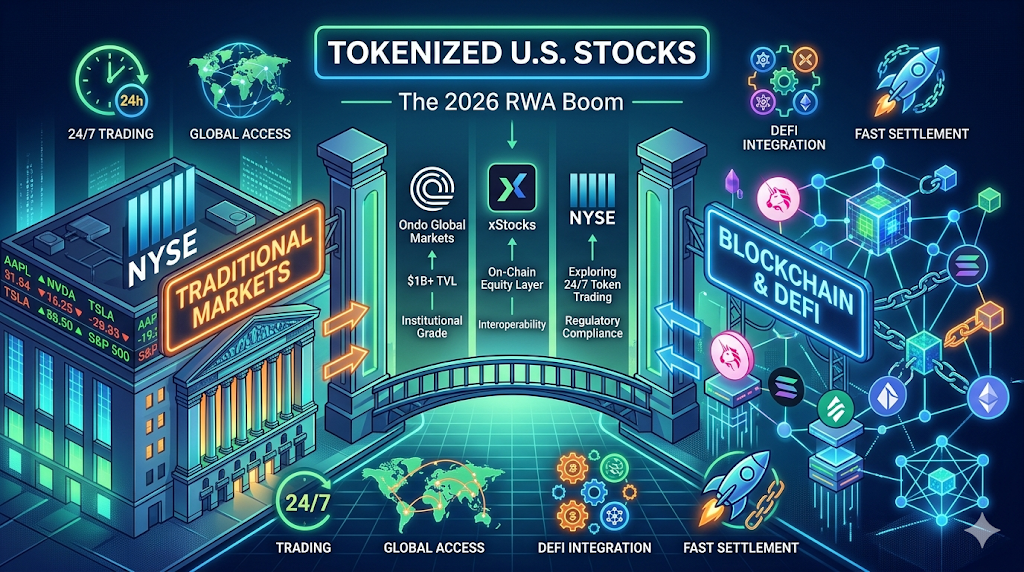
Introduction
What if you could trade Apple, Nvidia, Tesla, or an S&P 500 ETF 24/7 from a crypto wallet without waiting for Wall Street to open?
That vision is rapidly becoming reality. In 2026, tokenized U.S. stocks have emerged as one of the fastest-growing sectors within the real-world asset (RWA) industry. According to CoinGecko's 2026 RWA report, the tokenized stock market expanded from just $2 million in mid-2025 to nearly $500 million by March 2026, while trading activity continues to accelerate across multiple blockchain ecosystems.
The race is now being led by three distinct forces: Ondo Global Markets, which is building a comprehensive tokenized securities ecosystem; xStocks, which has become the dominant on-chain tokenized equity infrastructure; and the New York Stock Exchange (NYSE), which is reportedly exploring blockchain-based stock trading venues.
The result is a battle to become the next-generation gateway connecting traditional capital markets and blockchain finance.
What Are Tokenized U.S. Stocks?
Tokenized U.S. stocks are blockchain-based digital tokens that represent exposure to publicly traded equities.
Unlike traditional brokerage accounts, tokenized stocks can be transferred, traded, and integrated into decentralized finance applications. Most modern tokenized equity products are backed 1:1 by underlying shares held through regulated custodians, allowing investors to gain economic exposure to companies such as Apple, Tesla, Microsoft, and Nvidia through blockchain infrastructure.
The key innovation is not the stock itself. The innovation is the settlement layer.
Traditional stock markets operate during limited trading hours and rely on multiple intermediaries for clearing and settlement. Tokenized stocks allow ownership records and transfers to occur on-chain, enabling near-instant settlement and potentially 24/7 market access.
Why Are Tokenized Stocks Growing So Quickly in 2026?
Tokenized equities are growing because they solve several longstanding limitations of traditional markets.
According to CoinGecko research, the tokenized stock sector expanded roughly 29 times during 2025 and continued growing throughout early 2026. The rapid growth reflects increasing demand for globally accessible, blockchain-native exposure to U.S. capital markets.
Several factors are driving adoption.
24/7 Trading Access
Traditional U.S. stock markets operate during specific business hours.
Tokenized stocks can potentially trade around the clock, allowing investors in Asia, Europe, and emerging markets to access U.S. equities without waiting for market sessions to open. Multiple tokenized equity platforms now support continuous trading infrastructure.
Global Accessibility
Many investors face restrictions when opening U.S. brokerage accounts.
Blockchain-based stock products significantly reduce onboarding friction and can provide exposure through crypto-native platforms and wallets. This expands access to global investors who previously faced geographic barriers.
Integration With DeFi
Tokenized stocks can be used inside decentralized finance ecosystems.
Unlike traditional brokerage-held assets, blockchain-based equities can potentially interact with lending protocols, decentralized exchanges, collateral systems, and automated investment strategies. This creates entirely new financial use cases.
Faster Settlement
Traditional stock settlements typically require intermediary infrastructure and delayed finality.
Blockchain settlement can reduce operational complexity and provide near-instant asset transfers. This efficiency is one reason institutional participants continue to explore tokenization initiatives.
How Is Ondo Global Markets Leading the Tokenized Stock Market?
Ondo has emerged as the largest dedicated tokenized stock platform in 2026.
According to Ondo Finance, Ondo Global Markets surpassed $1 billion in total value locked (TVL) in May 2026, becoming the first tokenized stock platform to reach that milestone. The platform reported more than 260 tokenized stocks and ETFs available across Ethereum, Solana, and BNB Chain ecosystems.
What Makes Ondo Different?
Ondo's strategy focuses on replicating traditional capital markets on-chain. The platform emphasizes:
-
Fully backed tokenized equities
-
Cross-chain availability
-
Institutional-grade custody
-
ETF and stock exposure
-
Integration with major crypto wallets and exchanges
Ondo's Competitive Advantage
Ondo benefits from strong institutional relationships and deep involvement in the broader RWA ecosystem.
The company has also participated in tokenization initiatives involving traditional financial institutions and blockchain infrastructure providers, strengthening its credibility among institutional investors.
How Is xStocks Building the On-Chain Equity Layer?
xStocks has become the dominant infrastructure provider for tokenized equities.
Rather than focusing solely on a single platform, xStocks aims to become the standard issuance and distribution layer for tokenized stocks across multiple chains, exchanges, wallets, and DeFi applications.
What Are xStocks?
xStocks are tokenized equity products backed by underlying U.S. stocks and ETFs.
Available assets include major technology companies, broad market ETFs, and blue-chip equities. Examples include tokenized versions of Tesla, Nvidia, Apple, Meta, Alphabet, and index products.
Why xStocks Is Important
The key advantage of xStocks is interoperability.
Instead of requiring users to stay within a single ecosystem, xStocks can be integrated into centralized exchanges, decentralized exchanges, wallets, and lending applications. This allows tokenized equities to function more like internet-native financial assets.
Recent expansions onto BNB Chain and Ethereum-based ecosystems further demonstrate the platform's ambition to become a universal tokenized stock infrastructure layer.
Why Is NYSE Entering the Tokenization Race?
NYSE's involvement signals that tokenization is moving beyond crypto-native experiments.
Reports indicate that the New York Stock Exchange is exploring blockchain-powered trading venues capable of supporting 24/7 tokenized stock and ETF trading while preserving traditional shareholder rights.
What Makes NYSE Different?
Unlike crypto-native issuers, NYSE already controls one of the world's largest regulated equity marketplaces. Its approach focuses on:
-
Regulatory compliance
-
Institutional participation
-
Dividend preservation
-
Corporate governance rights
-
Integration with existing market infrastructure
If successful, NYSE could bridge traditional finance and blockchain technology without requiring investors to leave regulated financial markets.
Why Traditional Exchanges Are Paying Attention
Tokenization offers several potential advantages for exchanges:
| Traditional Markets | Tokenized Markets |
| Limited trading hours | Potential 24/7 access |
| T+1 settlement | Near-instant settlement |
| Multiple intermediaries | Streamlined blockchain infrastructure |
| Geographic restrictions | Global accessibility |
The emergence of tokenized stocks has created pressure for legacy exchanges to modernize their infrastructure.
What Regulatory Challenges Could Impact Tokenized Stocks?
Regulation remains the largest uncertainty facing the sector.
Recent reports suggest the U.S. Securities and Exchange Commission is evaluating frameworks that could allow tokenized stock trading through crypto platforms. However, investor protection, shareholder rights, and market integrity remain key concerns.
The Shareholder Rights Debate
Not all tokenized stocks provide identical rights to traditional equity ownership.
Depending on the structure, investors may receive economic exposure without voting rights or direct corporate governance participation. Understanding the legal structure of a tokenized stock is therefore essential before investing.
Regulatory Momentum Is Improving
Despite challenges, regulatory attitudes toward tokenization appear to be evolving.
Recent discussions surrounding innovation exemptions and tokenized securities frameworks indicate growing recognition that blockchain-based capital markets could become an important component of future financial infrastructure.
Conclusion
Tokenized U.S. stocks have moved from an experimental concept to a rapidly growing financial sector in 2026.
The competition between Ondo Global Markets, xStocks, and the New York Stock Exchange illustrates how both crypto-native innovators and traditional financial institutions are racing toward the same destination: a blockchain-powered capital market that operates continuously, settles efficiently, and reaches a global audience.
Ondo currently leads in tokenized stock market share and TVL, while xStocks has established itself as the dominant interoperability and distribution layer for on-chain equities. At the same time, NYSE's tokenization initiatives demonstrate that legacy financial infrastructure providers increasingly recognize the transformative potential of blockchain technology.
Although regulatory questions remain unresolved, the direction of travel is becoming clearer. Investors, institutions, and exchanges are all exploring ways to bring traditional securities onto blockchain networks. Whether through Ondo, xStocks, NYSE, or future competitors, tokenized equities are positioning themselves as one of the most important bridges between traditional finance and the digital asset economy.
FAQs
-
Are tokenized stocks backed by real shares?
Most leading tokenized stock products are backed 1:1 by underlying shares held through regulated custodians. However, investors should always verify the specific structure of each issuer before investing.
-
Can tokenized stocks pay dividends?
Yes, some tokenized stock structures pass through dividend payments or total-return exposure. The treatment depends on the issuer's legal and operational framework.
-
Can tokenized stocks be traded 24/7?
Many tokenized stock platforms support continuous trading, allowing investors to trade outside traditional U.S. market hours.
-
What blockchain networks support tokenized stocks?
Major tokenized stock issuers currently operate across Ethereum, Solana, and BNB Chain, with additional blockchain integrations continuing to expand.
-
What is the biggest risk of investing in tokenized stocks?
Regulatory uncertainty remains the largest risk. Investors should also evaluate custody arrangements, shareholder rights, liquidity conditions, and issuer transparency before purchasing tokenized equities.