

Tokenized RWA Market Reaches $46.3B as Ethereum Holds $21.8B in On-Chain Assets
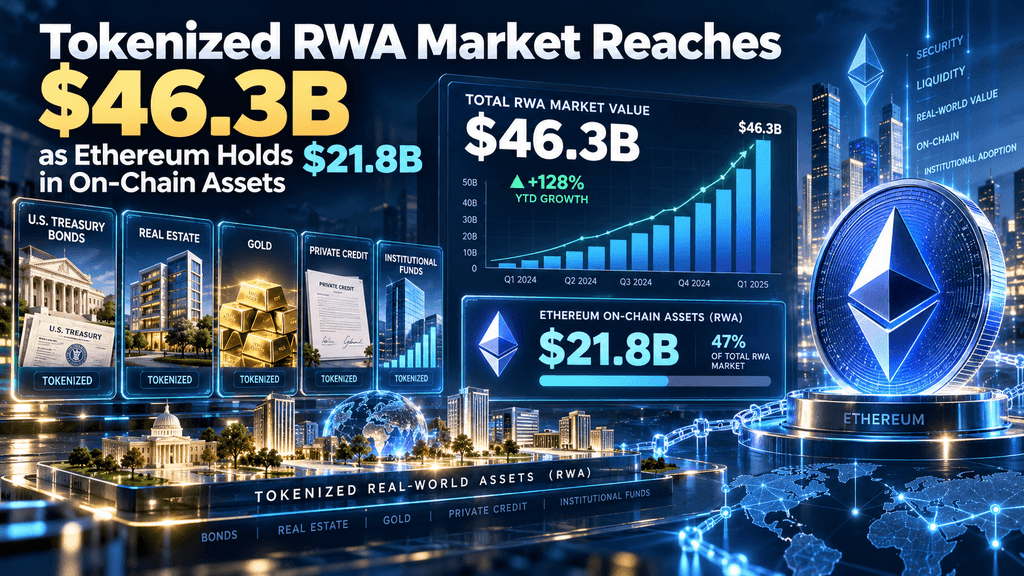
Ethereum Maintains Dominance as Tokenized Real-World Assets Surge to $46.3 Billion
The tokenized real-world asset market has experienced significant growth, expanding to an impressive total of $46.3 billion, as reported by Token Terminal data on October 25, 2026. Within this burgeoning market, the Ethereum protocol stands out, accounting for a substantial $21.8 billion of the overall total, which is more than three times the amount held by the next-largest network. Following Ethereum, BNB Chain holds a noteworthy $6.1 billion, while both Solana and Stellar each register $3.6 billion in tokenized assets. This overall figure represents a remarkable 920 percent increase over a span of three years, showing a rise from the $38.8 billion that was recorded in a snapshot taken in mid-September. The assets encompassed within this market include blockchain representations of various types of securities, commodities, funds, and real estate, all of which enable faster settlement processes and facilitate fractional ownership opportunities. Notably, tokenized U.S. government bonds constitute a substantial portion of Ethereum’s share in this market.
It is important to recognize that different data providers apply varying methodologies when tracking these figures. For instance, rwa.xyz monitors approximately $39 billion in distributed on-chain value, specifically excluding stablecoins, across dozens of different networks. This divergence in methodologies highlights how different counting rules can significantly affect headline numbers while simultaneously confirming the clear expansion that is occurring within the sector. Ethereum’s leadership position in the $46.3 billion tokenized real-world asset market underscores the network’s critical role as the primary venue for institutional-grade assets, even as multichain issuance continues to accelerate and tokenized Treasuries remain the dominant category within this growing space.
Ethereum’s $21.8 Billion Lead Reflects Institutional Preference for Established Settlement Rails
Ethereum continues to host the largest concentration of tokenized real-world assets, with $21.8 billion representing nearly half the $46.3 billion market tracked by Token Terminal as of late October 2026. This position stems from the network’s mature smart-contract environment, extensive custody infrastructure, and established connections to regulated fund issuers. Tokenized U.S. Treasuries and money-market products form the core of this value, as institutions favor environments with proven security track records and deep liquidity for secondary transfers. The $15.7 billion gap between Ethereum and BNB Chain illustrates the scale difference: Ethereum’s total exceeds the second-place network by more than threefold.
Growth over three years reached 920 percent for the broader market, yet Ethereum’s absolute holdings have remained resilient even as its percentage share moderated amid expansion elsewhere. Data from DefiLlama around the same period shows Ethereum holding roughly half of the tracked on-chain RWA market capitalization, excluding stablecoins, with a meaningful portion of DeFi-deployed value concentrated there. Network effects compound the advantage. Issuers seeking compliance-ready distribution and investors requiring reliable oracles and bridges continue to route significant volumes through Ethereum. This leadership does not prevent parallel growth on other chains; Rather, it establishes a reference standard against which newer platforms measure progress in custody standards, legal frameworks, and operational reliability.
BNB Chain’s $6.1 Billion Position Signals Expanding Issuance Beyond Traditional Smart-Contract Leaders
BNB Chain ranks second with $6.1 billion in tokenized RWA value, according to the October 25 Token Terminal figures. The network has attracted issuers seeking lower transaction costs and faster confirmation times for products aimed at broader distribution. Several large Treasury and fund products have found substantial homes on the chain, contributing to its rapid climb in absolute terms. Year-to-date growth contributions from BNB Chain have been material, with some analyses attributing roughly a quarter of recent market expansion to activity there. Holders and issuance platforms benefit from the chain’s established user base and exchange-linked liquidity pathways.
The $6.1 billion total remains well below Ethereum’s, yet the absolute scale demonstrates that cost and speed considerations can redirect meaningful capital when product structures allow multichain deployment. Tokenized funds and cash-equivalent instruments form a large share of this value. As more issuers adopt multichain strategies, BNB Chain’s share may continue to expand without necessarily displacing Ethereum’s core institutional holdings. The competitive dynamic encourages infrastructure improvements across the board, including better bridging and standardized reporting that reduce friction for cross-network transfers of the same underlying asset class.
Solana and Stellar Each Hold $3.6 Billion as Specialized Use Cases Drive Parallel Growth
Solana protocol and Stellar protocol each account for $3.6 billion of the $46.3 billion market in the latest Token Terminal snapshot. Solana’s share has expanded notably through tokenized equities and funds that benefit from high throughput and low fees, supporting higher-frequency activity and retail-accessible products. Stellar has similarly attracted value in specific categories, including certain fund and commodity representations, leveraging its focus on efficient payments and asset issuance. Both networks recorded material gains relative to earlier 2026 baselines. Solana’s RWA value growth has been among the more rapid in percentage terms in some tracker series, while Stellar has contributed a sizable portion of overall market expansion in recent months.
These parallel positions illustrate that no single chain monopolizes every use case. High-volume trading environments favor Solana’s architecture, while payment-oriented or lower-cost issuance routes suit Stellar. The combined $7.2 billion from the two networks approaches BNB Chain’s total and underscores the multichain nature of current RWA distribution. Investors and issuers increasingly treat chain selection as a product-design variable rather than a binary choice, deploying assets where settlement characteristics, regulatory clarity, and user access align most closely with the instrument’s intended holders.
Three-Year 920 Percent Expansion Shows Tokenization Moving from Experiment to Scale
The tokenized RWA market’s 920 percent growth over three years, reaching $46.3 billion, marks a transition from early pilots to measurable scale. Mid-September figures near $38.8 billion already indicated acceleration, and the subsequent rise to $46.3 billion confirms continued inflows. Earlier 2026 readings from various trackers placed the distributed market in the $30–40 billion range, with consistent upward trends. Tokenized U.S. Treasuries have provided a stable foundation, expanding from lower single-digit billions in prior periods to roughly $14–16 billion more recently. Credit products, commodities such as gold, and tokenized equities have added incremental layers.
Holder counts have multiplied as well, with some series showing several million wallets interacting with RWA tokens. The growth rate far exceeds many traditional asset classes over the same window and reflects both new issuance and rising valuations of underlying holdings. Importantly, the expansion has occurred across multiple networks rather than concentrating solely on one platform. This distribution reduces single-point dependency while creating interoperability challenges that industry participants continue to address through bridges, standardized metadata, and shared compliance tooling.
Tokenized U.S. Treasuries Anchor the Market Near $15 Billion with Broad Institutional Backing
Tokenized U.S. Treasuries and related cash-equivalent funds constitute the largest single category within the broader RWA market, with recent estimates ranging from approximately $14.7 billion to $16 billion. Products from established managers, including BlackRock’s BUIDL, Ondo’s USDY and related offerings, Franklin Templeton’s Benji funds, Circle’s USYC, and others, account for the majority of this value. These instruments provide on-chain exposure to short-duration government debt, offering yield with relatively low credit risk while enabling 24/7 transferability and fractional ownership.
Growth in the category has been substantial year-over-year, with some measurements showing more than 100 percent increases from prior periods. Foreign holders in certain jurisdictions represent a notable share of geolocated value, indicating that tokenization has expanded access routes beyond traditional U.S. brokerage channels. Despite the size, secondary trading activity remains limited relative to total outstanding value; many positions function primarily as held-to-maturity or yield-bearing reserves rather than actively traded instruments. The category’s maturity sets a template for other asset classes seeking similar regulatory and operational pathways.
Leading Issuers Including Sky, Ondo, and Securitize Concentrate Significant Portions of Outstanding Value
A relatively small number of platforms and issuers account for a large share of tokenized RWA value. Token Terminal data around late October 2026 attributes approximately $4.9 billion to Sky, $4.0 billion to Ondo, $3.9 billion to Securitize, and $2.5 billion to Franklin Templeton. These figures position crypto-native and traditional finance participants as joint builders of the market. Securitize’s role in distributing products such as BlackRock’s BUIDL illustrates the hybrid model in which regulated transfer agents and blockchain rails operate together.
Ondo has expanded both Treasury products and tokenized equities, achieving broad holder distribution in some offerings. Concentration among top issuers means operational or compliance developments at any one platform can influence meaningful percentages of total market value. At the same time, the presence of multiple substantial participants reduces systemic reliance on a single entity. New entrants continue to appear, particularly in equities and specialized credit, gradually broadening the issuer base even as the largest names retain leadership in absolute terms.
Tokenized Equities and Stocks Exhibit Fastest Relative Growth Among Asset Categories
Tokenized stocks and equities have posted some of the strongest percentage gains in recent 30-day and year-to-date windows. Category value has expanded from smaller bases earlier in 2026 to several billion dollars, with holder counts rising even more sharply in some tracker series. Platforms enabling on-chain representations of individual equities or baskets have attracted both retail and institutional interest seeking continuous trading and fractional access. Growth rates in this segment have outpaced those of Treasuries in relative terms, although absolute values remain lower. The rise coincides with increased infrastructure for corporate actions, pricing oracles, and compliant distribution.
Secondary market activity for equities tends to be higher than for held-to-maturity Treasury products, contributing measurable volume to decentralized and centralized venues. As more issuers and brokers explore tokenized equity products, this category is positioned to capture additional share of overall RWA growth, provided regulatory pathways remain clear and operational reliability matches investor expectations for traditional equity markets.
DeFi Deployment of RWA Value Remains Limited Relative to Total Outstanding Holdings
Only a modest fraction of total tokenized RWA value appears actively deployed within decentralized finance protocols. Recent DeFiLlama-aligned measurements place the DeFi-utilized share near 14–15 percent of tracked on-chain RWA market capitalization excluding stablecoins. Ethereum hosts the majority of this deployed value, while certain other chains show higher utilization ratios relative to their smaller overall holdings. Large portions of Treasury and fund products function primarily as yield-bearing reserves rather than collateral or liquidity providers.
Barriers include permissioned access requirements, regulatory constraints on secondary use, and the preference of many holders for simple custody over active strategy deployment. The gap between total outstanding value and DeFi activity indicates substantial room for growth if compliance frameworks and risk parameters evolve to support broader integration. Protocols that successfully bridge regulated RWA tokens into lending, collateral, or structured products could increase utilization rates without requiring proportional new issuance.
Multichain Distribution Creates Both Opportunity and Operational Complexity for Issuers
Assets now appear across 35 to 39 networks depending on the tracker, with meaningful value on Ethereum, BNB Chain, Solana, Stellar, and several others. Multichain strategies allow issuers to match product characteristics to network strengths, security and liquidity on one chain, and cost and speed on another. Bridging and synchronized reporting introduce operational overhead, including consistent metadata, synchronized pricing, and coordinated compliance checks. Some products maintain primary issuance on one network while offering wrapped or bridged versions elsewhere.
The resulting space improves accessibility for different investor segments yet raises questions about liquidity fragmentation and settlement finality across environments. Industry efforts toward standardized messaging and shared infrastructure aim to reduce these frictions. Successful multichain management will likely become a competitive differentiator as the market scales further.
Holder Counts Have Multiplied, Indicating Broader Distribution Beyond Institutional Concentration
RWA holder numbers have expanded significantly through 2026, with some series reporting several million wallets interacting with tokenized assets by October. Tokenized stock holders in particular have grown rapidly, accounting for a large percentage of total RWA holders in recent snapshots. Fund and commodity holders have also increased, though at more moderate rates. The rise in wallet counts outpaces pure value growth in certain periods, suggesting distribution to a wider set of participants rather than solely deeper concentration among existing large holders.
This broadening supports the thesis that tokenization can lower minimum investment sizes and improve access. At the same time, a substantial share of total value remains concentrated in a limited number of large products and addresses. Continued growth in both holder numbers and value will depend on maintaining operational simplicity and regulatory clarity for new entrants.
Retail Access Constraints Persist Despite Overall Market Expansion
A substantial majority of tokenized RWA value remains unavailable to U.S. retail investors under current structures. Reports indicate that only a small percentage of total value is structured for broad retail purchase in certain jurisdictions, with most products limited to accredited or institutional channels. Compliance requirements, including repeated KYC processes across platforms, contribute to this fragmentation. Tokenized Treasuries and certain funds designed under existing investment company frameworks provide the primary retail-reachable pathways.
The constraint limits the addressable market in major economies even as total on-chain value grows. Issuers and platforms that develop scalable, compliant distribution models for retail participants could unlock additional demand. Until then, the market’s expansion will continue to be driven predominantly by institutional and non-U.S. capital flows.
Outlook Centers on Operational Maturity and Cross-Network Interoperability
The $46.3 billion market size and Ethereum’s $21.8 billion holdings demonstrate that tokenization has achieved meaningful scale in selected asset classes. Future growth will depend less on pure issuance volume and more on improving secondary liquidity, increasing DeFi utilization where appropriate, expanding retail-accessible products, and reducing multichain operational friction. Tokenized Treasuries provide a proven template; equities and credit products are following similar paths with faster relative growth. Institutional participation from both traditional asset managers and crypto-native platforms continues to deepen infrastructure.
As data providers refine methodologies and reporting becomes more standardized, market participants will gain clearer visibility into true distributed value versus represented claims. The sector’s trajectory remains tied to the practical delivery of faster settlement, fractional ownership, and continuous transferability at institutional standards of reliability and compliance.
FAQs
What is the current size of the tokenized real-world asset market according to the most recent data?
Token Terminal places the market at $46.3 billion excluding stablecoins as of late October 2026, with Ethereum holding $21.8 billion. Other trackers such as rwa.xyz report distributed values near $39 billion using different inclusion criteria. Both series confirm substantial growth from earlier 2026 levels and from three years prior.
Which blockchain networks host the largest shares of tokenized RWAs?
Ethereum leads with $21.8 billion, followed by BNB Chain at $6.1 billion. Solana and Stellar each hold $3.6 billion in the Token Terminal figures. Additional value appears across dozens of other networks, reflecting a multichain distribution pattern.
Why do different data sources report different market sizes?
Methodologies vary in whether they count only freely transferable distributed tokens, include represented but non-circulating claims, exclude or include certain fund types, and apply different cut-off times. Token Terminal and rwa.xyz are among the most cited, yet their totals differ by several billion dollars due to these definitional choices.
How significant are tokenized U.S. Treasuries within the overall RWA market?
They form the largest single category, with recent estimates between roughly $14.7 billion and $16 billion. Leading products from major managers provide the bulk of this value and serve as the most mature and institutionally accepted segment of tokenized assets.
Which issuers control the largest amounts of tokenized RWA value?
The latest token terminal data attributes approximately $4.9 billion to Sky, $4.0 billion to Ondo, $3.9 billion to Securitize, and $2.5 billion to Franklin Templeton. These platforms span both crypto-native and traditional finance origins.
Disclaimer: This general market information, possibly from third-party, commercial, or sponsored sources, is provided for reference and educational purposes only and does not constitute financial or investment advice, an offer, solicitation, or guarantee. We disclaim liability for its accuracy, completeness, reliability, and any resulting losses. Investments/trading are risky; past performance doesn’t guarantee future results. Users should research, judge prudently, and take full responsibility. For further details, please consult KuCoin’s Terms of Use and Risk Disclosure.