

SpaceX's Multi-Billion Infrastructure Expansion Redefines Semiconductor Growth
Introduction
The convergence of aerospace logistics and artificial intelligence compute demand has triggered a historic hardware race, highlighted by major enterprise commitments to cutting-edge semiconductor architecture. According to reports from Thomasnet and industry analysts in October 2026, massive capital deployments are reshaping the technology landscape, positioning primary hardware manufacturers at the center of an unprecedented infrastructure boom.
Understanding how massive compute acquisition strategies influence market trajectories requires a close look at deployment velocity, supply chain mechanics, and enterprise valuation effects.
How Enterprise GPU Financing Drives Semiconductor Momentum
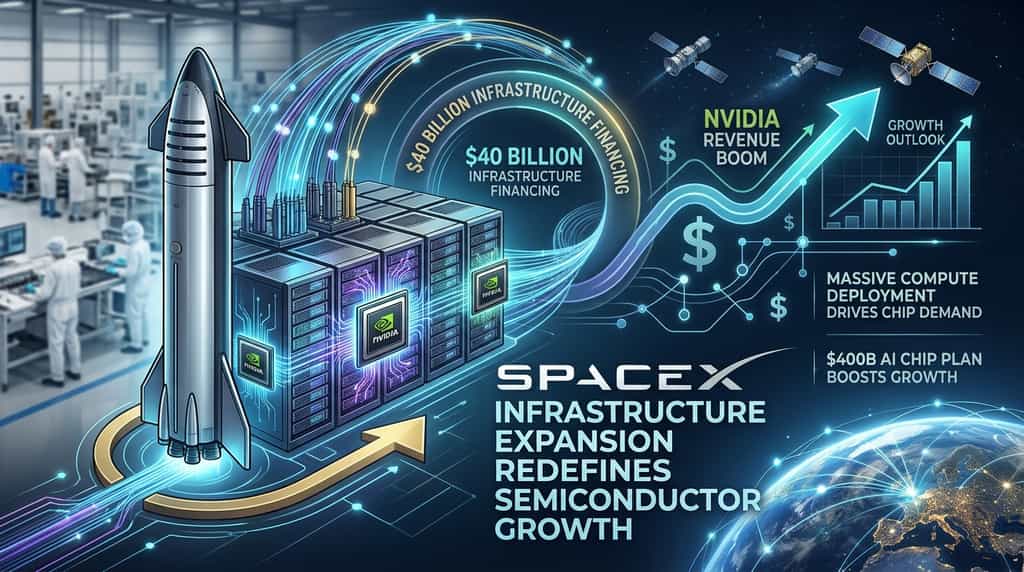
Direct financing commitments for hardware procurement establish an unyielding baseline of recurring demand for primary chipmakers. According to data from Securities.io, SpaceX secured a $40 billion financing commitment structured through an equipment lease agreement led by institutional lenders like Apollo Global Management and Goldman Sachs to procure advanced Nvidia processing units.
This arrangement transforms specialized hardware into long-duration corporate assets while guaranteeing forward revenue for semiconductor fabricators. By leveraging structured lease vehicles instead of standard cash burn, enterprise builders accelerate large-scale deployment schedules. Consequently, suppliers experience accelerated cash conversion cycles and elevated forward-looking revenue guidance.
| Financing Parameter | Structural Detail | Market Impact |
| Commitment Scale | $40 Billion Equipment Lease | Secures multi-year fabrication volume |
| Primary Lenders | Apollo Global Management, Goldman Sachs | Validates hardware as bankable collateral |
| Hardware Focus | Advanced NVIDIA Chips (Vera Rubin architecture) | Drives premium pricing power for suppliers |
Analyzing the Impact on NVIDIA’s Revenue Outlook
Hardware suppliers benefit directly from aggressive enterprise deployment targets that prioritize speed over cost reduction. According to quarterly reports tracked by 24/7 Wall St., Nvidia’s revenue reached $96.22 billion with a 105.8% year-over-year increase, driven heavily by data center expansion.
The integration of massive lessee cohorts into the broader customer ecosystem ensures that manufacturing lines operate at maximum capacity. Because institutional-backed leases insulate suppliers from individual enterprise cash flow fluctuations, overall earnings visibility improves significantly. This structural insulation reduces downside cyclicality for leading semiconductor designers.
Infrastructure Scaling and the Shift Toward Autonomous Compute
Accelerated hardware integration alters how corporate networks handle real-time data processing and distributed intelligence. According to insights published by Dealroom, rapid infrastructure deployment allows enterprises to bring hundreds of thousands of advanced processing nodes online per month, drastically cutting down model training times.
This rapid expansion directly supports advanced consumer services, decentralized cloud frameworks, and enterprise-grade generative intelligence platforms. As compute density per square foot increases, data center operators must adopt specialized liquid-cooling and power distribution systems supplied by specialized hardware partners.
Enterprise Valuation Dynamics in the Age of Artificial Intelligence
Capital-intensive hardware deployment strategies directly influence private and public company valuations across the technology sector. Based on market evaluations from TipRanks, large-scale ecosystem builders pursuing aggressive computing roadmaps command premium market capitalizations approaching the $400 billion threshold.
Investors increasingly reward entities that secure guaranteed access to scarce semiconductor inventory ahead of competitors. This dynamic creates a distinct competitive moat, where control over advanced computing clusters dictates market leadership across both traditional software services and emerging digital asset ecosystems.
Strategic Conversion: Capitalizing on Hardware-Driven Markets
Navigating rapid shifts in semiconductor demand and enterprise infrastructure expansion requires secure, agile digital asset management platforms. As institutional capital flows heavily into artificial intelligence and high-performance computing initiatives, the broader technology and blockchain sectors experience correlated growth spurts. Utilizing professional-grade trading platforms ensures you can capture market opportunities seamlessly as hardware milestones drive broader economic momentum.
Conclusion
Massive infrastructure investments by industry giants validate the sustained multi-year growth trajectory of foundational semiconductor providers. Structured lease commitments and aggressive deployment schedules ensure that supply chains remain saturated, shielding primary hardware designers from traditional cyclical downturns. As enterprise networks scale to support advanced computing requirements, the symbiosis between capital deployment and hardware manufacturing will continue to dictate broader market leadership.
FAQs
What specific financing structure was used for the recent hardware acquisition?
The arrangement relies on a $40 billion equipment lease agreement backed by institutional asset managers, treating advanced processing units as long-duration collateralized assets.
How do equipment leases affect semiconductor supplier revenues?
Lease-backed procurement guarantees forward manufacturing volume and predictable cash flows, insulating suppliers from short-term enterprise liquidity shifts.
What deployment rates are leading enterprises targeting for processing nodes?
Leading enterprise builders are tracking to bring hundreds of thousands of advanced processor chips online monthly to support intensive computational workloads.
Why is hardware availability considered the primary bottleneck for ecosystem expansion?
Global demand for specialized semiconductor architectures outpaces current cleanroom fabrication capacity, making secured supply allocations critical for market positioning.
How do these hardware investments impact broader technology valuations?
Securing guaranteed access to scarce computing hardware creates a decisive competitive moat, elevating enterprise valuations and attracting sustained institutional capital inflows.
Disclaimer
This general market information, possibly from third-party, commercial, or sponsored sources, is provided for reference and educational purposes only and does not constitute financial or investment advice, an offer, solicitation, or guarantee. We disclaim liability for its accuracy, completeness, reliability, and any resulting losses. Investments/trading are risky; past performance doesn’t guarantee future results. Users should research, judge prudently, and take full responsibility. For further details, please consult KuCoin’s Terms of Use and Risk Disclosure.