

Should You Invest in US Stocks or Bitcoin in 2026?
2026/06/16 11:43:00
Introduction
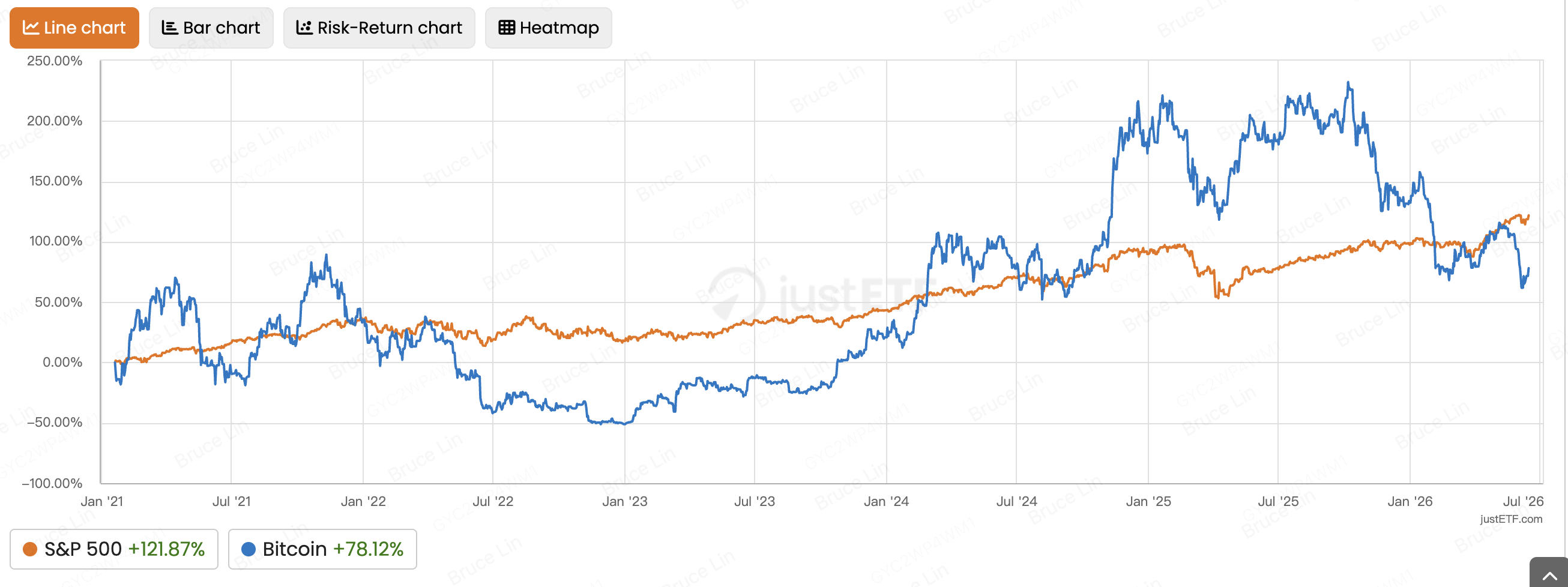
Over the past five years, both the S&P 500 and Bitcoin delivered staggering returns — but the gap between them in 2026 tells a very different story. Between June 11, 2021 and June 11, 2026, the S&P 500 has returned 71.3% and Bitcoin has returned 67.5%. Yet in the last six months, US stocks have decisively pulled ahead, leaving many investors asking the same question: should I put my money into US stocks or Bitcoin?
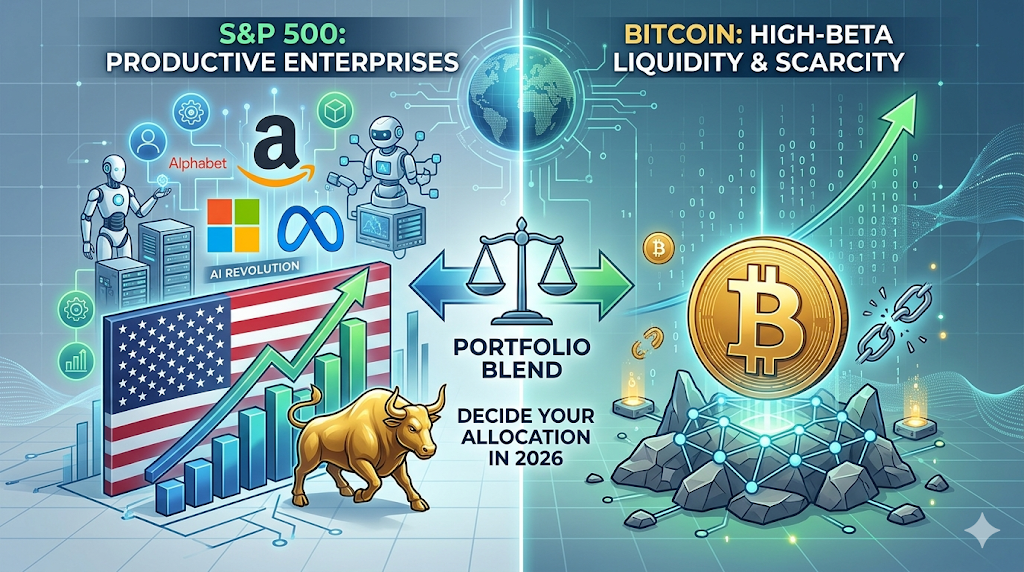
The short answer: both belong in a long-term portfolio, but they play fundamentally different roles. US stocks represent ownership of productive enterprises — currently dominated by the AI revolution — while Bitcoin functions as a high-beta barometer of global liquidity and fiat debasement. The right allocation depends on your time horizon, volatility tolerance, and what macro thesis you believe in.
This article breaks down the data, the structural differences, and how to decide which exposure — or what blend — fits your goals in 2026.
How Have US Stocks and Bitcoin Performed Recently?
US stocks have meaningfully outperformed Bitcoin over the past six months, despite Bitcoin's stronger long-term track record. As of June 15, 2026, the price of Bitcoin is $66,521.59 — approximately a $39,100 drop compared with one year ago. Meanwhile, the S&P 500 has continued grinding higher.
The drawdown for Bitcoin has been severe. Bitcoin's last cycle high was set in early October 2025, a peak just above $125,000. Then by February 5, 2026, Bitcoin had dropped below $70,000 as forced deleveraging accelerated.
Equities, by contrast, have continued their multi-year rally. According to Goldman Sachs Research published in January 2026, strategists project the S&P 500 to produce a 12% total return in 2026, compared with 18% last year and 25% in 2024, with earnings per share expected to increase 12% in 2026.
The Six-Month Divergence Explained
The gap reflects two different transmission mechanisms. Equities can grind on earnings narratives, while crypto often trades the funding and leverage layer first. When leverage unwound in crypto markets in early 2026, US equities barely flinched because they were not carrying the same speculative excess.
Why Are US Stocks Outperforming Bitcoin in 2026?
US stocks are outperforming because of one dominant force: artificial intelligence. The S&P 500's strength in 2026 is not broad-based — it is highly concentrated in companies building and supplying the AI infrastructure boom.
According to Jefferies research published in 2026, AI-related companies have generated over 80% of the S&P 500's year-to-date gains, leaving the index up just 2% without them. This is not speculative froth. The bank's analysis points to genuine earnings expansion, not speculative valuation spikes, as the key driver. Forward earnings estimates for the AI sector have risen more than 30% since mid-2025, with projected compound annual growth of 38.5% through 2027, far outpacing the 11.9% expected for non-AI sectors.
Concentration in AI Leaders
The contribution from individual names is striking. According to ETF.com data from May 2026, the single biggest engine of this year's rally is Alphabet, which has contributed 1.27 percentage points to the S&P 500's return all by itself — more than 20% of the index's return from a single name.
Capital expenditure on AI infrastructure is enormous. Tech giants Amazon, Alphabet, Microsoft, and Meta Platforms plan on spending almost $700 billion on this ramp-up in 2026.
What This Means for Investors
US stocks today represent something specific: ownership of the companies leading the most important technological transition since the internet. If you believe AI productivity gains are real and durable, US equities give you direct exposure to that earnings stream. The risk is concentration — strip out AI names and the index looks far less impressive.
Why Has Bitcoin Underperformed — and Does It Still Have Long-Term Value?
Bitcoin has underperformed because the past six months coincided with a massive deleveraging cycle and tight liquidity conditions, but its long-term investment case remains intact. Bitcoin behaves less like a stock and more like a leveraged bet on global liquidity and fiat currency debasement.
Bitcoin as a Liquidity Barometer
Equities tend to absorb changes gradually through earnings expectations and discount rates. Bitcoin doesn't wait. It reacts faster, and usually louder. When liquidity tightens, Bitcoin sells off first; when liquidity expands, it rallies hardest.
This sensitivity makes Bitcoin a clean read on monetary conditions. A Bitcoin vs. S&P 500 chart over the past 5 years shows two assets shaped by the same liquidity cycles but responding in fundamentally different ways — one anchored to corporate cash flows, the other driven by risk appetite and positioning.
The Long-Term Scarcity Thesis
Bitcoin's long-term investment value rests on a simple fact: supply is capped while fiat supply expands indefinitely. According to research published in June 2026, Bitcoin has a hard cap of 21 million coins. As of 2026, approximately 1.32 million BTC remain unmined (less than 7% of total supply), while an estimated 3–4 million BTC are considered permanently lost. This shrinking effective float means demand competes for an increasingly fixed pool.
As long as central banks continue expanding the monetary base over the long run, the structural case for holding scarce digital assets persists — even if the path is volatile.
How Do US Stocks and Bitcoin Compare on Risk?
US stocks and Bitcoin carry very different risk profiles, even though both are classified as risk assets. Bitcoin's volatility is several times higher, and its drawdowns are correspondingly deeper.
The volatility gap hasn't closed. Equity volatility, measured by the VIX, stayed muted into year-end, consistent with a market not pricing systemic stress. Bitcoin volatility remained far higher, reinforcing the long-standing divide.
Historical drawdowns illustrate this. Bitcoin generated 200-300%+ annual performance during bull market years (2017, 2020-2021, 2024), while experiencing -60% to -70% drawdowns in bear cycles. The S&P 500's worst drawdowns over the same period have rarely exceeded 25-35%.
| Risk Dimension | US Stocks (S&P 500) | Bitcoin |
| Typical bear market drawdown | 20–35% | 50–75% |
| Annualized volatility | 15–20% | 50–80% |
| Income (dividends) | Yes | None |
| 24/7 trading | No | Yes |
Correlation Has Tightened — But Not Always
The two assets have started to move together more often. According to Phemex analysis published in 2026, the 30-day rolling correlation between Bitcoin and the S&P 500 hit 0.74 in early March 2026, the highest reading this year, and on certain intraday windows the r-squared between the two assets has touched 0.94. BTC is trading near $67,000 as of late March 2026 after falling roughly 47% from its $126,000 all-time high, and the selloff has tracked equity weakness almost tick for tick.
However, that correlation is not permanent. Correlation bettwen BTC and us equities is not constant. It spikes during liquidity crises, fades during crypto-native catalysts, and has broken down completely at least three times in the past seven years.
How to Trade US Stocks and Bitcoin on KuCoin
KuCoin gives you streamlined access to Bitcoin and a growing range of crypto-equity products, making it one of the most efficient platforms for building a blended portfolio. Whether you want to dollar-cost average into BTC, trade short-term moves, or use leverage, KuCoin's spot, futures, and earn products cover the full spectrum.
Getting Started in Three Steps
-
Create your account — Sign up on KuCoin in minutes and complete identity verification to unlock full trading limits.
-
Fund your wallet — Deposit via crypto transfer, P2P trading, or supported fiat on-ramps.
-
Choose your strategy — Buy BTC spot for long-term holding, use futures for tactical exposure, or stake/lend through KuCoin Earn for passive yield.
KuCoin also offers exposure to trading US stock perps — meaning you can rebalance between crypto and US equity narratives without leaving the platform. Combined with the security infrastructure of a tier-one global exchange, KuCoin is positioned for investors who want flexibility across both asset classes.
Conclusion
The choice between US stocks and Bitcoin in 2026 is less about picking a winner and more about understanding what each asset represents. US stocks — particularly the AI-driven leaders of the S&P 500 — give you direct ownership in the companies powering the most important technology shift of this generation, with earnings growth and lower volatility supporting the case. Bitcoin, despite a punishing six-month drawdown, remains the cleanest expression of global liquidity and digital scarcity, with a long-term thesis intact and the 2028 halving cycle ahead.
The data shows both have been worthy long-term holdings, with comparable five-year returns despite very different paths. The smartest move for most investors is not to choose one over the other but to size each according to time horizon, volatility tolerance, and conviction. A blended portfolio captures the productivity story of US equities and the monetary story of Bitcoin — two of the most powerful long-term trends in modern markets.
FAQs
-
Is Bitcoin riskier than US stocks?
Yes. Bitcoin's volatility is roughly 3–4 times higher than the S&P 500's, and its drawdowns frequently exceed 50%, while US stock bear markets typically bottom around 20–35%. Bitcoin also lacks dividends and underlying cash flows, so its valuation depends entirely on demand and macro liquidity.
-
What percentage of my portfolio should be Bitcoin versus US stocks?
There is no one-size-fits-all answer, but a common framework allocates 5–20% to Bitcoin within a broader equity-heavy portfolio. Conservative investors often stay at 1–5%, while higher-conviction holders go to 20%+. Size your position so a 70% Bitcoin drawdown would not force you to sell.
-
Could Bitcoin replace US stocks in a portfolio entirely?
For almost all investors, no. US stocks represent claims on productive cash flows from thousands of businesses, while Bitcoin is a single non-yielding asset. A 100% Bitcoin portfolio would expose you to extreme drawdowns, no income, and concentration risk in a single thesis. Even Bitcoin maximalists typically retain some equity exposure for stability and diversification.