

RLUSD Hits $2.49B Market Cap, Up 86% in 2026, and Closing In on PYUSD
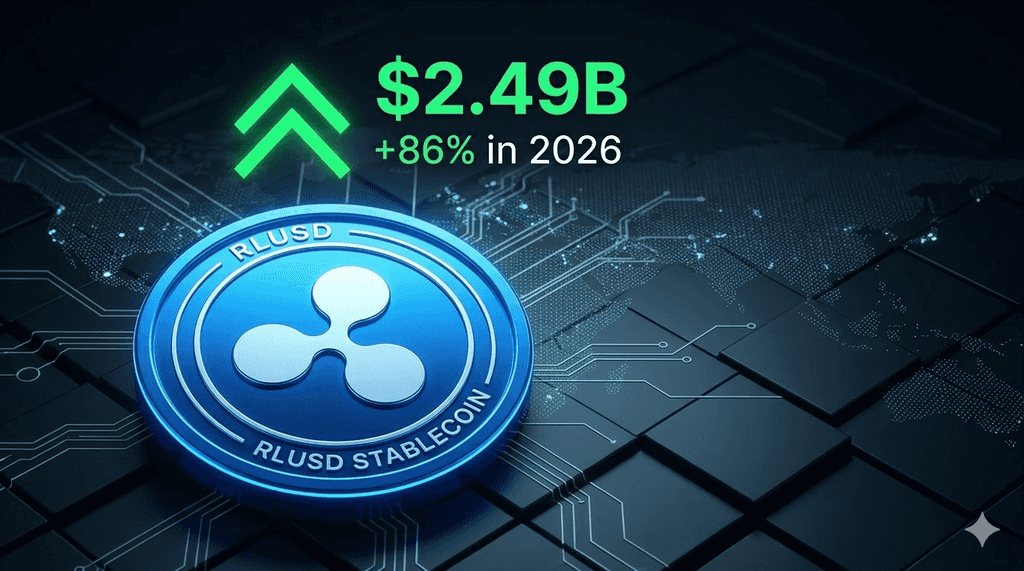
Ripple’s dollar-backed stablecoin RLUSD has reached a circulating market capitalization of approximately $2.491 billion as of September 28, 2026, marking an increase of more than 86 percent from its $1.336 billion level at the beginning of the year. Recent on-chain and market data show the token’s supply rose by about $112 million over the preceding seven days while PayPal’s PYUSD contracted by roughly $61 million, leaving RLUSD only $248 million behind PYUSD’s approximately $2.739 billion market cap. The expansion has occurred across both primary issuance networks, with Ethereum holding about 56 percent of total RLUSD supply and the XRP Ledger accounting for the remaining 44 percent.
Between September 21 and 28, XRPL supply increased by approximately $63 million to $1.099 billion, and Ethereum supply grew by about $49 million to $1.392 billion. These figures place RLUSD among the faster-growing regulated stablecoins in a global market estimated near $304–306 billion. The sustained rise in RLUSD circulating supply, combined with contrasting contraction in PYUSD and the progressive migration of balances toward the XRP Ledger, demonstrates that institutional demand for a New York-regulated, fully reserved dollar stablecoin is translating into measurable market-share gains within the second tier of the stablecoin hierarchy.
RLUSD Circulating Supply Hits Record High Amid Steady Weekly Inflows
Market data published in late September 2026 confirm that RLUSD’s circulating supply crossed a new high near $2.491 billion on September 28, reflecting continued net minting rather than price appreciation, since the token remains tightly pegged near $1.00. Independent trackers recorded an addition of roughly $112 million in the prior week alone, a pace that has contributed to the 86 percent year-to-date expansion from the $1.336 billion starting point. This growth has been supported by consistent institutional minting channels and broader liquidity provision across both major chains. Holders numbered approximately 83,000 according to recent analytics platforms, while monthly transfer volumes have remained in the multi-billion-dollar range, indicating active rather than purely dormant balances. The token’s rank among all crypto assets has stabilized near the mid-40s by market capitalization, underscoring its emergence as a meaningful participant beyond the dominant USDT and USDC pair. Reserve reports published by the issuer continue to show assets exceeding outstanding tokens, reinforcing confidence that new supply is fully backed.
The weekly inflow pattern stands in contrast to broader stablecoin market dynamics, where total capitalization has hovered near $304 billion with limited net expansion in recent months. RLUSD’s ability to attract fresh capital while larger peers experience more muted flows points to differentiated demand drivers tied to its regulatory status and multi-network availability. Analysts tracking on-chain metrics note that the September acceleration followed an earlier crossing of the $2 billion threshold in late August, suggesting momentum has been building rather than appearing as a one-off event. Practical implications include deeper order-book liquidity for trading pairs and greater utility as collateral or settlement media for entities already integrated with Ripple’s payment infrastructure. The consistency of the peg through these volume increases further validates the reserve management framework overseen by Standard Custody & Trust Company.
PYUSD Contraction Creates Narrowing Competitive Gap
PayPal’s PYUSD has followed a divergent trajectory in 2026, opening the year near $3.531 billion, peaking at $4.214 billion on March 5, and subsequently declining by roughly 35 percent from that high to approximately $2.739 billion. The recent weekly reduction of about $61 million has directly contributed to the compression of the gap with RLUSD to only $248 million. This reversal has occurred even as PYUSD remains available on multiple networks and benefits from PayPal’s extensive consumer and merchant reach. Data indicate that portions of the decline have been concentrated on specific chains, including noticeable reductions on Arbitrum in certain periods. The result is a tighter race among mid-tier regulated stablecoins that compete for institutional treasury, settlement, and DeFi collateral roles.
Market observers attribute part of PYUSD’s pullback to shifting preferences among larger holders seeking alternative yield or compliance profiles, though no single explanatory factor dominates public reporting. The relative stability of RLUSD’s growth during the same interval highlights how supply dynamics can shift rapidly within the second tier even when the overall stablecoin market remains relatively flat. For market participants, the narrowing differential raises the practical question of which asset will capture incremental flows from payment providers, trading platforms, and tokenized-asset platforms over the coming months. Continued monitoring of weekly net issuance for both tokens will provide the clearest near-term signal of competitive positioning.
Ethereum continues to host the larger portion of RLUSD supply at approximately 56 percent, or about $1.392 billion as of the late-September snapshot, reflecting the network’s deep DeFi liquidity and broad institutional tooling. Growth on Ethereum between September 21 and 28 totaled roughly $49 million, demonstrating ongoing demand even as balances migrate elsewhere. The network’s mature smart-contract environment supports complex use cases such as collateralized lending, automated market-making, and integration with existing Ethereum-based payment rails. High transfer volumes on Ethereum have helped sustain the token’s visibility among traditional finance participants already active on the chain. Reserve transparency and NYDFS oversight apply equally across networks, so the Ethereum allocation does not introduce differential credit risk.
Simultaneously, the XRP Ledger has increased its share to roughly 44 percent, or $1.099 billion, with a $63 million rise in the same September window. This shift continues a longer-term trend observed earlier in 2026 in which XRPL’s proportion of total RLUSD expanded markedly from lower double-digit percentages. The ledger’s low-cost, high-throughput characteristics make it attractive for high-frequency settlement and institutional payment flows. Recent infrastructure developments, including progress on native lending primitives, further enhance the utility of holding RLUSD directly on XRPL. The dual-network distribution provides issuers and holders with optionality while distributing operational risk.
Institutional Lending and Settlement Drive XRPL Utility
Ripple has actively promoted RLUSD for institutional lending scenarios on the XRP Ledger, positioning the stablecoin as working capital rather than a static reserve. Proposed lending protocol standards aim to allow permissioned pools in which credit underwriting remains off-chain while loan terms, interest accrual, and repayment are enforced programmatically on-ledger. Payment providers holding RLUSD can, in principle, bridge short-term liquidity gaps without liquidating positions or drawing expensive traditional facilities. Partnerships with platforms facilitating exchanges between tokenized funds and RLUSD have expanded around-the-clock conversion options for holders of certain real-world asset products.
These developments increase the velocity of RLUSD balances on XRPL and support deeper secondary-market liquidity. The practical effect is a gradual transformation of XRPL from a primarily payments-focused network into one supporting a broader set of capital-markets functions. Transaction data showing elevated RLUSD-related activity contribute to network fee generation and overall ledger usage metrics. Institutions evaluating settlement assets now weigh both the regulatory clarity of RLUSD and the operational efficiency of the underlying ledger. Continued validator support for lending-related amendments will determine how quickly these capabilities move from proposal to production use.
Reserve Composition and Independent Attestations Underpin Confidence
RLUSD is issued by Standard Custody & Trust Company, LLC, a New York limited-purpose trust company supervised by the New York State Department of Financial Services. Reserves consist of cash, short-term U.S. Treasury securities, government money-market funds, and overnight reverse-repurchase agreements held in segregated accounts, primarily with BNY Mellon as custodian. Monthly attestations by an independent U.S.-licensed CPA following AICPA standards confirm that reserve assets equal or exceed outstanding tokens. Transparency reports published by the issuer have consistently shown a buffer above the one-to-one requirement; one recent snapshot listed approximately $2.396 billion in circulation against $2.518 billion in reserve funds.
This structure aligns with NYDFS guidance on U.S. dollar-backed stablecoins and provides institutional holders with a clear supervisory framework. The absence of longer-duration or higher-risk assets in the reported reserve mix reduces interest rate and credit exposure relative to less conservative designs. Regular public disclosure of attestation reports allows market participants to verify backing without relying solely on issuer statements. The combination of state-level trust company oversight and third-party verification has become a distinguishing feature for entities prioritizing regulatory certainty.
Global Stablecoin Context Places RLUSD in Second-Tier Leadership
The broader stablecoin market stood near $304–306 billion in late September 2026, with USDT and USDC together accounting for the large majority of capitalization. Within this landscape, RLUSD’s $2.49 billion places it among the leading non-dominant dollar tokens, trailing only a handful of peers. Year-to-date growth of 86 percent significantly outpaces the overall market’s more modest expansion, illustrating concentration of incremental demand among a smaller set of regulated issuers. Transfer volume and holder metrics for RLUSD indicate usage beyond pure store-of-value behavior, supporting its role in settlement and collateral applications.
Competitive dynamics among mid-tier stablecoins remain fluid, as evidenced by the simultaneous expansion of RLUSD and contraction of PYUSD. Issuers that combine regulatory clarity, multi-chain distribution, and concrete institutional integrations appear better positioned to capture share. For the market as a whole, the rise of additional regulated options diversifies risk away from the two largest tokens while still operating under the same dollar-peg paradigm.
Multi-Network Issuance Expands Accessibility and Liquidity
Beyond Ethereum and the XRP Ledger, RLUSD has been extended to additional environments, including Base, Optimism, and other Ethereum-compatible networks. This multi-chain presence allows holders to move balances according to preferred fee structures, liquidity depth, and application ecosystems. Native issuance rather than bridged representations reduces certain operational risks associated with cross-chain transfers. Liquidity providers and trading venues benefit from the ability to source RLUSD on the network that best matches their existing infrastructure.
The approach also supports geographic and jurisdictional preferences among institutional clients. The practical outcome is a more resilient distribution model in which temporary congestion or elevated fees on one chain do not isolate the entire supply. Data showing concurrent growth on both primary networks in September illustrate that demand is not confined to a single ecosystem. Continued expansion of supported chains will likely further broaden the addressable user base without diluting the core regulatory and reserve guarantees.
Tokenized Asset Integrations Create New Conversion Pathways
Recent collaborations have enabled holders of certain tokenized money-market funds to exchange shares for RLUSD on a continuous basis. These integrations create additional on-ramps and off-ramps that link traditional fixed-income products with on-chain dollar liquidity. For institutional portfolios already holding tokenized assets, the ability to rotate into a regulated stablecoin without exiting the blockchain environment improves capital efficiency.
The arrangements also generate secondary demand for RLUSD as a settlement medium within those ecosystems. Such partnerships illustrate how stablecoin growth can be driven by adjacent real-world asset activity rather than solely by crypto-native trading. As more asset managers bring funds on-chain, the demand for compliant, fully reserved dollar tokens is expected to increase. RLUSD’s regulatory positioning makes it a natural candidate for these conversion rails.
Peg Stability and Trading Volume Support Market Confidence
Throughout the period of rapid supply growth, RLUSD has maintained a tight peg near $1.00, with 24-hour ranges typically measured in fractions of a cent. Trading volumes have reached hundreds of millions of dollars on peak days across centralized and decentralized venues, providing sufficient depth for institutional-sized transactions. The combination of reserve transparency and observable market liquidity reduces the likelihood of sustained de-pegging events. Market makers and arbitrageurs play a continuous role in keeping secondary-market prices aligned with the redemption value.
This operational track record matters for counterparties that treat stablecoins as cash equivalents in collateral or settlement calculations. Consistent peg performance through periods of elevated issuance and redemption activity provides empirical evidence supporting the reserve and operational framework. Ongoing volume growth further deepens the market, creating a positive feedback loop for additional institutional participation.
Growth Patterns Highlight Different Sources of Demand
While dominant stablecoins have experienced relatively stable or modestly growing capitalization, RLUSD’s 86 percent year-to-date increase stands out among regulated peers. The concurrent decline in PYUSD supply from its March peak underscores that growth is not automatic even for well-known brands. Factors specific to RLUSD, New York trust company oversight, dual primary-network distribution, and targeted institutional product development, appear to be resonating with the segment of demand seeking both compliance and operational utility.
Weekly net-issuance differentials provide a high-frequency indicator of relative momentum. These patterns suggest that the second tier of the stablecoin market is becoming more competitive and differentiated rather than purely hierarchical. Issuers able to demonstrate both regulatory robustness and concrete use-case traction are capturing incremental share. Continued data on supply migration between networks will further clarify which distribution strategies prove most effective.
Conclusion
Looking ahead, RLUSD’s ability to close or reverse the remaining gap with PYUSD will hinge on the persistence of current weekly issuance trends and the successful activation of additional on-ledger financial primitives. Expansion of lending, payment-corridor, and tokenized-asset integrations can increase both the stock and velocity of RLUSD balances. Reserve attestation cadence and custodian arrangements remain foundational to maintaining institutional confidence.
Broader macroeconomic conditions and overall stablecoin market growth will influence the absolute size of opportunity available to all mid-tier tokens. Market participants will watch net supply changes, network distribution shifts, and new partnership announcements as the primary near-term signals. The current trajectory positions RLUSD as a credible contender for second-tier leadership among regulated dollar stablecoins, provided the recent growth rate is sustained.
🔥 Beyond the Headlines: What KuCoin 5.0 Means for You
Market news moves fast — but where you act on it matters just as much. This October, KuCoin launches KuCoin 5.0, transforming KuCoin into a rebuilt platform. Here's what actually changes for you:
-
One account for everything. Older platforms split your money across separate "spot," "margin," and "futures" accounts and expected you to understand why. KuCoin 5.0's unified account removes that entirely — deposit once, and everything is simply there (only available to VIPs for now).
-
Stocks, indices, and commodities. KuCoin 5.0 expands beyond crypto into global markets. When crypto chops sideways and equities rally (or the reverse), you rotate in minutes instead of opening a brokerage account and waiting days for fiat rails.
-
Real-world assets (RWA). Tokenized exposure to traditional assets like commodities, right inside your crypto account. One of the fastest-growing segments in global finance is no longer reserved for institutions — you access it from the same balance you trade with.
-
Earn while you learn. Not ready to trade? KCUSD lets your stablecoins earn daily, auto-compounding interest. The lowest-stress way to put your idle deposit to work for 4% yield.
-
An AI assistant in plain language. Ask questions, get market context, understand what you're looking at — built into the platform, no jargon required.
-
An app that doesn't overwhelm. Faster, cleaner, and consistent — intuitive from the first tap, not after a tutorial.
-
Safety you can check, not just trust. A MiCAR-licensed EU entity, Proof of Reserves you can verify yourself, and internationally certified security (SOC 2 Type II, ISO 27001:2022).
Create your account in minutes — and start on the platform built for where crypto is going, not where it's been.
FAQs
How has RLUSD’s market capitalization changed since the start of 2026?
RLUSD began 2026 with a market capitalization of approximately $1.336 billion and reached about $2.491 billion by September 28, representing growth of more than 86 percent. The increase has been driven almost entirely by rising circulating supply rather than any deviation from the $1.00 peg. Weekly data in late September showed continued net additions, indicating that the expansion remains active rather than having plateaued after the earlier $2 billion milestone.
What is the current gap between RLUSD and PYUSD?
As of the most recent late-September figures, RLUSD’s market capitalization stood roughly $248 million below that of PYUSD. The gap has narrowed because RLUSD added approximately $112 million in supply over one recent week while PYUSD’s supply declined by about $61 million. PYUSD itself has fallen substantially from its March 2026 peak of $4.214 billion.
On which networks is RLUSD primarily issued?
The majority of RLUSD, approximately 56 percent or $1.392 billion, resides on Ethereum, while the XRP Ledger holds about 44 percent or $1.099 billion. Both networks recorded positive supply growth between September 21 and 28, with the XRP Ledger adding a larger absolute amount in that specific window. Additional Ethereum-compatible networks also support the token.
Who issues RLUSD, and how are reserves managed?
Standard Custody & Trust Company, LLC, a New York limited-purpose trust company supervised by the NYDFS, issues RLUSD. Reserves consist of cash and cash equivalents, short-term U.S. Treasuries, and related instruments held in segregated accounts, primarily with BNY Mellon. Independent CPA attestations are published monthly to confirm that reserve assets cover outstanding tokens.
Disclaimer
The information provided on this page may originate from third-party sources and does not necessarily represent the views or opinions of KuCoin. This content is intended solely for general informational purposes and should not be considered financial, investment, or professional advice. KuCoin does not guarantee the accuracy, completeness, or reliability of the information, and is not responsible for any errors, omissions, or outcomes resulting from its use. Investing in digital assets carries inherent risks. Please carefully evaluate your risk tolerance and financial situation before making any investment decisions. For further details, please consult KuCoin’s Terms of Use and Risk Disclosure.