

Pyth Network Becomes Nasdaq Basic Data Distributor as PYTH Jumps Over 8%
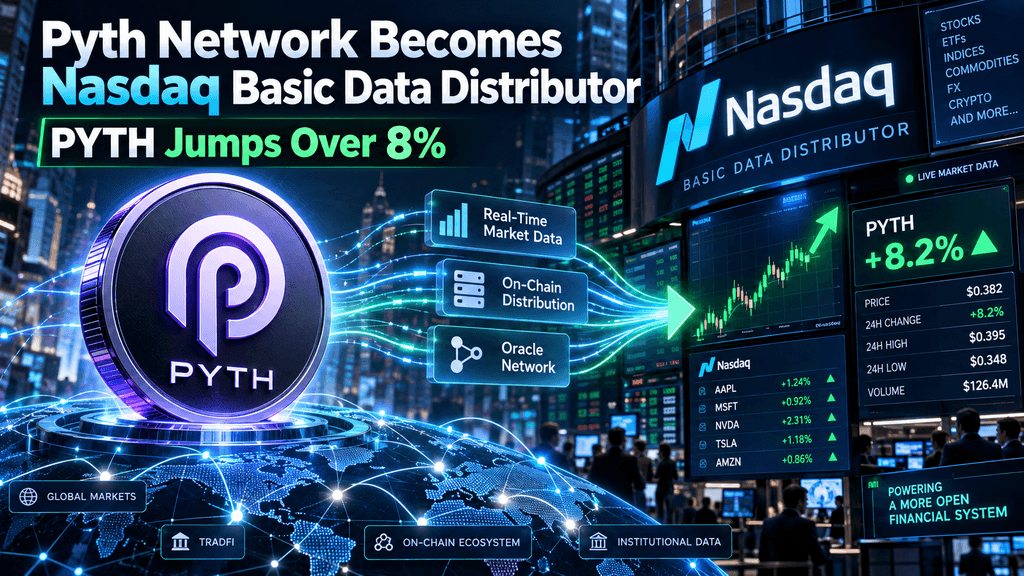
Pyth Expands Nasdaq Market Data Access Through Its Blockchain-Native Marketplace
Pyth Network announced on September 22, 2026, that it has been approved as an external distributor of Nasdaq Basic, Nasdaq’s proprietary real-time quote and trade product covering U.S. equities. The feed will reach software and blockchain-native applications through the Pyth Data Marketplace, extending a product long used by brokerages, banks, and fintech platforms. Clients must still secure prior written approval from Nasdaq before consuming the data. The announcement triggered an immediate market response, with the PYTH token rising more than 8 percent as traders digested the institutional validation.
The latest development follows a June 2026 agreement that saw Nasdaq make its TotalView depth-of-book data available through the same marketplace. Taken together, the two arrangements show a growing shift among traditional exchanges toward programmable, software-native channels for distributing proprietary market data, alongside established terminals and vendor networks. For Pyth, the strategy positions its Data Marketplace as a controlled but accessible distribution layer that connects institutional data with blockchain-based applications. The expanding relationship with Nasdaq also gives greater practical relevance to Pyth’s role as a bridge between traditional financial infrastructure and on-chain markets.
Nasdaq Basic Coverage Now Extends Directly Into Blockchain-Native Applications
Nasdaq Basic delivers real-time top-of-book information for every U.S. exchange-listed security. It includes the best bid and offer with associated size drawn from liquidity in the Nasdaq market center, the last sale price and size from Nasdaq’s U.S. venues and the FINRA/Nasdaq Trade Reporting Facility, plus the Nasdaq Official Opening and Closing Prices generated by the Opening, Closing, and IPO/Halt Crosses. These reference prices are widely used across the industry for position valuation at the start and end of the trading day. For more than a decade, the product has served firms that require timely equity quotes and trades without the higher cost structure of full consolidated feeds.
Through the Pyth Data Marketplace, the same dataset becomes available via a single integration designed for software and blockchain-native destinations. Publishers retain full attribution and commercial control; any client wishing to consume Nasdaq Basic via Pyth must first obtain Nasdaq’s written approval. This structure preserves the exchange’s governance while opening a new class of consumers, decentralized applications, quantitative systems, and hybrid platforms that previously faced friction accessing institutional-grade U.S. equity data. The practical effect is a reduction in integration overhead and a clearer path for real-time equity information to power on-chain analytics, risk models, and execution logic.
PYTH Token Registers Immediate Double-Digit Intraday Momentum After the Announcement
Market data from multiple venues shows the PYTH token climbed more than 8 percent in the hours following the September 22 disclosure, with some short-term prints exceeding 10 percent. Opening levels near $0.063 rose to session highs above $0.072 before settling in the $0.067 range by the close of the day, according to aggregated exchange figures. Trading volume expanded sharply, showing both retail momentum and institutional interest in the oracle’s expanding data franchise. The price action occurred against a backdrop of already elevated attention to Pyth’s role as a bridge between traditional market data and on-chain environments.
Earlier in 2026, the network had transitioned portions of its offerings to paid subscription models, directing revenue toward token buybacks and thereby creating a more direct link between usage growth and token economics. The Nasdaq Basic approval arrives as that model continues to mature, giving market participants a concrete signal that high-quality traditional equity data is flowing into the same infrastructure that already secures substantial decentralized finance volume. Price discovery on the day illustrated how quickly traders incorporate institutional distribution deals into valuations of specialized oracle tokens. Historical price series confirm the move represented one of the stronger single-session gains for PYTH in recent months.
Pyth Data Marketplace Functions as a Controlled Single-Integration Channel for Institutional Datasets
The Pyth Data Marketplace, launched in April 2026, operates as a direct distribution layer between first-party data providers and software-native destinations. Publishers onboard their proprietary feeds once; the marketplace then makes those feeds available under terms set by the publisher, with attribution and commercial rights retained throughout. Nasdaq Basic joins a roster that already includes datasets from Tradeweb, SGX FX, OTC Markets, Kalshi, Euronext, and the U.S. Department of Commerce. The architecture sits alongside Pyth Pro, the network’s institutional subscription product, and Pyth Indices, its proprietary 24/7 index series.
For Nasdaq, the arrangement adds a modern channel without altering the underlying product or the approval process required of end users. Software teams and blockchain developers gain access through a consistent API rather than negotiating separate legacy connections for each data source. This model reduces operational complexity while preserving the commercial integrity that traditional exchanges demand. Core contributor Michael Cahill noted that an increasing share of market activity now runs on software, requiring data to reach a wider and more varied set of applications; he described the addition of the marketplace as a natural extension of Nasdaq’s long-standing goal of placing its data in more hands.
Earlier TotalView Partnership Established the Precedent for On-Chain Equity Depth Data
In June 2026, Nasdaq selected Pyth to distribute TotalView, its full depth-of-book market data product, through the same Data Marketplace. TotalView displays buy and sell interest at every price level for securities trading on Nasdaq, NYSE, and regional exchanges, together with the Net Order Imbalance Indicator that provides real-time visibility into auction imbalances. That earlier agreement marked the first time a major U.S. exchange chose a blockchain-based network for proprietary depth-of-book distribution. The September Basic approval extends the relationship from depth data to the more widely consumed top-of-book product used by a broader set of platforms.
Together, the two feeds give developers and institutions complementary views: TotalView for detailed liquidity analysis and quantitative modeling, and Basic for efficient real-time quoting and last-sale tracking. Both arrangements emphasize programmable interfaces over traditional terminal delivery. Industry coverage at the time framed the TotalView move as part of a larger Wall Street effort to make market infrastructure compatible with tokenized assets and on-chain services. The sequential deals demonstrate a deliberate expansion of Nasdaq’s distribution strategy rather than an isolated experiment.
Software-Native Destinations Create New Demand for Traditional Equity Market Data
Financial applications increasingly operate as software systems that consume data programmatically rather than through human-facing terminals. Brokerages, fintech platforms, and consumer investing apps already rely on Nasdaq Basic for cost-effective real-time coverage. Blockchain-native environments add further demand: automated trading strategies, risk engines, prediction markets, and hybrid products that combine on-chain settlement with traditional asset reference prices all require reliable equity data.
The Pyth Data Marketplace meets this demand with a single integration point while leaving commercial control and approval processes with the original publisher. Developers no longer need to maintain multiple legacy connections or navigate separate vendor negotiations for each dataset. The result is lower friction for building applications that reference live U.S. equity prices and trades. As more of the market migrates onto software rails, the infrastructure that delivers institutional data becomes as critical as the matching engines that execute trades. Nasdaq’s decision to route Basic through Pyth reflects recognition of that shift and a willingness to meet demand where it is emerging.
Token Economics Benefit From Expanding Institutional Data Partnerships
Pyth’s revenue model has evolved to create clearer alignment between network usage and token value. After transitioning core services to paid plans in mid-2026, application revenue began flowing into a reserve that executes open-market purchases of PYTH. Earlier figures indicated millions of tokens had already been acquired through this mechanism. Each new high-quality dataset, such as Nasdaq Basic, expands the addressable set of paying users, institutions, developers, and platforms that require first-party equity data.
Greater usage volume supports higher subscription revenue, which in turn supports additional buybacks. Market participants observed the September price reaction as evidence that traders are assigning value to this flywheel. The token’s circulating supply stands near 7.87 billion against a maximum of 10 billion, with market capitalization moving above $500 million in the days surrounding the announcement. While short-term price moves remain subject to broader crypto market conditions, the underlying driver is the progressive accumulation of institutional data relationships that increase the network’s utility and fee potential.
Real-Time Top-of-Book Data Supports On-Chain Risk and Execution Systems
Access to best bid, offer, size, and last sale information enables more precise on-chain risk management and execution logic. Smart contracts and automated strategies can now reference the same top-of-book signals that traditional desks use, reducing information asymmetry between centralized and decentralized environments. For example, lending protocols or perpetual futures markets that incorporate U.S. equity references gain improved mark-to-market accuracy. Quantitative models that previously relied on delayed or aggregated feeds can operate closer to the source.
The requirement for Nasdaq’s prior written approval ensures that only authorized parties consume the feed, maintaining the integrity standards expected of institutional data. This controlled expansion allows innovation without compromising the commercial and regulatory frameworks that govern equity market data. Practical implementations will likely appear first in hybrid platforms that already bridge traditional and on-chain rails, then broaden as more developers adopt the marketplace integration.
Exchanges Explore New Programmable Infrastructure for Data Distribution
Nasdaq is not alone in exploring blockchain-native channels for market data. The presence of Tradeweb, SGX, Euronext, and other institutional publishers on the Pyth Data Marketplace indicates a wider recognition that software and decentralized applications represent a growing consumption surface. Traditional distribution networks optimized for terminals and dedicated circuits face limitations when the primary consumer is code. Programmable interfaces, consistent APIs, and retained commercial control address those limitations.
Coverage of the June TotalView announcement by major outlets showed the strategic intent: extending reach into environments where tokenized assets and on-chain finance are developing. The September Basic approval continues that trajectory with a higher-volume, more widely used product. As tokenized equity experiments and 24/7 trading concepts advance, the availability of authoritative real-time reference data becomes a foundational requirement. Pyth’s role as intermediary infrastructure positions it to capture a share of that expanding demand.
Client Approval Process Maintains Nasdaq Commercial and Attribution Control
Any party seeking to consume Nasdaq Basic through the Pyth Data Marketplace must first secure written approval directly from Nasdaq. Licensing occurs between the client and Nasdaq; Pyth supplies the technical distribution layer. This arrangement ensures that attribution remains with the exchange and that commercial terms are set by the data owner rather than an intermediary. The model differs from aggregated free feeds that can dilute source integrity. Publishers retain the ability to set pricing, usage restrictions, and compliance requirements.
For end users, the process adds a deliberate step but assures that the data arrives with full provenance. Software teams benefit from a standardized technical interface once approval is granted, avoiding the need to build and maintain separate connections for each traditional data vendor. The design balances openness of distribution with the control that major exchanges require when placing proprietary products into new channels.
Market Reaction Extends Beyond Short-Term Token Price Movement
While the immediate price reaction focused attention on PYTH, the longer-term significance lies in the normalization of institutional equity data within on-chain environments. Developers building applications that reference U.S. stocks now have a clearer path to authoritative top-of-book information. Risk systems, analytical tools, and hybrid trading platforms gain higher-fidelity inputs. Exchanges gain additional distribution reach without surrendering governance.
The combination supports the gradual convergence of traditional market infrastructure and blockchain-native finance. Volume metrics, subscription adoption rates, and the number of approved clients will serve as measurable indicators of success in the coming quarters. Earlier TotalView adoption already demonstrated demand for depth data; Basic is expected to attract a larger set of users given its broader historical footprint across brokerages and fintech platforms.
Oracle Networks Steps Up Competition for Access to Institutional Market Data
Specialized oracle networks compete on latency, coverage, security, and increasingly on the quality and exclusivity of institutional datasets they can deliver. Securing distribution rights for a product such as Nasdaq Basic strengthens Pyth’s position relative to competitors that rely primarily on aggregated or secondary sources. First-party data carries higher trust and commercial value for professional users. The marketplace model further differentiates the network by allowing multiple publishers to distribute under their own terms rather than forcing all data into a single aggregated feed.
As more traditional venues evaluate on-chain distribution, the ability to demonstrate successful, controlled integrations becomes a competitive advantage. Market observers will watch whether additional equity or fixed-income products follow the TotalView and Basic path. Success will depend on continued technical reliability, clear commercial frameworks, and measurable adoption by software and blockchain applications.
Practical Use Cases Span Quantitative Models, Hybrid Platforms, and Risk Engines
Quantitative trading systems can incorporate live best-bid-offer and last-sale data into execution algorithms that operate across both centralized and decentralized venues. Hybrid platforms that offer tokenized equity exposure benefit from official reference prices for valuation and settlement. Risk engines monitoring portfolios containing both crypto and traditional assets gain improved real-time equity inputs. Consumer-facing applications that previously relied on delayed quotes can upgrade to institutional-grade streams once approvals are in place.
Each use case reduces the information gap that has historically separated on-chain and traditional markets. Implementation requires technical integration with the marketplace API plus the necessary Nasdaq approval, creating a deliberate onboarding path that prioritizes compliance. Early adopters are likely to be firms already active in both domains, followed by pure software and decentralized teams as documentation and tooling mature. The availability of both depth and top-of-book feeds expands the range of strategies that can be supported.
Strategic Positioning Aligns With the Shift Toward Software-Driven Finance
Michael Cahill’s observation that an increasing share of market activity runs on software captures the core strategic rationale. Data infrastructure must evolve to serve programmable destinations as effectively as it once served human terminals. By offering Nasdaq a controlled, single-integration channel, Pyth addresses that requirement directly. The successive TotalView and Basic agreements illustrate a deliberate partnership rather than opportunistic announcements.
For the broader market, the developments signal that major exchanges view blockchain distribution networks as viable extensions of their existing data businesses. Continued expansion of the publisher roster and measurable growth in consuming applications will determine the ultimate scale of the opportunity. Price action around the September announcement already showed that market participants are monitoring these developments closely and assigning value to incremental institutional validation.
🔥 Beyond the Headlines: What KuCoin 5.0 Means for You
Market news moves fast — but where you act on it matters just as much. This October, KuCoin launches KuCoin 5.0, transforming KuCoin into a rebuilt platform. Here's what actually changes for you:
-
One account for everything. Older platforms split your money across separate "spot," "margin," and "futures" accounts and expected you to understand why. KuCoin 5.0's unified account removes that entirely — deposit once, and everything is simply there (only available to VIPs for now).
-
Stocks, indices, and commodities. KuCoin 5.0 expands beyond crypto into global markets. When crypto chops sideways and equities rally (or the reverse), you rotate in minutes instead of opening a brokerage account and waiting days for fiat rails.
-
Real-world assets (RWA). Tokenized exposure to traditional assets like commodities, right inside your crypto account. One of the fastest-growing segments in global finance is no longer reserved for institutions — you access it from the same balance you trade with.
-
Earn while you learn. Not ready to trade? KCUSD lets your stablecoins earn daily, auto-compounding interest. The lowest-stress way to put your idle deposit to work for 4% yield.
-
An AI assistant in plain language. Ask questions, get market context, understand what you're looking at — built into the platform, no jargon required.
-
An app that doesn't overwhelm. Faster, cleaner, and consistent — intuitive from the first tap, not after a tutorial.
-
Safety you can check, not just trust. A MiCAR-licensed EU entity, Proof of Reserves you can verify yourself, and internationally certified security (SOC 2 Type II, ISO 27001:2022).
Create your account in minutes — and start on the platform built for where crypto is going, not where it's been.
FAQs
What exactly does Nasdaq Basic include and how does it differ from full consolidated feeds?
Nasdaq Basic provides real-time top-of-book data, the best bid and offer with size from the Nasdaq market center, the last sale price and size from Nasdaq venues and the FINRA/Nasdaq Trade Reporting Facility, plus official opening and closing prices. It is designed as a cost-effective alternative to fully consolidated tape products, delivering the most frequently needed quote and trade information without the broader depth or higher fees associated with complete feeds.
How does the approval process work for clients wanting to use Nasdaq Basic through Pyth?
Clients license the data directly with Nasdaq and must obtain prior written approval from Nasdaq before consuming the feed via the Pyth Data Marketplace. Pyth supplies the technical distribution infrastructure but does not set commercial terms or grant access independently. This structure keeps attribution and control with the exchange while enabling software-native delivery.
Did the PYTH token reaction reflect lasting fundamental change or short-term speculation?
The price rose more than 8 percent on the announcement day with elevated volume, consistent with markets assigning value to new institutional data partnerships. Longer-term impact will depend on actual adoption of the feed by paying clients and any subsequent contribution to network revenue and buyback activity. Short-term moves remain subject to overall market conditions.
What earlier partnership existed between Nasdaq and Pyth?
In June 2026, Nasdaq began distributing TotalView, its full depth-of-book product including order imbalance indicators, through the Pyth Data Marketplace. The Basic approval in September extends the relationship to the higher-volume top-of-book product used across a wider set of platforms.
Which other institutions already publish data through the Pyth Data Marketplace?
The marketplace includes datasets from Tradeweb, SGX FX, OTC Markets, Kalshi, Euronext, the U.S. Department of Commerce, and additional institutional providers onboarded since its April 2026 launch. Nasdaq Basic and TotalView expand the equity coverage within that roster.
How does the Data Marketplace preserve publisher control while expanding reach?
Publishers onboard once and set their own terms; data retains source attribution and commercial rights end-to-end. Clients still negotiate licenses and approvals directly with the original provider. The marketplace functions as technical infrastructure rather than a reseller that alters commercial relationships.
Disclaimer: This content is for informational purposes only and does not constitute investment advice. Stock investments carry risk. Please do your own research (DYOR).