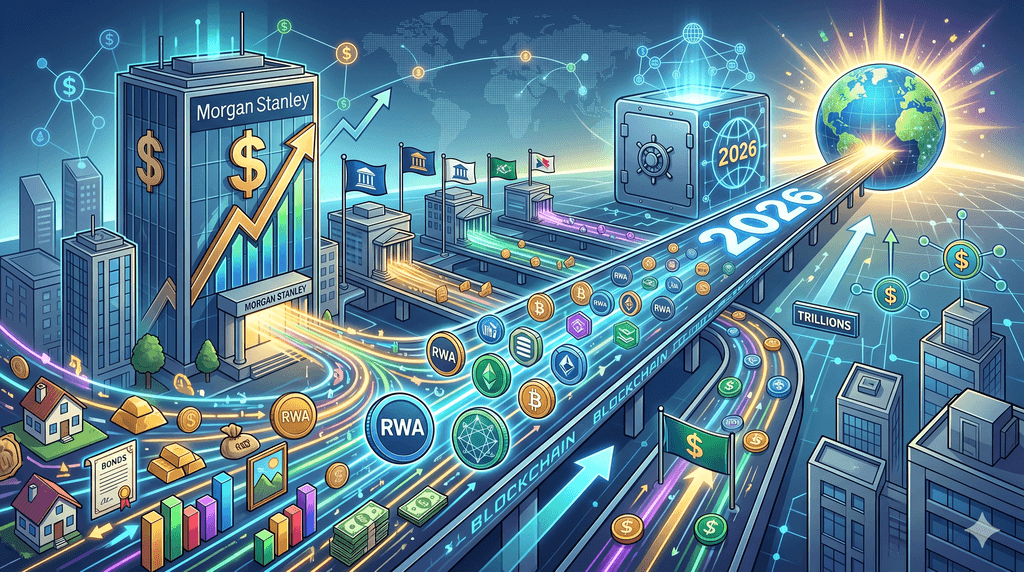
Morgan Stanley Bets Big on RWA Tokenization: Institutions Race to Bring Trillions On-Chain in 2026
Morgan Stanley Bets Big on RWA Tokenization: Institutions Race to Bring Trillions On-Chain in 2026
Thesis Statement
Morgan Stanley just signaled a major shift in how Wall Street handles money. The banking giant listed tokenization of real-world assets as a top global business focus in mid-April 2026, calling it the next major step for upgrading financial infrastructure. This move comes as the on-chain RWA market surges past $27-30 billion in total value, with tokenized U.S. Treasuries alone hitting around $12-13 billion. Institutions see blockchain as the tool to fix slow settlement times, unlock liquidity in private markets, and open access to assets once reserved for the ultra-wealthy. The story goes far beyond hype, driven by real capital flows, operational needs, and early wins in yield-bearing products that blend traditional finance with on-chain efficiency.
How Morgan Stanley's RWA Push Signals Wall Street's On-Chain Turning Point
Morgan Stanley's announcement on April 16, 2026, marks a clear commitment. The firm plans to launch an institutional digital wallet in the second half of the year to hold tokenized traditional investments alongside exposure to assets like Bitcoin, Ethereum, and Solana. Leadership highlighted tokenization as essential for modernizing wealth management and trading infrastructure. This builds on earlier steps, including support for tokenized stocks and ETFs on its internal alternative trading system starting in late 2026. Amy Oldenburg, head of digital asset strategy, described the effort as a managed journey focused on real infrastructure upgrades rather than chasing trends.
The bank aims to enable near real-time on-chain settlement for certain products, integrating traditional assets with digital rails in a secure way. Such moves position Morgan Stanley to capture efficiency gains in a market where private equity and real estate often sit locked up for years with limited trading options. Early internal pilots and partnerships show the firm building expertise to handle hybrid models that combine public-blockchain liquidity with private-ledger controls for compliance. Clients with billions in assets under management now have pathways to fractional ownership and faster access, changing how portfolios are built and rebalanced.
Morgan Stanley's Plans for Tokenized Stocks and ETFs by Late 2026
Executives outlined concrete timelines during recent briefings. Morgan Stanley intends to let institutional clients trade tokenized versions of select U.S. blue-chip stocks and ETFs directly on its alternative trading system alongside conventional shares. This setup targets improved settlement speeds and 24/7 availability in phases. The initiative ties into broader industry tests at venues like DTCC and Nasdaq for on-chain equity handling. By running tokenized and traditional versions in parallel, the bank minimizes disruption while testing real-world performance. Sources close to the planning note initial focus on high-liquidity names to build volume and confidence.
Tokenized equities currently represent a smaller slice of the RWA market at roughly $1 billion in on-chain value, but monthly trading activity has grown steadily. Morgan Stanley's entry could accelerate this by bringing its vast client network into play. Wealth advisors and family offices stand to benefit from easier allocation to digitized public markets without leaving familiar platforms. The approach reflects years of quiet preparation, including digital asset pilots through E*TRADE partnerships. Leadership stresses that these developments fit a stepped roadmap to enhance client services across wealth and institutional channels.
The Explosive Growth Numbers Behind the 2026 RWA Boom
Data from tracking platforms paints a striking picture of momentum. The tokenized RWA market, excluding stablecoins, expanded roughly 30 percent in the first quarter of 2026 alone, pushing total on-chain value to around $27-29 billion. Some estimates place the figure near $30 billion by mid-April. Tokenized U.S. Treasuries lead with $12-13 billion in value, up significantly from prior periods as yield-seeking capital flows in. Private credit follows closely, often exceeding $5-19 billion depending on the inclusion of represented assets, while tokenized gold and commodities add several billion more. Overall growth since early 2025 shows multiples in the 4x range for key segments. Over 700,000 unique holders now interact with these assets, up sharply as products mature.
Institutional products from names like BlackRock, Ondo Finance, Franklin Templeton, and Circle dominate inflows, with flagship funds such as BUIDL and USYC each crossing the $2 billion mark at various points. This scale demonstrates that RWAs have moved past experiments into production environments where real money moves daily. Yield remains a core driver, with on-chain Treasuries offering accessible returns in a still-elevated rate environment. The numbers reflect not just retail interest but also large batch transfers typical of institutional activity.
Why Tokenized Treasuries Became the Gateway Drug for Institutions
Tokenized U.S. government debt products exploded in popularity because they deliver familiar safety with blockchain perks. Funds like BlackRock's BUIDL, which reached over $2 billion in assets under management and spread across multiple networks, allow daily or near-instant redemption while accruing yield. Similar offerings from Ondo, Franklin Templeton, and Circle attracted billions by letting investors hold exposure in wallets compatible with DeFi protocols. As of early 2026, this category alone accounts for a massive share of on-chain RWA value, with growth rates exceeding 100 percent year-over-year in some measurements. Institutions appreciate the ability to use these tokens as collateral or for liquidity management without traditional banking hours constraints.
One large asset manager executive noted in recent discussions that tokenized Treasuries serve as a low-risk entry point to test on-chain operations at scale. Retail users also pile in for fractional access and composability. The result is a flywheel where higher liquidity draws more participants, further tightening spreads and improving efficiency. Morgan Stanley's interest in tokenized money market funds fits this pattern, positioning the bank to offer clients seamless yield options within its ecosystem. Early data shows these products handling meaningful volumes with transparent on-chain records that traditional equivalents often lack.
Private Credit on Blockchain Delivers Higher-Yielding Institutions Crave
Beyond government securities, tokenized private credit emerged as a high-yield powerhouse within RWAs. Platforms originating or representing loans in real estate, infrastructure, and corporate debt brought on-chain values into the billions. Yields in the 8-15 percent range appeal to allocators hunting returns above Treasuries while gaining liquidity advantages over traditional lock-up periods. Centrifuge and similar protocols demonstrated how blockchain can handle origination and distribution at scale, with some home equity lines reaching tens of billions cumulatively. Institutional players now explore these for portfolio diversification, using tokens to slice risk and enable secondary trading that rarely existed before.
A typical example involves credit notes backed by verified off-chain assets but settled instantly on-chain. This setup reduces counterparty friction and provides real-time visibility into performance. Morgan Stanley's broader RWA focus likely includes private markets, given the bank's strength in alternatives and real assets. Clients report interest in blending such products with core holdings for better risk-adjusted returns. The human element shines through in stories of smaller funds gaining access to institutional-grade credit pools previously closed off, creating new capital formation channels. Growth here underscores how tokenization unlocks trapped value in illiquid markets worth trillions globally.
How Fractional Ownership Changes Real Estate and Private Equity Access
Tokenization lowers barriers dramatically for assets like commercial real estate and private equity stakes. Instead of million-dollar minimums and long hold periods, investors buy fractions represented by tokens that trade more freely. Early platforms tokenized individual properties or fund interests, allowing global participation with lower entry points. Morgan Stanley's wallet plans explicitly target tokenized private equity in secondary markets, aiming to improve liquidity for holdings that traditionally sit dormant. One insider described how a single tokenized building share can now change hands in minutes rather than months of paperwork.
This fluidity attracts wealth advisors seeking to offer clients diversified exposure without tying up capital indefinitely. Real stories include family offices reallocating portions of illiquid portfolios into on-chain versions for tactical adjustments. Broader market data shows tokenized real estate and alternatives growing steadily within the overall RWA mix. The efficiency gains compound when combined with automated compliance checks and transparent ownership records. Institutions view this as a way to democratize access while maintaining control through hybrid custody models. As volumes build, secondary markets deepen, creating virtuous cycles of participation and price discovery.
The Role of Digital Wallets in Making RWAs Usable for Big Money
Morgan Stanley's upcoming institutional digital wallet represents a practical bridge. Scheduled for the second half of 2026, it will support tokenized traditional products and crypto assets in one place, simplifying operations for clients. This tool addresses a key pain point: managing hybrid portfolios across legacy systems and blockchain rails. Early descriptions suggest features for seamless transfers, yield accrual tracking, and integration with existing advisory platforms. Similar efforts at other banks highlight the push toward unified custody that reduces operational overhead. For portfolio managers, a single wallet means faster rebalancing and fewer reconciliation headaches.
Human impact appears in teams that once spent hours on manual settlements, now focusing on strategy. The wallet also opens doors to composability, where tokenized holdings interact with on-chain protocols under controlled conditions. Morgan Stanley's scale, with trillions in client assets, could accelerate adoption if the rollout proves smooth. Observers note that successful execution here sets a template for wealth management at large, turning abstract tokenization talks into daily tools. Security and user experience will determine uptake, but the strategic intent is clear: make on-chain assets feel as natural as traditional holdings.
Near Real-Time Settlement: The Efficiency Edge Institutions Seek
Blockchain promises to slash settlement times from days to seconds or minutes. Morgan Stanley and peers highlight near-real-time on-chain processes as a core benefit for integrating traditional and digital assets. In current markets, equity or bond trades can take T+1 or longer to clear, tying up capital and adding risk. Tokenized versions enable atomic settlement where payment and delivery happen simultaneously. This reduces counterparty exposure and frees liquidity for reinvestment. Industry pilots show cost savings in clearing and custody that add up quickly at scale. One wealth manager shared how faster cycles allow more agile responses to market moves, benefiting end clients through better execution.
For private markets, the change could transform secondary trading volumes. Morgan Stanley's hybrid strategy, using public chains for liquidity and controlled ledgers for sensitive data, aims to balance speed with institutional requirements. Real-world tests already demonstrate lower friction in fund subscriptions and redemptions. As more assets move on-chain, network effects strengthen, with interconnected protocols handling complex workflows end-to-end. The shift represents infrastructure modernization on par with past leaps in electronic trading.
BlackRock, JPMorgan, and Others Fuel the Institutional RWA Wave
Morgan Stanley joins a growing list of heavyweights. BlackRock's BUIDL fund expanded across networks and amassed billions, proving tokenized liquidity funds work at scale. JPMorgan advanced its own on-chain initiatives, including private equity tokenization and settlement systems. Franklin Templeton, Ondo Finance, and Goldman Sachs rolled out or expanded products that attracted steady inflows. These efforts create shared infrastructure and standards that lower barriers for everyone. Collective activity signals confidence that tokenization addresses real pain points in fixed income, credit, and alternatives markets worth tens of trillions.
A portfolio manager at a large allocator described evaluating multiple providers for yield and custody options, noting improved transparency as a decisive factor. Competition drives innovation, with issuers competing on redemption speed, yield distribution, and multi-chain availability. Morgan Stanley's wallet and ATS plans add another layer of distribution muscle. The convergence brings traditional risk management practices to blockchain environments, building trust. Early data show institutional flows dominating growth rather than pure retail speculation. This foundation supports projections of much larger market sizes in the coming years.
What Tokenization Means for Liquidity in Once-Illiquid Markets
Illiquid assets like private credit or real estate traditionally suffer from limited buyers and slow exits. Tokenization creates digital representations that trade on secondary markets with greater frequency. Even modest increases in turnover improve price discovery and reduce discounts for early sellers. Platforms report rising activity in tokenized fund interests and property shares. For institutions, this means better capital efficiency across portfolios. Narratives explained reallocating from locked positions into on-chain versions to maintain dry powder for opportunities. Broader effects ripple through markets as liquidity pools deepen.
Morgan Stanley's focus on private equity tokenization targets exactly this gap in secondary markets. Combined with real-time settlement, the setup supports more dynamic strategies. Data indicate holder counts are climbing steadily, signaling broader participation. While early stages show concentrated activity in top products, diversification across asset classes builds resilience. The liquidity premium shrinks as blockchain rails connect buyers and sellers globally around the clock. This evolution benefits originators too, by expanding funding sources beyond traditional lenders.
Composability and Yield Opportunities in the Emerging RWA Ecosystem
On-chain RWAs gain power through composability, where tokens interact with protocols for lending, trading, or structured products. Tokenized Treasuries serve as collateral in DeFi-like setups while still accruing underlying yields. This dual utility attracts sophisticated users seeking optimized returns. Private credit tokens enable tranching and risk slicing in transparent ways. Morgan Stanley's infrastructure push could extend such features to its clients under supervised conditions. Early examples include funds using tokenized holdings for margin or liquidity management without selling core positions.
Yield narratives dominate conversations, with on-chain products offering accessible entry to rates that once required large commitments. As ecosystems mature, automated strategies emerge that blend RWAs with other digital assets. The result is a more interconnected financial layer where capital flows efficiently. Institutions monitor these developments closely for integration potential. Real innovation lies in combining traditional asset backing with programmable features that enhance usability without added complexity for end users. Growth in this area points to deeper embedding of blockchain in daily finance.
Why 2026 Feels Like the Inflection Year for On-Chain Assets
Multiple forces converged in 2026 to accelerate RWA adoption. Institutional pilots scaled into live products with billions in value. Infrastructure like wallets, ATS platforms, and settlement layers reached readiness. Market data shows consistent quarterly growth and expanding holder bases. Morgan Stanley's explicit prioritization adds credibility and distribution reach. Industry leaders across banks and asset managers now treat tokenization as a core strategy rather than a side project. Projections vary, but the direction points to continued expansion as efficiencies compound and new asset classes join.
Challenges around interoperability and education remain, yet progress feels tangible through daily usage metrics. Clients and advisors increasingly view on-chain options as practical tools for portfolio construction. The year stands out as the period when abstract ideas turned into operational reality for mainstream finance. Fresh insights emerge weekly as participants share performance data and integration lessons. Morgan Stanley's moves capture this spirit, positioning the firm and the sector for broader impact in wealth management and capital markets.
FAQs
How does Morgan Stanley plan to support RWAs through its new digital wallet?
The bank targets a launch in the second half of 2026 for an institutional wallet that holds tokenized traditional assets alongside select crypto exposures. This setup aims to simplify management for clients by providing one interface for hybrid portfolios, with features focused on secure transfers and integration into existing advisory workflows.
What makes tokenized U.S. Treasuries so popular among institutions right now?
These products combine low-risk government backing with on-chain benefits like faster redemptions and yield distribution directly in digital wallets. Major funds have attracted billions because they offer familiar safety plus liquidity and composability that traditional equivalents often lack, appealing to both yield seekers and those testing blockchain operations.
Why are banks like Morgan Stanley focusing on tokenized stocks and private equity?
Tokenization improves liquidity and settlement speeds for assets that traditionally trade infrequently. By enabling fractional ownership and secondary market activity on controlled platforms, banks can offer clients more flexible access to equities and alternatives while reducing operational frictions in trading and custody.
Can individual investors access institutional-grade RWAs through these developments?
Many tokenized products, especially Treasuries and funds, already reach retail users via compatible wallets and platforms. As banks expand offerings, advisors may incorporate them into client portfolios, though availability depends on account type and suitability checks.
What asset classes show the strongest growth in the RWA space during 2026?
Tokenized U.S. Treasuries lead with over $12 billion in on-chain value, followed by private credit and gold-backed products. Funds and money market equivalents also gained significantly as institutions deployed capital seeking yield and efficiency in familiar categories.
How might faster on-chain settlement change daily operations for wealth managers?
Shorter settlement times free up capital quicker, reduce risk during transfers, and enable more responsive portfolio adjustments. Teams spend less time on reconciliations and more on strategy, potentially improving client outcomes through better timing and lower costs over time.
Disclaimer: This content is for informational purposes only and does not constitute investment advice. Cryptocurrency investments carry risk. Please do your own research (DYOR).