

Cathie Wood Predicts $1.25 Million Bitcoin in 5 Years: Bull Case Breakdown
2026/05/27 18:09:02
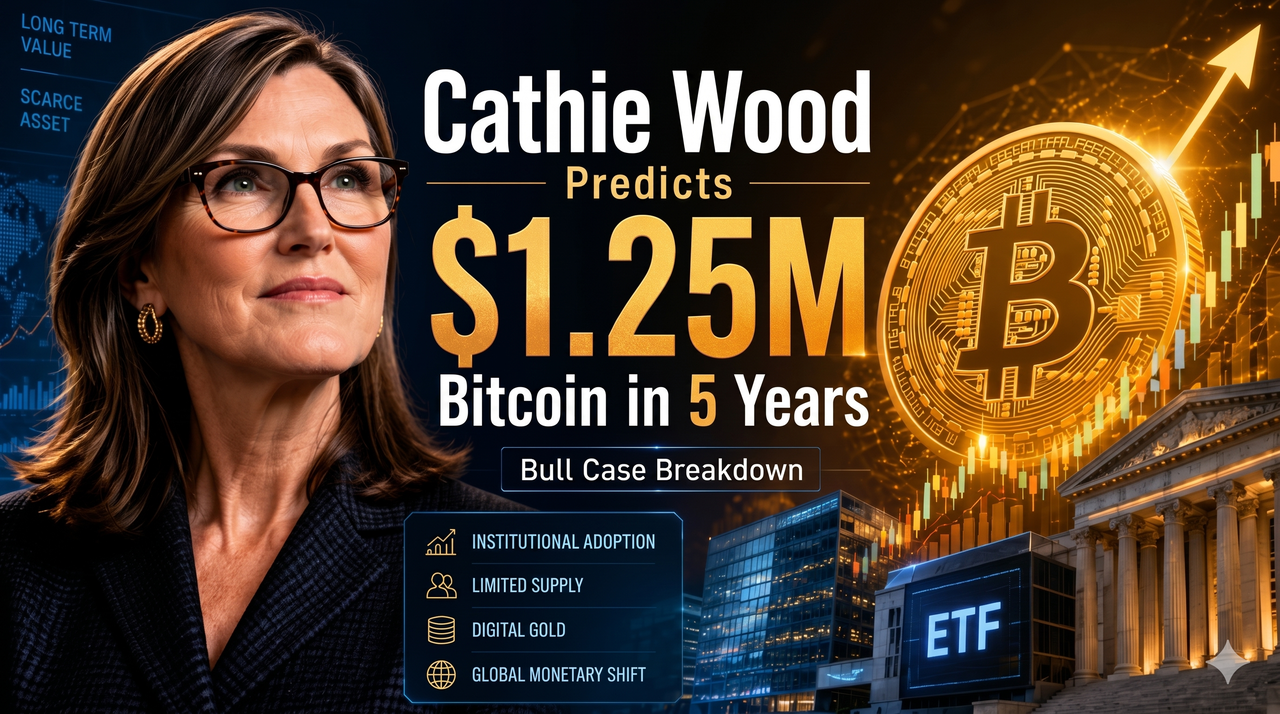
Cathie Wood says Bitcoin could reach $750,000 in her base case and $1.25 million in a bullish scenario within five years. Here is the full Bitcoin bull case, including ETFs, institutional adoption, digital gold demand, and key risks.
Cathie Wood, the founder and CEO of ARK Invest, has made another bold Bitcoin prediction. Wood reportedly believes Bitcoin could reach around $750,000 in a base-case scenario and as much as $1.25 million in a bullish scenario within the next five years. Recent reports say her forecast is based on institutional adoption, emerging-market demand, generational wealth transfer, and Bitcoin’s role as a digital store of value.
The prediction has attracted major attention across the crypto market because it suggests Bitcoin may still have significant upside despite already becoming a mainstream financial asset. Wood’s long-term thesis is not just about short-term price momentum. It is based on the idea that Bitcoin could become a major global asset class.
While the $1.25 million target is highly ambitious, it reflects ARK Invest’s belief that Bitcoin could benefit from limited supply, growing ETF access, rising institutional demand, and increasing interest in alternatives to traditional stores of value.
What Did Cathie Wood Predict About Bitcoin?
Cathie Wood’s latest Bitcoin forecast includes two important price targets. In her base case, Bitcoin could reach approximately $750,000. In a more optimistic bull case, Bitcoin could climb as high as $1.25 million within about five years.
This prediction is not based on short-term market hype alone. Instead, it is built around long-term adoption trends. Wood believes Bitcoin could benefit from growing institutional demand, stronger recognition as digital gold, emerging-market adoption, and a generational shift toward digital assets.
Wood’s forecast suggests that Bitcoin could move from being viewed mainly as a speculative crypto asset to being treated as a serious global macro asset.
Cathie Wood Bitcoin Prediction: Can BTC Reach $1.25 Million in 5 Years?
Cathie Wood’s Bitcoin prediction has become one of the most discussed forecasts in the crypto market. The ARK Invest CEO has long been one of the most bullish voices on Bitcoin, and her latest forecast continues that pattern.
ARK’s own 2030 Bitcoin model previously projected bear, base, and bull cases of roughly $300,000, $710,000, and $1.5 million per BTC. More recent reporting says Wood’s updated five-year outlook includes a $750,000 base case and a $1.25 million bull case.
-
Cathie Wood’s Bitcoin Price Target Explained
Cathie Wood’s Bitcoin forecast includes two key levels. The first is the base case, which places Bitcoin around $750,000. This scenario assumes steady adoption, continued institutional interest, and Bitcoin’s growing role as a long-term financial asset.
The second is the bull case, which places Bitcoin around $1.25 million. This is a more aggressive scenario that depends on stronger adoption, larger institutional allocations, continued ETF demand, and broader recognition of Bitcoin as digital gold.
The $1.25 million target suggests Bitcoin would need to become far more deeply integrated into global investment portfolios than it is today. It would require demand from institutions, retail investors, corporations, and global users to rise significantly.
-
Why the $1.25 Million Bitcoin Forecast Matters
The forecast matters because it shows how some major investors view Bitcoin’s long-term potential. Wood is not only predicting a higher BTC price. She is suggesting that Bitcoin could become one of the most important financial assets of the next decade.
If Bitcoin reaches $1.25 million, it would likely mean the market has accepted BTC as more than a speculative cryptocurrency. It would suggest Bitcoin has gained a stronger role as a store of value, portfolio hedge, and digital alternative to gold.
That is why the prediction has gained attention from both crypto investors and traditional market analysts. The number is not just a price target; it represents a broader thesis about Bitcoin’s place in the global financial system.
-
What Needs to Happen for Bitcoin to Reach $1.25 Million?
For Bitcoin to reach $1.25 million in five years, several major catalysts would need to align.
Institutional adoption would need to increase significantly. Large asset managers, hedge funds, pension funds, family offices, and corporations would need to allocate more capital to Bitcoin.
Bitcoin ETFs would also need to keep attracting strong inflows. ETFs make it easier for mainstream investors to gain exposure to Bitcoin without directly holding crypto.
In addition, Bitcoin would need to strengthen its reputation as digital gold. If more investors view BTC as a hedge against inflation, currency weakness, and financial instability, demand could rise sharply.
-
Is Cathie Wood’s Bitcoin Prediction Realistic?
Cathie Wood’s Bitcoin prediction is possible, but it is not guaranteed. The $1.25 million target is a bull-case scenario, which means it depends on highly favorable conditions.
Bitcoin has already proven that it can attract global attention and institutional demand. However, reaching $1.25 million would require much deeper adoption than what exists today.
Regulation, volatility, macroeconomic conditions, and competition from other digital assets could all slow Bitcoin’s growth. For that reason, investors should view the forecast as an optimistic long-term scenario rather than a certain outcome.
Bitcoin Bull Case Explained: ETFs, Institutional Adoption, and Digital Gold Demand
The Bitcoin bull case is built on the idea that BTC is becoming more than a speculative crypto asset. Supporters believe Bitcoin could grow into a major global store of value, supported by rising ETF demand, institutional adoption, and its reputation as digital gold.
For Cathie Wood’s $1.25 million Bitcoin prediction to become realistic, these drivers would need to play a major role in pushing long-term demand higher.
-
Bitcoin ETFs Are Making BTC Easier to Access
One of the biggest drivers behind the Bitcoin bull case is the rise of spot Bitcoin ETFs. These funds allow investors to gain exposure to Bitcoin through traditional brokerage accounts without directly buying or storing BTC.
This is important because many mainstream investors are still uncomfortable using crypto exchanges or managing private wallets. ETFs reduce that barrier and make Bitcoin more accessible to retail investors, financial advisors, and institutions.
Spot Bitcoin ETFs have also helped Bitcoin become more familiar to traditional financial markets. If ETF demand continues over several years, it could create a steady source of buying pressure and strengthen Bitcoin’s position as an investable asset.
-
Institutional Adoption Could Drive Long-Term Demand
Institutional adoption is another key reason Cathie Wood and other Bitcoin bulls remain optimistic. Large investors such as asset managers, hedge funds, pension funds, and family offices control trillions of dollars in capital.
Even a small allocation from these institutions could have a major impact on Bitcoin demand. For example, if more institutions decide to allocate a small percentage of their portfolios to BTC, the buying pressure could be significant.
This is why institutional adoption is central to the Bitcoin bull case. It suggests Bitcoin is no longer only a retail-driven asset but is becoming part of serious long-term investment strategies.
-
Bitcoin’s Fixed Supply Supports the Bull Case
Bitcoin’s supply is limited to 21 million coins, which makes it different from fiat currencies that can be expanded by central banks. This fixed supply is one of the strongest arguments behind long-term Bitcoin price predictions.
If demand increases while supply remains limited, Bitcoin’s price could rise over time. This supply-demand imbalance is especially important after Bitcoin halving events, which reduce the amount of new BTC entering circulation.
For investors who believe in scarcity as a source of value, Bitcoin’s fixed supply is a major reason the asset could continue gaining strength.
-
Digital Gold Demand Could Boost Bitcoin’s Value
Bitcoin is often called digital gold because many investors see it as a modern store of value. Like gold, Bitcoin is scarce and not directly controlled by any central bank or government.
However, Bitcoin also has features that gold does not. It can be transferred globally within minutes, stored digitally, and divided into very small units. These qualities make it attractive to investors who want a portable and borderless asset.
If Bitcoin captures even a small portion of gold’s market share, its price could rise significantly. This is a major part of Cathie Wood’s bullish Bitcoin outlook.
-
Emerging-Market Demand Could Add Another Catalyst
Another part of the bull case is Bitcoin’s potential use in emerging markets. In countries facing inflation, weak currencies, capital controls, or limited access to reliable banking services, Bitcoin can be viewed as an alternative financial tool.
Although Bitcoin is volatile, some users may still prefer it to currencies that are losing purchasing power quickly. Bitcoin can also be transferred globally without relying on traditional banking systems.
Recent reporting says Wood has cited emerging-market adoption as one of the drivers behind her forecast. If demand grows in these markets, it could support Bitcoin’s long-term value proposition.
-
Generational Wealth Transfer Could Support Bitcoin Adoption
Generational wealth transfer is another long-term factor in the Bitcoin bull case. Younger investors are generally more familiar with digital assets than older generations.
As wealth gradually shifts to younger investors, Bitcoin could benefit from changing investment preferences. Millennials and Gen Z investors are more likely to understand crypto platforms, digital wallets, and blockchain-based assets.
If younger investors allocate more capital to Bitcoin over time, it could create another source of long-term demand.
-
Why These Catalysts Matter for the $1.25 Million Forecast
Cathie Wood’s $1.25 million Bitcoin forecast depends on multiple catalysts working together. ETFs could bring easier access, institutions could bring large-scale capital, and digital gold demand could strengthen Bitcoin’s long-term investment case.
Individually, each factor is important. Together, they create the foundation for the Bitcoin bull case.
The forecast remains ambitious, but the argument is clear: if Bitcoin becomes a widely accepted store of value and institutional portfolio asset, its market value could rise dramatically over the next five years.
Bitcoin Price Forecast Risks: What Could Stop BTC From Hitting $1.25 Million?
Although Cathie Wood’s $1.25 million Bitcoin prediction presents a strong bull case, several risks could prevent BTC from reaching that level within five years. Bitcoin has major long-term potential, but its path depends on regulation, investor demand, macroeconomic conditions, and market confidence.
The $1.25 million target should be viewed as a bullish scenario, not a guaranteed outcome. For Bitcoin to reach that price, multiple positive catalysts would need to continue while major risks remain under control.
-
Regulatory Pressure Could Slow Bitcoin Adoption
Regulation is one of the biggest risks to Bitcoin’s long-term price forecast. Governments around the world are still developing rules for crypto exchanges, ETFs, taxation, custody, and investor protection.
If regulators introduce strict policies, Bitcoin adoption could slow. For example, tighter rules on crypto platforms, mining operations, or institutional investment products could reduce market participation.
Clear regulation could help Bitcoin, but harsh or uncertain regulation could make large investors more cautious. This would weaken one of the main drivers behind the $1.25 million bull case.
-
Bitcoin Volatility May Limit Institutional Demand
Bitcoin remains highly volatile compared with traditional assets. Large price swings can make BTC attractive to traders, but they can also discourage conservative investors.
Institutions such as pension funds, insurance companies, and wealth managers often prefer assets with more predictable risk profiles. If Bitcoin continues to experience sharp corrections, some institutions may avoid large allocations.
For BTC to reach $1.25 million, it would likely need broader institutional confidence. Continued volatility could slow that process.
-
Weak ETF Inflows Could Hurt the Bull Case
Spot Bitcoin ETFs are a major part of the bullish Bitcoin narrative. They make BTC easier to access through traditional financial markets and can bring in new capital from mainstream investors.
However, ETF demand is not guaranteed. If Bitcoin ETFs see weak inflows or major outflows during market downturns, the price could face pressure.
Cathie Wood’s bull case depends partly on sustained institutional and ETF demand. If that demand fades, the path to $1.25 million becomes much harder.
-
Macroeconomic Conditions Could Pressure Bitcoin
Bitcoin is often promoted as a hedge against inflation and currency weakness, but it can also behave like a risk asset during periods of market stress.
High interest rates, tight liquidity, recession fears, or a strong U.S. dollar could reduce investor appetite for Bitcoin. When investors become more cautious, they may move capital into cash, bonds, or safer assets instead of crypto.
If global liquidity remains tight, Bitcoin may struggle to achieve the kind of growth needed to reach $1.25 million in five years.
-
Stablecoins and Other Digital Assets Could Compete With Bitcoin
Bitcoin is not the only major asset in the crypto market. Stablecoins, Ethereum, tokenized assets, and other blockchain-based products may capture investor attention and capital.
Stablecoins are especially important because they are widely used for payments, trading, and digital dollar access. In some emerging markets, users may prefer stablecoins over Bitcoin because stablecoins avoid BTC’s volatility.
This has already affected some long-term Bitcoin forecasts. In 2026, reports said Wood had lowered an earlier Bitcoin bull-case target because stablecoins were taking some demand in emerging markets that might otherwise have supported Bitcoin.
-
Security and Custody Risks Could Damage Market Confidence
The Bitcoin network itself has remained highly resilient, but the broader crypto ecosystem still faces security risks. Exchange hacks, custody failures, wallet mistakes, and fraud can damage investor confidence.
Institutional investors need reliable custody solutions before committing large amounts of capital. If major security failures occur, they could slow adoption and create fear across the market.
For Bitcoin to reach $1.25 million, investors must trust not only Bitcoin’s technology but also the infrastructure surrounding it.
-
Political and Environmental Concerns Could Create Headwinds
Bitcoin mining continues to face criticism over energy use and environmental impact. Some governments may use environmental concerns as a reason to restrict mining operations or impose additional rules.
Political pressure could also increase if Bitcoin is viewed as a threat to capital controls, tax enforcement, or monetary policy.
These concerns may not stop Bitcoin entirely, but they could create obstacles that slow adoption and reduce institutional confidence.
-
Market Sentiment Could Shift Quickly
Bitcoin’s price is heavily influenced by investor sentiment. During bull markets, optimism can drive prices higher. During bear markets, fear can trigger sharp declines.
If investors lose confidence in the Bitcoin narrative, demand could fall quickly. Negative news, failed price expectations, or broader crypto market scandals could all weaken sentiment.
Because Cathie Wood’s prediction depends on strong long-term confidence, a major sentiment shift could make the $1.25 million target less realistic.
-
The Five-Year Timeline May Be Too Aggressive
Bitcoin may continue growing over the long term, but reaching $1.25 million within five years is an ambitious timeline.
Even if the long-term thesis remains strong, adoption may take longer than expected. Institutions often move slowly, regulation can take years to develop, and market cycles can delay price growth.
This means Bitcoin could still perform well without reaching Cathie Wood’s bull-case target within the projected timeframe.
-
Investor Takeaway
Cathie Wood’s Bitcoin price forecast is bold, but investors should understand the risks behind it. Regulation, volatility, weak ETF inflows, macroeconomic pressure, competition from stablecoins, and custody concerns could all prevent BTC from reaching $1.25 million.
The bull case remains possible if Bitcoin continues gaining institutional adoption and strengthens its role as digital gold. However, the forecast depends on several major assumptions. Investors should treat the $1.25 million target as an optimistic scenario, not a guaranteed price prediction.
Conclusion
Cathie Wood’s prediction that Bitcoin could reach $1.25 million within five years is one of the most bullish forecasts in the crypto market. Her bull case is based on Bitcoin’s fixed supply, institutional adoption, ETF growth, digital gold demand, emerging-market use cases, and generational wealth transfer.
The forecast is ambitious, but it reflects a clear thesis: Bitcoin could become a major global financial asset if adoption continues to accelerate.
However, the path to $1.25 million is not guaranteed. Bitcoin still faces volatility, regulatory uncertainty, competition from stablecoins, macroeconomic pressure, and investor sentiment risks.
For now, Cathie Wood’s $1.25 million Bitcoin prediction should be viewed as a bold bull-case scenario. It shows what could happen if Bitcoin becomes a core part of global portfolios, but it also depends on several major assumptions playing out over the next five years.
FAQs
What is Cathie Wood’s latest Bitcoin prediction?
Cathie Wood reportedly predicts that Bitcoin could reach around $750,000 in her base case and as much as $1.25 million in a bullish scenario within the next five years.
Can Bitcoin really reach $1.25 million in five years?
Bitcoin could reach $1.25 million only in a strong bull-case scenario. It would likely require major institutional adoption, steady Bitcoin ETF inflows, supportive regulation, and rising demand for BTC as digital gold.
Why does Cathie Wood think Bitcoin will go up?
Cathie Wood’s bullish view is based on Bitcoin’s fixed supply, growing institutional demand, ETF access, and its potential role as a global store of value.
What is Cathie Wood’s Bitcoin base case?
Cathie Wood’s reported base case is around $750,000 per Bitcoin within five years. This assumes steady adoption and continued investor demand.
What is Cathie Wood’s Bitcoin bull case?
Her reported bull case is around $1.25 million per Bitcoin. This scenario depends on faster adoption, larger institutional allocations, and stronger demand for Bitcoin as digital gold.
What could stop Bitcoin from reaching $1.25 million?
The biggest risks include regulation, volatility, weak ETF inflows, macroeconomic pressure, stablecoin competition, and a loss of investor confidence.
Why are Bitcoin ETFs important for this forecast?
Bitcoin ETFs make BTC easier to access through traditional brokerage accounts. This can attract mainstream investors, financial advisors, and institutions that may not want to hold Bitcoin directly.
Is Cathie Wood’s $1.25 million Bitcoin forecast guaranteed?
No. It is a bullish forecast, not a guarantee. Bitcoin would need strong adoption, favorable market conditions, and continued institutional demand to reach that level.
Disclaimer
The information provided on this page may originate from third-party sources and does not necessarily represent the views or opinions of KuCoin. This content is intended solely for general informational purposes and should not be considered financial, investment, or professional advice. KuCoin does not guarantee the accuracy, completeness, or reliability of the information, and is not responsible for any errors, omissions, or outcomes resulting from its use. Investing in digital assets carries inherent risks. Please carefully evaluate your risk tolerance and financial situation before making any investment decisions. For further details, please consult KuCoin’s Terms of Use and Risk Disclosure.