

Could a Fed Rate Hike in October 2026 Boost Stocks? Bank of America Explains
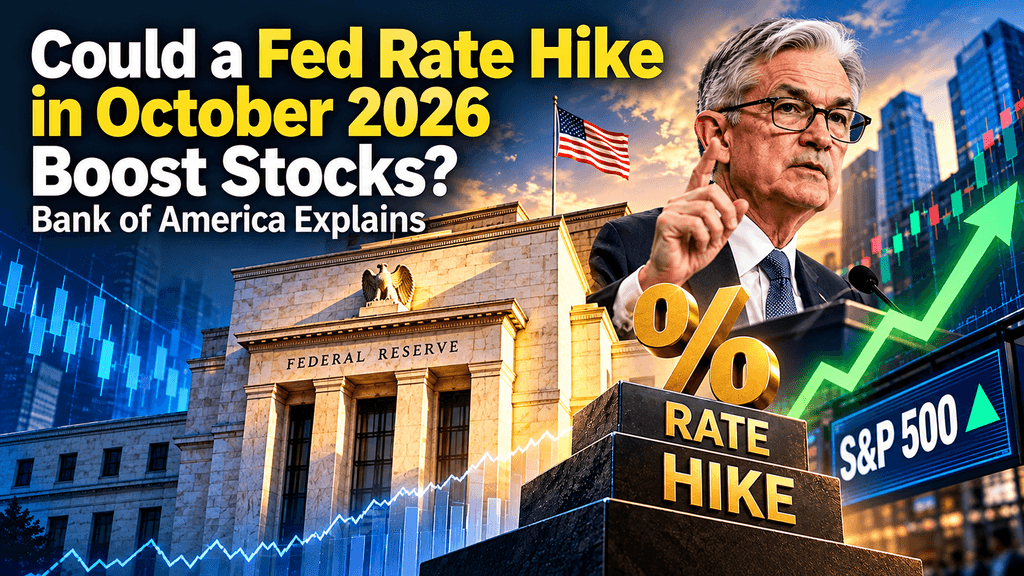
An October 2026 Federal Reserve rate hike could potentially boost U.S. stocks, according to an unconventional market argument from Bank of America strategist Michael Hartnett. While higher interest rates typically pressure equity valuations, Hartnett believes another increase could help stabilize long-term Treasury yields and prevent more damaging bond-market volatility. The Fed raised its benchmark rate to 3.75%–4.00% in September, and fresh inflation data showing consumer prices rising 3.7% annually have renewed expectations of further tightening. With the next Federal Open Market Committee (FOMC) meeting scheduled for October 27–28, investors are weighing whether decisive action against inflation could ultimately benefit the S&P 500 and other risk assets, despite the immediate economic costs of higher borrowing rates.
Why Bank of America Says an October 2026 Fed Rate Hike Could Boost Stocks
Bank of America strategist Michael Hartnett believes an October 2026 Federal Reserve rate hike could unexpectedly benefit U.S. stocks, challenging the conventional view that higher interest rates are bearish for equities. His argument centers on the growing risks associated with rising long-term Treasury yields rather than another modest increase in short-term borrowing costs. A proactive Fed decision could strengthen confidence in inflation control, ease pressure on the bond market, and help stabilize stock valuations. With Treasury yields already elevated and investors concerned about persistent inflation, Hartnett sees a potential advantage in acting before financial conditions deteriorate further. However, the benefits would depend on how bond investors interpret the decision and whether longer-term borrowing costs respond favorably.
Why Hartnett Sees a Bigger Threat in the Bond Market
Hartnett's analysis suggests that rising long-term Treasury yields may pose a greater threat to stocks than an additional Fed rate hike. Higher government bond yields increase financing costs for businesses, make fixed-income investments more competitive with equities, and reduce the present value of expected corporate earnings. These pressures are particularly significant for highly leveraged companies and growth stocks whose valuations depend heavily on future profits. Even when major stock indices remain relatively stable, rising borrowing costs can gradually weaken financial conditions across the economy. Companies refinancing existing debt may face substantially higher interest expenses, potentially reducing profits and limiting future investment. Sustained increases in Treasury yields can also encourage investors to shift capital away from riskier assets.
The concern is that keeping short-term interest rates unchanged while inflation expectations remain elevated could encourage investors to demand higher returns on longer-term government debt. This additional compensation, known as the term premium, can push Treasury yields higher independently of the Fed's benchmark rate. According to Hartnett's analysis, allowing bond-market pressures to intensify could eventually create greater difficulties for U.S. stocks than a carefully timed increase in policy rates. Rising term premiums can also increase mortgage rates, corporate borrowing costs, and government financing expenses, placing additional pressure on economic activity. From Hartnett's perspective, addressing inflation concerns earlier could help prevent these financial pressures from becoming more difficult to manage.
Why a Proactive Fed Rate Hike Could Restore Market Confidence
A Federal Reserve rate hike in October 2026 could signal a stronger commitment to controlling inflation, potentially reassuring investors concerned about persistent price pressures. Hartnett's argument suggests that decisive monetary tightening might reduce uncertainty surrounding future inflation and prevent long-term Treasury yields from climbing further. If investors become more confident in the Fed's ability to maintain price stability, they may demand less additional compensation for holding longer-term bonds, easing one source of pressure on equity valuations. Such a response could improve conditions in the Treasury market, where borrowing costs influence financing decisions across the broader economy. It could also reduce concerns that the central bank might need to introduce more aggressive tightening measures later.
For the stock market, the potential benefit would come from more stable long-term borrowing costs rather than higher interest rates themselves. Lower bond-market volatility could support investor confidence and reduce pressure on businesses that depend on external financing. More predictable yields could also make it easier for investors to assess corporate earnings and determine reasonable stock valuations. However, a rate hike would not automatically trigger a stock-market rally. If investors interpret the decision as evidence of persistent inflation or rising recession risks, Treasury yields could remain elevated while stocks face additional selling pressure. The outcome would depend on inflation expectations, economic conditions, and the Fed's accompanying policy guidance. Ultimately, Hartnett's argument rests on whether restoring confidence in inflation control can offset the immediate financial costs of tighter monetary policy.
How Rising Treasury Yields and the Term Premium Affect U.S. Stocks
Rising U.S. Treasury yields have become an important factor shaping stock-market valuations, borrowing costs, and investor demand for riskier assets. The benchmark 10-year Treasury yield stood at 5.19% on October 14, 2026, according to official U.S. Treasury data, following sharp intraday fluctuations triggered by inflation concerns. Although Treasury yields are influenced by Federal Reserve policy, they also reflect expectations about future interest rates, economic growth, and the risks of holding government debt. Understanding these different forces is essential because rising yields do not always have the same implications for the S&P 500, Nasdaq, or individual stocks.
What Drives Treasury Yields and the Term Premium?
The 10-year Treasury yield has two main components: expected future short-term interest rates and the term premium. The first reflects where investors believe interest rates will move over the coming decade, while the second represents compensation for uncertainty associated with holding longer-term bonds. According to the Federal Reserve Bank of New York, the term premium cannot be observed directly and must be estimated using financial models. This distinction matters because long-term yields can increase even when the Federal Reserve leaves its benchmark interest rate unchanged. Investors may demand higher returns if they expect persistent inflation, greater interest-rate volatility, or additional uncertainty surrounding government finances.
Treasury bond supply, fiscal deficits, and institutional investment demand can also influence the premium investors require. For example, concerns about substantial government borrowing may encourage bondholders to seek higher yields, while increased demand for longer-term securities can have the opposite effect. Recent Treasury-market volatility has also been affected by mortgage-related hedging activity, which can generate additional bond selling when yields rise. Reuters reported in October that these adjustments were contributing to pressure on longer-term government debt. The key distinction is whether yields are rising because investors expect stronger economic growth or because they demand greater compensation for financial uncertainty. Those two developments can have very different consequences for equities.
How Higher Bond Yields Influence Stock Valuations and Investor Demand
Treasury yields play an important role in determining how investors value future corporate earnings. When long-term yields rise, the discount rates used to calculate the present value of expected profits generally increase, reducing the amount investors may be willing to pay for those earnings. This relationship is especially relevant for technology and other growth-oriented companies whose valuations depend heavily on profits expected several years into the future. Meanwhile, higher Treasury returns can make government bonds more competitive with dividend-paying stocks and other income-producing investments. Investors may consequently reconsider how much additional return they require to accept the uncertainty associated with equities, particularly when stock valuations are already elevated.
However, the effect of rising Treasury yields on U.S. stocks depends partly on what is driving the increase. If yields climb alongside stronger economic growth and improving corporate earnings, companies may be able to offset some valuation pressure through higher profits. By contrast, an increase driven primarily by inflation uncertainty or a rising term premium can weigh on share prices without providing a corresponding improvement in earnings expectations. Higher yields also affect industries differently, with real estate and utilities often sensitive to financing costs, while financial companies face a more complicated balance between lending income, deposit expenses, and bond-portfolio valuations. For investors assessing the relationship between Treasury yields and stocks, changes in inflation-adjusted yields, corporate earnings expectations, and credit-market conditions can provide more useful context than the headline 10-year yield alone.
How September Inflation Data Is Shaping the Fed’s October 2026 Rate Decision
The Federal Reserve's October 2026 interest rate decision has become more uncertain following stronger-than-expected U.S. inflation data released on October 14. Consumer prices accelerated in September, raising concerns that inflation could remain elevated despite the Fed's recent monetary tightening. The central bank increased its benchmark interest rate in September, but policymakers remain divided over how quickly additional action may be necessary. With the next FOMC meeting scheduled for October 27–28, investors are reassessing the likelihood of another quarter-point increase while monitoring economic growth, employment conditions, and inflation expectations.
September CPI Rises to 3.7% as Inflation Pressures Broaden
According to the U.S. Bureau of Labor Statistics, annual headline inflation reached 3.7% in September 2026, up from 3.4% in August, while consumer prices increased 0.6% month over month. Core CPI, which excludes volatile food and energy prices, climbed to 2.6% annually from 2.4%, exceeding economists' expectations of 2.5%. Gasoline prices jumped 9.1% during September, accounting for more than half of the monthly headline increase, while shelter costs rose 0.4%. Price increases across categories including used vehicles, airline fares, and recreation suggested that inflationary pressure was not limited to energy. These figures complicate the Fed's effort to restore price stability, although its official 2% inflation target is measured using the Personal Consumption Expenditures (PCE) price index rather than CPI.
What the September Fed Rate Hike and FOMC Minutes Reveal
The Federal Reserve raised its benchmark interest rate by 25 basis points on September 16, 2026, bringing the federal funds target range to 3.75%–4.00%. The decision received unanimous support from the 12 voting FOMC members, reflecting concerns that inflation remained above the central bank's objective despite resilient economic activity. Minutes released on October 7 indicated that most policymakers considered another increase appropriate before the end of 2026, although they did not commit to acting at the October meeting. Officials continued to assess the balance between persistent inflation and potential weakness in economic activity. Federal Reserve Governor Christopher Waller subsequently emphasized flexibility over the timing of further increases, suggesting that policymakers did not necessarily need to raise rates at consecutive meetings. The discussions indicate that additional tightening remains possible, but the October decision is not predetermined.
October Fed Rate Hike Expectations Shift After the Inflation Report
The September CPI release prompted investors to reconsider the probability of another Federal Reserve rate hike in October 2026. Before the announcement, interest-rate futures indicated roughly a 22% chance of an increase, reflecting expectations that policymakers might wait until December before tightening further. Following the stronger inflation figures, market-implied probabilities approached 50% at some points during October 14 trading. Reuters subsequently reported approximately a 37% probability later that day, while an October 15 Asian-market update put the estimate near 32%. Meanwhile, San Francisco Fed President Mary Daly indicated that further rate increases might be necessary but were not urgently required at the October meeting. Her comments reinforced the possibility that policymakers could wait for additional evidence before acting. These changing probabilities reflect market expectations, not a confirmed Federal Reserve decision, and could shift again before October 28.
What Could Influence the Fed's October 27–28 Decision?
The upcoming FOMC meeting will require policymakers to balance persistent inflation against the possibility that additional rate increases could weaken economic activity. September employment data showed just 29,000 jobs added and unemployment at 4.2%, giving officials another reason to assess whether consecutive increases are necessary. The September Producer Price Index (PPI), scheduled for release on October 15 at 8:30 a.m. Eastern Time could provide further evidence about inflation pressures at the wholesale level. Policymakers will also consider whether higher energy costs are spreading through consumer prices and whether business activity remains strong enough to withstand tighter financial conditions. A conventional 25-basis-point hike would raise the target range to 4.00%–4.25%, while a pause would leave the existing range unchanged. The accompanying policy statement and Federal Reserve Chair Kevin Warsh's comments could be as important as the decision itself in shaping expectations for December and beyond.
Could the S&P 500 Rally After a Fed Rate Hike?
The S&P 500 could recover following an October 2026 Federal Reserve rate hike, but the outcome would depend on inflation expectations, corporate earnings, and how investors interpret the central bank's next policy move. Recent market performance highlights the uncertainty. On October 14, the S&P 500 closed down 1.11%, while the Nasdaq Composite declined 1.88%, as stronger-than-expected inflation increased concerns about further monetary tightening and technology shares faced additional selling pressure. Despite this negative reaction, a future rate increase could produce a different outcome if investors believe the Fed is bringing inflation under control without substantially weakening economic growth. The market's response would also depend on whether the decision was already reflected in stock prices before the October 28 announcement. The Fed's guidance on future interest rates could ultimately matter more than the size of the October adjustment itself.
What Could Support a Stock-Market Rally or Trigger Further Losses?
A favorable market response would likely require stable Treasury yields, resilient corporate earnings, and signs that inflation is moving toward the Federal Reserve's target. Technology and other growth-oriented stocks could benefit if investors become more confident about future financing conditions, while smaller companies may respond positively to reduced credit-market uncertainty. However, a stronger-than-expected tightening signal could push stocks lower if investors anticipate weaker consumer spending, slower business investment, or additional pressure on company profits. The S&P 500's performance would also depend on earnings results from its largest companies, making it difficult to isolate the impact of monetary policy from other market developments. Investors can assess the market's reaction by monitoring the 10-year Treasury yield, corporate credit spreads, earnings forecasts, and whether gains extend beyond a small group of major technology stocks. These indicators would help distinguish a broad improvement in investor confidence from a temporary rebound driven by short-term trading activity.
🔥 Beyond the Headlines: What KuCoin 5.0 Means for You
Market news moves fast — but where you act on it matters just as much. This October, KuCoin launches KuCoin 5.0, transforming KuCoin into a rebuilt platform. Here's what actually changes for you:
-
One account for everything. Older platforms split your money across separate "spot," "margin," and "futures" accounts and expected you to understand why. KuCoin 5.0's unified account removes that entirely — deposit once, and everything is simply there (only available to VIPs for now).
-
Stocks, indices, and commodities. KuCoin 5.0 expands beyond crypto into global markets. When crypto chops sideways and equities rally (or the reverse), you rotate in minutes instead of opening a brokerage account and waiting days for fiat rails.
-
Real-world assets (RWA). Tokenized exposure to traditional assets like commodities, right inside your crypto account. One of the fastest-growing segments in global finance is no longer reserved for institutions — you access it from the same balance you trade with.
-
Earn while you learn. Not ready to trade? KCUSD lets your stablecoins earn daily, auto-compounding interest. The lowest-stress way to put your idle deposit to work for 4% yield.
-
An AI assistant in plain language. Ask questions, get market context, understand what you're looking at — built into the platform, no jargon required.
-
An app that doesn't overwhelm. Faster, cleaner, and consistent — intuitive from the first tap, not after a tutorial.
-
Safety you can check, not just trust. A MiCAR-licensed EU entity, Proof of Reserves you can verify yourself, and internationally certified security (SOC 2 Type II, ISO 27001:2022).
Create your account in minutes — and start on the platform built for where crypto is going, not where it's been.
Conclusion
An October 2026 Fed rate hike could potentially support U.S. stocks, but Bank of America strategist Michael Hartnett's argument depends on whether tighter monetary policy can reduce pressure on long-term Treasury yields. September's stronger inflation data have made the upcoming Federal Reserve decision more uncertain, while recent weakness in the S&P 500 and Nasdaq demonstrates the risks associated with higher borrowing costs. Investors will be watching the October 27–28 FOMC meeting for evidence that policymakers can contain inflation without significantly damaging economic growth. Ultimately, a sustainable stock-market recovery would depend on improving financial conditions and corporate earnings rather than the rate decision alone.
FAQs
What does it mean when a Fed rate hike is already priced into stocks?
A rate hike is considered priced in when investors have largely adjusted stock valuations to reflect the expected decision. If the Federal Reserve acts as anticipated, the immediate market reaction may be limited. However, unexpected changes in the Fed's economic outlook or future interest-rate guidance can still trigger substantial price movements.
How can investors check the probability of an October 2026 Fed rate hike?
Investors can monitor the CME FedWatch Tool, which calculates market-implied probabilities using 30-day federal funds futures prices. These estimates indicate how traders are positioning for potential policy decisions. However, FedWatch probabilities are not official Federal Reserve forecasts and can change significantly following economic reports, central bank speeches, or unexpected market developments.
Would a 25-basis-point Fed rate hike immediately increase mortgage rates?
Not necessarily. A 25-basis-point increase equals 0.25 percentage points, but mortgage rates do not automatically rise by the same amount. Fixed mortgage rates depend heavily on longer-term bond yields, inflation expectations, and mortgage-market conditions. If investors already anticipate tighter monetary policy, some of its effects may be reflected in borrowing rates before the announcement.
How could an October Fed rate hike affect the U.S. dollar and corporate earnings?
Higher U.S. interest rates can attract foreign investment and strengthen the dollar, although the relationship is not guaranteed. A stronger dollar can reduce the dollar-denominated value of overseas earnings for multinational companies. It may also make American exports more expensive for international customers, creating potential earnings pressure for S&P 500 companies with substantial foreign revenue.
Could small-cap stocks react differently from the S&P 500 after a rate hike?
Yes. Smaller companies often have fewer financing options and may depend more heavily on bank loans or variable-rate debt. Higher interest expenses can therefore affect their profitability more directly. The Russell 2000, a widely followed small-cap index, may respond differently from the large-cap S&P 500 depending on credit availability, domestic economic conditions, and corporate earnings expectations.
Disclaimer: This article is for informational purposes only and does not constitute investment advice. Crypto assets can be highly volatile, and market conditions, token liquidity and project developments may change rapidly. Readers should conduct their own research and assess their risk tolerance before making financial decisions.