

Fed Rate Hike Cycle 2026: Why Rising Yields Could Pressure US Stocks
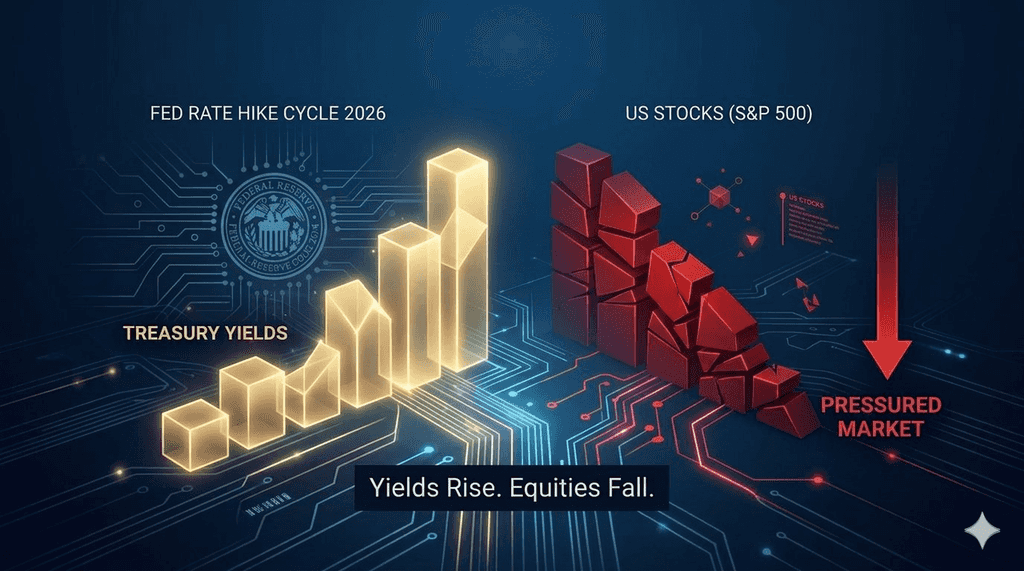
The Federal Reserve delivered its first interest rate increase since 2023 on September 16, 2026, lifting the federal funds target range by 25 basis points to 3.75%–4.00% in a unanimous decision. Chair Kevin Warsh framed the move as removing a dose of accommodation while economic activity expands at a solid pace and inflation remains elevated. Updated Summary of Economic Projections showed stronger growth, lower unemployment, and higher inflation forecasts, with the median path pointing to one additional hike by year-end and rates holding near 4.1% through 2027. Concurrently, the 10-year Treasury yield has climbed above 5%, reaching levels last sustained before the 2008 financial crisis, driven by firmer data, fiscal concerns, and expectations of tighter policy.
Equity markets have shown relative resilience supported by robust corporate profits and AI-related capital spending, yet the combination of higher policy rates and rising long-term yields increases the cost of capital, elevates discount rates applied to future cash flows, and creates competition for investor funds from fixed-income assets. Rising yields in the early stages of the 2026 Fed hiking cycle are positioned to exert measurable pressure on US stock valuations and sector leadership through higher required returns, potential capital rotation, and tighter financial conditions, even if the overall tightening path remains relatively shallow compared with prior aggressive episodes.
September 2026 Policy Decision Sets a Higher Rate Path Forward
The Federal Open Market Committee’s September 16 decision marked a clear pivot after three years without an increase. Policymakers cited inflation that has stayed above the 2% target for an extended period and described the economy as expanding solidly, with the move intended to support a more timely return to price stability. The accompanying Summary of Economic Projections revised 2026 real GDP growth upward to 2.3% and unemployment downward to 4.1%, while lifting core PCE inflation expectations to 3.4%. Median projections for the federal funds rate moved higher to 4.1% at the end of both 2026 and 2027, removing earlier assumptions of near-term cuts. Sixteen of eighteen participants anticipated at least one further increase this year.
Market reaction included an initial equity pullback followed by relative stabilization, while Treasury yields pushed higher. This combination of firmer activity forecasts and a higher policy path has reinforced the view that borrowing costs will remain elevated for longer, directly influencing the discount rates investors apply to equity cash flows and the relative attractiveness of stocks versus bonds. Historical studies of initial rate increases show that equities often experience short-term softness as markets reprice the cost of capital, even when the cycle ultimately proves moderate. The current backdrop differs from purely inflation-driven or recession-fearing cycles because growth and earnings remain supportive, yet the signal of tighter policy still elevates the hurdle rate for risk assets and invites closer scrutiny of valuations that had expanded during the prior low-rate period.
Ten-Year Yields Near Highest Levels in Nearly Two Decades
Benchmark 10-year Treasury yields have advanced to the 5% area and beyond in recent sessions, marking the highest readings since 2007 according to market data reported in late September. The move accelerated after stronger manufacturing and composite PMI readings suggested business activity was running at multi-year highs, prompting traders to increase the odds of additional Federal Reserve tightening. Yields on the 2-year note also rose sharply, reflecting near-term policy expectations, while the 30-year yield reached levels not seen in roughly two decades. Higher long-term rates raise the opportunity cost of holding equities because risk-free returns become more competitive. They also increase the discount rate used in valuation models, which reduces the present value of distant cash flows that are especially important for growth-oriented companies.
Institutional investors with asset-liability matching requirements, such as pension funds and insurers, often reallocate toward fixed income when yields reach these thresholds, creating technical pressure on equity markets. Corporate borrowing costs rise in tandem, affecting capital expenditure decisions and refinancing for firms with floating-rate or near-term maturity debt. Although strong nominal growth can partially offset the impact by supporting earnings, the psychological and mathematical effects of a sustained move above 5% have historically coincided with periods of equity caution and rotation. Market participants continue to monitor whether yields stabilize near current levels or push further into the mid-5% range, as the latter would amplify valuation compression across the broader market.
Equity Performance Patterns Following the Start of Hiking Cycles
Analysis of past Federal Reserve tightening episodes reveals a consistent pattern of near-term equity weakness after the first rate increase. Data covering cycles since the mid-1990s show the S&P 500 recording a median decline of roughly 2.6% three months after the initial hike, with meaningful drawdowns of 8% to 14% from peak levels occurring within one to three-and-a-half months in most cases. Across a longer sample of postwar hiking cycles, the average peak-to-trough decline within twelve months has approached 14%. One-month returns after a standard 25-basis-point initial increase have been negative in every instance over the past 36 years, although twelve-month returns have often recovered and turned positive by an average of more than 12%.
The 2022 cycle remains an outlier in investors’ minds because of its aggressive pace and associated recession fears, producing a full bear market. Current conditions feature a shallower projected path and stronger underlying growth, which may limit the depth of any correction. Still, the historical record underscores that markets typically require time to digest higher policy rates and the associated rise in long-term yields. Equity performance tends to improve once investors gain confidence that the tightening cycle will not derail earnings or trigger a sharp slowdown. In the present environment, the combination of elevated starting valuations and yields already near multi-decade highs suggests that any digestion phase could involve greater volatility than a simple average of prior mild cycles would imply.
Corporate Profit Growth Offers Partial Offset to Higher Rates
Consensus expectations point to robust S&P 500 earnings expansion of approximately 25% in 2026 and a further 14% in 2027, supported by broad-based profit gains for the median company near 14%. Technology and capital-expenditure-intensive sectors linked to artificial intelligence infrastructure continue to report strong order books and investment pipelines that appear relatively insulated from moderate rate increases. Resilient consumer spending and a low unemployment rate near 4.1% provide additional fundamental support. Higher yields raise interest expense for leveraged firms and can slow discretionary investment, yet the absolute level of earnings growth projected for the next two years remains substantial enough that many analysts believe equities can absorb a shallow tightening cycle.
The key variable is whether inflation pressures force the Federal Reserve into a more prolonged series of increases that ultimately slows the economy. So far, the central bank’s own modeling suggests that 50 basis points of additional tightening would reduce growth by only a few tenths of a percentage point. Markets are therefore focused on the trajectory of core inflation and energy prices as the primary determinants of whether profit forecasts remain intact. If earnings delivery stays on track, valuation multiples may compress modestly without producing a sustained equity bear market. Conversely, any disappointment in the growth or margin outlook would amplify the negative effect of rising discount rates.
Discount Rate Increases Compress Present Values of Future Cash Flows
Rising Treasury yields directly elevate the risk-free component of the discount rates used in discounted-cash-flow models. When the 10-year yield moves from the mid-4% range into the low- to mid-5% area, the present value of cash flows expected several years in the future declines, all else equal. Growth stocks with the bulk of their value concentrated in distant earnings are most sensitive to this mathematical effect. Valuation multiples that expanded during the preceding low-rate period face natural pressure as required returns increase. Institutional surveys have ranked a disorderly rise in bond yields among the top risks to equity markets, reflecting concern that higher rates of return demanded by investors will lower current prices even if nominal earnings continue to grow.
Real yields, which adjust for inflation expectations, have also advanced, raising the true cost of capital for businesses and governments. Historical episodes in which real yields rose by nearly 90 basis points within a year produced noticeable equity volatility until markets adjusted to the new cost-of-capital regime. The current advance in real yields is already comparable in scale to the 2023 experience. Equity investors therefore watch the path of both nominal and real yields closely, because sustained increases above current levels would require a corresponding expansion in earnings or a reduction in risk premia to prevent multiple compression.
Growth and Technology Leadership Faces Greater Rate Sensitivity
Sectors with high duration characteristics, those whose valuations depend heavily on long-term growth assumptions, typically experience the sharpest pressure when yields rise. Technology and related growth names have led market advances in recent years on the back of AI infrastructure investment, yet they also carry elevated multiples that are more vulnerable to higher discount rates. Rate-sensitive groups such as small-capitalization stocks and materials have already shown greater day-to-day volatility in response to yield spikes. Value-oriented and financial sectors can benefit relatively as net interest margins expand and as investors seek companies with nearer-term cash flows or higher current dividend yields.
Historical rotation patterns during hiking cycles frequently favor these groups once the initial market digestion phase begins. The AI capital-expenditure boom provides a partial buffer because much of the spending is driven by competitive necessity rather than purely interest-rate-sensitive return calculations. Nevertheless, any sustained move in long-term yields toward 5.5% or higher would likely intensify the relative underperformance of high-multiple growth stocks. Portfolio managers monitoring concentration risk have begun emphasizing diversification away from the most rate-sensitive segments while maintaining exposure to secular themes that can still deliver earnings growth in a moderately higher-rate environment.
Higher Borrowing Costs Begin to Influence Consumer and Housing Activity
Mortgage rates have climbed in tandem with Treasury yields, with the average 30-year fixed rate recently reaching levels near 7.26%, the highest in more than a year. Elevated consumer borrowing costs reduce housing affordability and can slow the turnover of existing homes, affecting related industries from construction to retail durables. Auto loans and other consumer credit also become more expensive, potentially restraining discretionary spending even while overall employment remains firm. The Federal Reserve’s dual-mandate focus includes maximum employment, and current projections still show the unemployment rate holding near 4.1%.
Yet the transmission of higher rates into the real economy typically occurs with a lag. Strong wage growth and accumulated savings have so far supported consumption, limiting the immediate drag. Continued strength in business activity readings, however, raises the possibility that additional rate increases will be required, extending the period of elevated consumer borrowing costs. Equity sectors tied to housing, autos, and discretionary retail therefore face a two-sided risk: resilient demand in the near term versus gradual erosion of purchasing power if rates remain high or rise further. Investors track monthly retail sales, housing starts, and consumer confidence data for early signs that the rate channel is beginning to constrain household balance sheets more meaningfully.
Real Yields Advance and Raise the True Cost of Capital
Real yields, which strip out inflation expectations, have risen substantially and now represent one of the most consequential market developments. After accounting for inflation, the increase in real yields directly raises the cost of capital for corporations, households, and the government. The last comparable advance occurred in 2023, when 10-year real yields climbed nearly 90 basis points in less than a year as markets priced stronger growth, larger fiscal deficits, and a higher-for-longer policy stance. That episode produced volatility across risk assets until valuations adjusted. The current move carries similar implications because it occurs against a backdrop of elevated equity valuations and heavy Treasury issuance.
Businesses evaluating capital projects face a higher hurdle rate, which can slow investment outside of the highest-return AI-related projects. Governments confront rising interest expense on outstanding debt, adding to fiscal pressures that themselves contribute to term-premium demands in the bond market. Equity investors must therefore incorporate a permanently higher real cost of capital into their assumptions rather than treating the recent yield rise as purely temporary. The interaction between real yields and equity risk premia will help determine whether stocks can continue to advance or whether a period of consolidation becomes necessary to restore equilibrium.
AI-Related Capital Spending Provides a Partial Buffer
Large-scale investment in artificial intelligence infrastructure continues to support earnings and capital expenditure even as the broader cost of capital rises. Major technology firms and related suppliers report sustained demand for computing capacity, data centers, and energy infrastructure that is driven more by competitive positioning than by marginal changes in interest rates. This secular spending wave has contributed to the resilience of equity markets following the September rate decision. Analysts note that the traditional interest-rate channel appears less binding for these firms because the expected returns on AI projects remain high enough to justify continued outlays.
The concentration of market leadership in a relatively small group of companies nonetheless creates vulnerability if rate-driven multiple compression outweighs earnings delivery. Diversification away from the most concentrated names while retaining exposure to the broader AI ecosystem has become a common recommendation among wealth managers. The ability of this spending cycle to persist through a period of higher yields will be an important determinant of overall equity performance in the coming quarters. Should energy prices or supply constraints further elevate inflation and force additional policy tightening; even the AI sector could face secondary effects through higher operating costs and tighter financial conditions.
Market Pricing Reflects Expectations of Further Tightening
Interest-rate futures markets have adjusted rapidly to the hawkish tone of the September meeting and subsequent economic data. Probabilities of an additional hike in October or December have risen, with some sessions showing odds above 60% for a move at the next gathering. The median Fed projection already incorporates one more increase in 2026, and private forecasts range from a single additional hike to two moves extending into early 2027. The 2-year Treasury yield has climbed above 4.7%, reflecting these expectations. Equity markets have responded with increased day-to-day sensitivity to data that could alter the rate path.
Stronger-than-expected activity readings push yields higher and stocks lower, while any signs of cooling inflation or softening demand produce the opposite reaction. This heightened sensitivity is characteristic of the early phase of a hiking cycle, when investors continually recalibrate the terminal rate and the duration of restrictive policy. The Federal Reserve’s own forecasts currently envision rates remaining near 4.1% through 2027 before gradual declines later in the decade. Markets will continue to test whether that path is sufficient to restore inflation to target without a more pronounced slowdown in growth.
Fixed-Income Yields Attract Capital That Might Otherwise Flow to Stocks
When risk-free Treasury yields approach or exceed 5%, the relative appeal of equities diminishes for yield-oriented and liability-driven investors. Pension funds, insurance companies, and other institutions that match assets to long-term liabilities find it easier to meet return targets with high-quality fixed income, reducing the need for equity risk. Retail and mutual fund flows can also shift toward bond funds offering competitive income without the volatility of stocks. This technical reallocation can exert downward pressure on equity prices independent of changes in corporate fundamentals.
Historical periods in which 10-year yields sustained levels above 5% often coincided with equity underperformance or at least a pause in the upward trend. The current environment features the additional complication of elevated starting valuations, which leave less cushion against capital outflows. Quality corporate bonds and intermediate-duration Treasuries have already seen increased investor interest as yields have risen. Equity strategists therefore emphasize the importance of addressing concentration risk and maintaining diversified exposure rather than assuming that strong earnings alone will fully offset the competitive pressure from higher fixed-income returns.
Portfolio construction in the present environment favors quality balance sheets, reasonable valuations, and companies with pricing power that can protect margins as financing costs rise. Diversification across sectors reduces exposure to the most rate-sensitive growth names while retaining participation in secular themes such as AI infrastructure. Fixed-income allocations can be used both for income and as a ballast against equity volatility, with shorter to intermediate durations offering attractive yields without excessive interest-rate risk. Historical evidence indicates that equities have often recovered and advanced over twelve-month horizons after the first hike of a cycle, provided the tightening does not trigger a sharp economic contraction.
Maintaining a longer-term perspective while managing near-term volatility therefore remains central. Investors should monitor the path of core inflation, real yields, and corporate earnings revisions as the primary signals for whether the current pressure intensifies or stabilizes. A shallow hiking cycle accompanied by continued profit growth would support a constructive medium-term outlook, whereas a more extended series of increases would raise the probability of deeper valuation adjustments.
Conclusion
Most institutional forecasts currently anticipate a relatively contained tightening episode rather than a return to the aggressive pace of 2022. Base-case scenarios call for one further 25-basis-point increase in 2026 followed by an extended hold, with the first cuts potentially delayed until later in the decade. Under this path, robust earnings growth is expected to help equities absorb moderately higher yields. S&P 500 year-end targets from major firms remain constructive, reflecting confidence that the economy can continue expanding near 2% while inflation gradually moderates.
Risks to this outlook include sticky energy-driven price pressures, larger-than-expected fiscal deficits that keep term premiums elevated, and any deterioration in labor-market conditions that would complicate the Federal Reserve’s dual mandate. Equity performance over the next twelve months will therefore depend less on the fact of rate increases and more on the interaction between the ultimate policy path, the resilience of corporate profits, and the level at which long-term yields stabilize. A sustained move in the 10-year yield toward 5.5%–6% would test the market’s ability to maintain current valuations, while a plateau near 5% accompanied by steady earnings would be more readily absorbed.
🔥 Beyond the Headlines: What KuCoin 5.0 Means for You
Market news moves fast — but where you act on it matters just as much. This October, KuCoin launches KuCoin 5.0, transforming KuCoin into a rebuilt platform. Here's what actually changes for you:
-
One account for everything. Older platforms split your money across separate "spot," "margin," and "futures" accounts and expected you to understand why. KuCoin 5.0's unified account removes that entirely — deposit once, and everything is simply there (only available to VIPs for now).
-
Stocks, indices, and commodities. KuCoin 5.0 expands beyond crypto into global markets. When crypto chops sideways and equities rally (or the reverse), you rotate in minutes instead of opening a brokerage account and waiting days for fiat rails.
-
Real-world assets (RWA). Tokenized exposure to traditional assets like commodities, right inside your crypto account. One of the fastest-growing segments in global finance is no longer reserved for institutions — you access it from the same balance you trade with.
-
Earn while you learn. Not ready to trade? KCUSD lets your stablecoins earn daily, auto-compounding interest. The lowest-stress way to put your idle deposit to work for 4% yield.
-
An AI assistant in plain language. Ask questions, get market context, understand what you're looking at — built into the platform, no jargon required.
-
An app that doesn't overwhelm. Faster, cleaner, and consistent — intuitive from the first tap, not after a tutorial.
-
Safety you can check, not just trust. A MiCAR-licensed EU entity, Proof of Reserves you can verify yourself, and internationally certified security (SOC 2 Type II, ISO 27001:2022).
Create your account in minutes — and start on the platform built for where crypto is going, not where it's been.
FAQs
How has the September 2026 Federal Reserve rate decision altered the expected path of policy rates through 2027?
The September meeting produced a unanimous 25-basis-point increase and an upward revision to the median federal funds rate projection to 4.1% at the end of both 2026 and 2027. Sixteen of eighteen participants anticipated at least one additional hike this year, removing earlier assumptions of near-term cuts. Private forecasts range from one further increase to two moves extending into early 2027, with futures markets assigning elevated probabilities to an October or December action.
What level of 10-year Treasury yields has historically coincided with equity market pressure?
Sustained readings above 5% have often marked periods of heightened caution for stocks. The last time the 10-year yield traded in this region for an extended period was before the 2008 financial crisis, when subsequent equity declines were substantial. Current yields have reached or exceeded that threshold in recent sessions, prompting institutional investors to rank rising bond yields among the top risks to equities.
Can strong corporate earnings fully offset the negative effects of higher discount rates?
Robust profit growth of 25% projected for the S&P 500 in 2026 and 14% in 2027 provides a meaningful buffer. Many companies, particularly those linked to AI infrastructure, continue to expand capital spending despite higher financing costs. However, higher discount rates still reduce the present value of future cash flows, especially for growth stocks. The net effect depends on whether earnings delivery remains on track and whether yields stabilize or continue climbing.
Which equity sectors tend to underperform most when long-term yields rise sharply?
High-duration growth and technology stocks, whose valuations rely heavily on distant cash flows, typically face the greatest pressure. Small-capitalization and material names also exhibit heightened sensitivity. Value, financial, and quality dividend-paying sectors often show relative resilience because they offer nearer-term cash flows or benefit from wider net interest margins.
Disclaimer
The information provided on this page may originate from third-party sources and does not necessarily represent the views or opinions of KuCoin. This content is intended solely for general informational purposes and should not be considered financial, investment, or professional advice. KuCoin does not guarantee the accuracy, completeness, or reliability of the information, and is not responsible for any errors, omissions, or outcomes resulting from its use. Investing in digital assets carries inherent risks. Please carefully evaluate your risk tolerance and financial situation before making any investment decisions. For further details, please consult KuCoin’s Terms of Use and Risk Disclosure.