

Nvidia Turmoil and Texas Permit Restrictions Test Bitcoin Miners' AI Pivot

Bitcoin miners' AI pivot is facing two tests: uncertainty surrounding Nvidia's future infrastructure financing and new data center approval restrictions in Texas. On November 12, 2026, Nvidia announced that Jensen Huang had resigned as chief executive, with Colette Kress appointed interim CEO. Texas regulators have also paused certain environmental permits and reviewed large electricity connections amid concerns about power and water use. Neither development proves that existing AI agreements have been canceled or that all construction has stopped. However, companies including IREN, Core Scientific and Riot Platforms must still finance projects, deliver capacity and turn long-term AI commitments into operating revenue.
Key Takeaways
-
Nvidia's leadership change has raised questions about future AI infrastructure financing, although existing commitments have not been generally canceled.
-
Texas data center approvals face delays while regulators examine electricity demand, water consumption and community impacts.
-
IREN outlined $15 billion in remaining planned fiscal 2027 capital expenditure, including $6 billion targeted from additional funding sources.
-
Core Scientific, TeraWulf, Riot Platforms and Cipher Digital face different construction, leasing, financing and customer-delivery risks.
-
Third-quarter 2026 results confirm that AI cloud services and data center leasing generate substantial revenue for several former mining-focused companies.
-
CoinShares estimates AI-grade infrastructure costs at $8 million–$15 million per megawatt, compared with $0.7 million–$1 million for mining infrastructure.
How Nvidia's Leadership Turmoil Affects Bitcoin Miners' AI Financing Plans
Nvidia's leadership transition matters because the chipmaker is more than a supplier of graphics processing units (GPUs). It also participates in customer agreements, equity investments and financing arrangements that support the broader AI infrastructure market. According to Nvidia's November 12 filing with the U.S. Securities and Exchange Commission, its board accepted Huang's resignation on November 11 and appointed Chief Financial Officer Colette Kress as interim CEO. Nvidia's public announcement expressed an intention to maintain business continuity. The uncertainty concerns the approach future management may take toward new or expanded agreements, rather than a documented termination of existing commitments.
How Nvidia's AI Cloud Contracts and Financing Partnerships Support Bitcoin Miners
IREN illustrates how the chipmaker's commercial relationships extend into the mining sector. On May 7, 2026, IREN announced a five-year AI cloud services contract with Nvidia worth approximately $3.4 billion, initially involving about 60 megawatts at its Childress, Texas, campus. The companies also outlined a strategic partnership targeting potential deployment of up to 5 gigawatts of AI infrastructure over time. Under a separate conditional arrangement, Nvidia received the right to acquire up to 30 million IREN shares at $70 each, representing a possible $2.1 billion equity investment. That purchase right is not equivalent to cash already transferred to IREN.
Nvidia has disclosed substantial commitments across the wider AI cloud market. Its quarterly filing for the period ended July 26, 2026, listed $36 billion in AI cloud service commitments. The company also described preliminary arrangements with large capital providers intended to mobilize more than $500 billion of third-party capital over time. These arrangements are subject to definitive agreements and project-level assessments. The distinction matters: long-term service commitments, potential equity purchases and proposed financing platforms are different financial instruments. None should be presented as an unrestricted funding pool available to Bitcoin mining companies.
Why Nvidia's Leadership Change Could Raise AI Data Center Financing Costs
A more selective approach to new commitments could matter most for projects that still need outside capital. AI facilities require funding for construction, power equipment, computing systems and commissioning before they can earn the full value of customer contracts. Reuters reported on November 16, 2026, that Nvidia's financial partners continued discussing transactions and that there was no indication of a general pause. Analysts nonetheless questioned whether Nvidia's future leadership would accept the same level of financial exposure. That is a concern about future deal terms, not confirmation that existing financing agreements have changed.
The broader credit market has shown signs of pressure. Reuters reported on November 17 that the market yield on a CoreWeave bond issue had risen from 9.625% at issuance to nearly 15%. CoreWeave is an AI cloud operator, so the figure cannot be treated as a borrowing rate for Bitcoin miners. It does illustrate how financing costs may change for highly leveraged computing infrastructure businesses. For miners, the implications depend on the amount of debt already secured, conditions attached to future borrowing, customer credit quality and the remaining construction program. Projects with reliable operating cash flow may face different funding conditions from those awaiting delivery.
How Texas Data Center Permit Restrictions Impact Bitcoin Miners' AI Expansion
Texas has introduced additional approval hurdles for large data centers, affecting some plans to convert Bitcoin mining sites or develop new artificial intelligence facilities. In August 2026, state officials ordered more extensive checks on major proposed electricity connections. A September directive then paused environmental permits associated with data center development. The measures address concerns about electricity demand, water resources and local effects. They do not constitute a permanent statewide prohibition on AI data centers, but they can influence when a project secures the authorizations needed for construction and operation.
What the Texas Data Center Permit Pause Covers
On September 21, 2026, Governor Greg Abbott directed the Texas Commission on Environmental Quality (TCEQ) to stop issuing permits related to data center projects while the relevant infrastructure review continued. In an October 19 response, TCEQ confirmed a pause affecting construction and infrastructure directly supporting these facilities. The agency also said it was screening pending applications and certain authorizations that ordinarily do not require an individually issued permit. Bitcoin miners converting industrial sites may need approvals for new structures, backup generation, cooling equipment or other regulated activities. Whether a particular facility is delayed depends on its permits and development status. The directive does not establish that every operating data center must close.
How ERCOT's Power Connection Review Affects AI Data Center Timelines
Electricity interconnection is a separate requirement from environmental permitting. The Electric Reliability Council of Texas (ERCOT) is reviewing large data center loads before certain projects advance through its grid-connection process. In a preliminary November 5, 2026, update, ERCOT reported issuing community-impact questionnaires covering 465 loads and receiving 433 responses. Those responses represented approximately 177 gigawatts of requested connection capacity, not approved or energized capacity. The review considers factors such as on-site generation, cooling systems, water requirements and community effects. Delays can postpone the point at which a completed facility receives sufficient power to commission equipment and begin service, even if the operator already holds the land and buildings.
Why Existing Bitcoin Mining Sites and New AI Projects Face Different Approval Risks
A mining site with an established electricity connection may be in a different position from a new campus requiring major grid upgrades. Existing power infrastructure can help some operators develop AI facilities, although it does not eliminate the need for new approvals when capacity or operations change. Cipher Digital, for example, disclosed that phased high-performance computing delivery began at its Black Pearl facility in August 2026, while warning that certain other large-load energization approvals were temporarily paused. ERCOT has targeted December 10, 2026, for its review report. That deadline is a regulatory checkpoint, not an automatic approval date for pending projects, and the duration of individual delays remains uncertain.
Which Bitcoin Mining Companies Face the Greatest AI Transition Risks
The Bitcoin miners' AI pivot involves more than one business model. Some companies buy GPUs and provide cloud computing directly, while others lease powered land or finished facilities to technology tenants. That distinction determines who bears equipment costs, construction obligations and operating responsibilities. IREN, Core Scientific, TeraWulf, Riot Platforms and Cipher Digital have all announced material AI plans, but their disclosures do not support a definitive ranking of which faces the greatest overall risk. A more meaningful comparison focuses on the obligations each operator still needs to fulfill.
Bitcoin Mining Companies' AI Infrastructure Models and Transition Risks
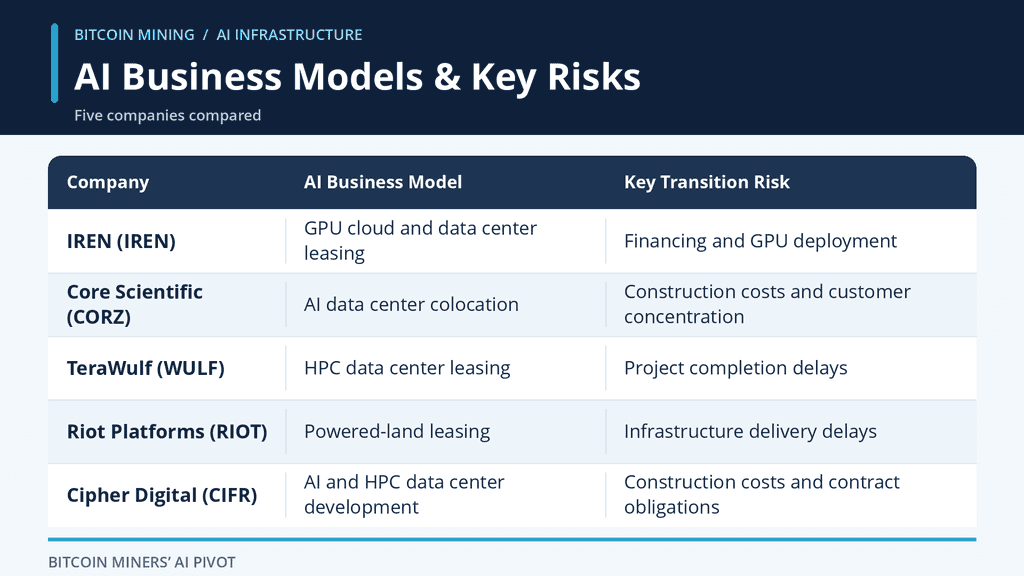
IREN, Core Scientific, and TeraWulf Face Different Financing and Construction Risks
IREN faces significant capital requirements because it owns data centers and operates GPU computing infrastructure. In results published on November 5, 2026, the company outlined approximately $15 billion in remaining planned fiscal 2027 capital expenditure. Around $9 billion was associated with cash, committed GPU financing and customer prepayments, while a further $6 billion was targeted from other sources subject to market conditions. IREN also moved its target for more than $4 billion in annualized run-rate revenue from late 2026 to January 2027, potentially February. Management attributed the adjustment to customer-requested design changes and supplier timing. The change demonstrates how commissioning schedules can shift even where demand is under contract.
Core Scientific and TeraWulf primarily provide high-performance computing infrastructure to tenants, although their portfolios and development schedules differ. Core Scientific reported 485 megawatts of billing capacity as of September 30, 2026, alongside approximately $985.1 million in quarterly capital expenditure. It must continue delivering new capacity while managing construction costs and reliance on major customers. TeraWulf reported 102 megawatts of revenue-generating HPC capacity at Lake Mariner, with another 336 megawatts under construction. Its long-term Anthropic lease for approximately 401 megawatts in Kentucky has a Google credit-support arrangement. Those commercial arrangements provide visibility into potential demand, but future rent and project economics still depend on construction, financing conditions and timely delivery.
Riot Platforms and Cipher Digital Face AI Leasing and Project Delivery Risks
Riot Platforms concentrates on powered land and electrical infrastructure rather than owning the tenant's entire AI computing system. In November 2026, it announced a 15-year agreement covering 910 megawatts at Corsicana, with approximately $28 billion in total contracted value over the initial term. Under the lease, Riot provides the site and power infrastructure, while the tenant is responsible for procuring and operating its computing equipment. Riot plans to deliver 400 megawatts in September 2027, another 200 megawatts in January 2028 and the remaining 310 megawatts in July 2028. These are scheduled milestones, not completed deliveries, and the contract value is not revenue already earned.
Cipher Digital has different responsibilities under its turnkey HPC development agreements. Its September 2026 Barber Lake lease amendment revised delivery milestones and established a framework for additional construction spending. Cipher is responsible for the first $359.3 million of costs above the original project budget, while the tenant is expected to reimburse 50% of any further excess costs over the contracted term, subject to agreed conditions. The company has scheduled portions of the facility for delivery between late 2026 and early 2027. These terms show why a signed lease does not eliminate execution risk: cost increases, changes in tenant specifications and missed milestones can affect the timing and economics of future revenue.
Bitcoin Miners' AI Revenue, Infrastructure Costs, and Future Outlook
Bitcoin miners' expansion into artificial intelligence is increasingly visible in reported revenue, but the scale of signed contracts still exceeds the amount of capacity generating income. Operators must complete specialized facilities, deliver computing equipment and meet customer service requirements while controlling construction expenses and financing costs. Results for the three months ended September 30, 2026, provide a more useful measure of operating progress than long-term contract announcements alone. Upcoming project milestones and regulatory decisions will help show whether additional capacity can become operational during 2027.
How Bitcoin Miners' AI Revenue Compares With Contracted Growth
IREN reported $200 million in AI cloud revenue out of $228 million in total revenue for the September 2026 quarter, approximately 87.7%. Core Scientific generated $215.4 million in colocation revenue from $232.9 million in total revenue, about 92.5%. TeraWulf recorded $63 million in HPC leasing revenue out of $76.2 million, roughly 82.7%. Riot Platforms reported $18.4 million in data center revenue from $181.4 million in total quarterly revenue, approximately 10.1%. These percentages are calculations based on company-reported results, not measures of future contract value. They also reflect different operating models, so they should not be compared as if each company provides the same service.
Revenue growth does not necessarily translate into comparable net income or cash flow. IREN recorded a consolidated net loss of approximately $263 million during the quarter despite growing AI revenue. Core Scientific reported about $1.18 billion in net income, and TeraWulf reported approximately $710 million; both figures were materially affected by noncash changes in warrant valuations. These accounting effects can obscure operating trends. The more informative indicators include the amount of capacity actually billing customers, recurring operating cash flow, interest expenses and the remaining cost of delivering contracted projects. Revenue recognized during a quarter should also remain distinct from annualized targets and amounts expected over multiyear agreements.
AI Infrastructure Costs and the Key Developments Shaping the 2027 Outlook
Converting a Bitcoin mining site into an AI-ready data center usually requires substantial additional investment. Existing land, substations and power connections may be reusable, but AI workloads demand high-speed networking, specialized GPUs, dependable backup systems and more advanced cooling. Traditional Bitcoin mining relies on purpose-built ASIC mining hardware, which performs a different computing task from AI accelerators. In research published September 15, 2026, CoinShares estimated AI-grade infrastructure costs at $8 million to $15 million per megawatt, compared with $700,000 to $1 million for mining facilities. Applied to a hypothetical 100-megawatt development, those ranges imply $800 million to $1.5 billion for AI-grade infrastructure versus $70 million to $100 million for mining. These are illustrative research estimates, not actual project budgets.
The next important evidence will come from project delivery and financing disclosures. ERCOT's forthcoming review reports may clarify the process for some Texas power connections, but individual approvals could take longer. During late 2026 and throughout 2027, planned commissioning, customer acceptance and quarterly earnings releases should reveal how much contracted capacity becomes billable. Nvidia's future capital-allocation decisions may also influence expectations for new infrastructure deals, although changes to specific company agreements would require confirmation. For the sector as a whole, delivered capacity, operating cash flow, financing terms and customer payment performance will be more meaningful measures of progress than announced backlog alone.
Conclusion
Nvidia's leadership change and Texas data center approval restrictions have added uncertainty to an AI infrastructure transition that is already producing material revenue for several Bitcoin mining companies. Official disclosures show that the businesses involved face different challenges: some must finance GPUs and cloud operations, while others are responsible for constructing and leasing facilities to major technology customers. Existing power connections and long-term agreements can provide a useful foundation, but they do not remove the costs or risks of construction, regulatory approval and customer delivery. The outcome of the industry's AI expansion will depend less on the headline size of contracts than on how reliably companies convert those commitments into operating capacity and sustainable cash flow.
FAQs
What Is the Difference Between AI Cloud Services and Data Center Colocation?
An AI cloud provider typically owns or operates GPUs and sells access to computing power. A colocation provider supplies facilities, electricity, cooling and network access, while the tenant may own the computing equipment. Both can generate AI-related revenue, but their hardware investments, operating responsibilities and financial risks differ.
What Do Contracted, Energized, and Billing Megawatts Mean?
Contracted megawatts represent data center capacity covered by customer agreements. Energized capacity has an active electricity supply, while billing capacity generally refers to infrastructure that has met the conditions required to charge customers. These measurements are not interchangeable because a project can have signed contracts long before its full capacity becomes operational and generates revenue.
How Is Annualized Run-Rate Revenue Different From Reported AI Revenue?
Annualized run-rate revenue estimates a full year's sales based on a company's current level of qualifying service activity. For example, IREN's methodology annualizes contracted hourly GPU pricing over 8,760 hours. This calculation differs from revenue recognized under accounting standards and does not guarantee that the projected amount will be earned during the following year.
Do Customer Prepayments Remove the Need for AI Data Center Financing?
Customer prepayments can reduce the amount of external financing required before equipment deployment or construction milestones. However, these arrangements may include performance conditions, repayment obligations or service-delivery requirements. Receiving advance payments does not eliminate construction expenses or guarantee profitability, particularly when projects experience delays or additional costs.
Can Bitcoin Miners Power AI Facilities With On-Site Electricity Generation in Texas?
Some data center developers can use on-site electricity generation to reduce their dependence on new grid connections. However, local power generation may still require environmental approvals, fuel infrastructure, water arrangements and other regulatory authorizations. An independently powered facility is not automatically exempt from the rules governing data center construction and operation.
Disclaimer: This general market information, possibly from third-party, commercial, or sponsored sources, is provided for reference and educational purposes only and does not constitute financial or investment advice, an offer, solicitation, or guarantee. We disclaim liability for its accuracy, completeness, reliability, and any resulting losses. Investments/trading are risky; past performance doesn’t guarantee future results. Users should research, judge prudently, and take full responsibility. For further details, please consult KuCoin’s Terms of Use and Risk Disclosure.