

Bitcoin Dominance vs Altseason: What Happens Once BTC Stabilizes at Around $60K?
2026/07/13 15:00:00
Introduction
Bitcoin has spent weeks consolidating around the $60,000 level, leaving traders asking the same question: what comes next? Historically, when Bitcoin stops making new highs and enters a sideways phase, capital doesn't sit idle—it moves. That movement, from Bitcoin into Ethereum and then into smaller altcoins, is what crypto traders call "altseason."
But altseason doesn't begin the moment BTC stalls. Understanding the relationship between Bitcoin dominance and altseason is what separates prepared investors from those who rotate too early or miss the move entirely. In this guide, you'll learn:
-
What Bitcoin dominance (BTC.D) actually measures—and why the raw number can mislead you
-
The three confirmed signals that have preceded every major altseason since 2017
-
How capital rotates in stages: from BTC → ETH → large-cap alts → mid-cap alts
-
Why the 2024–2026 cycle is structurally different from previous ones
-
How to track these metrics yourself and time your exposure
Let's break down what really happens once Bitcoin finds its footing.
What Is Bitcoin Dominance—and Why It Matters for Altcoin Season
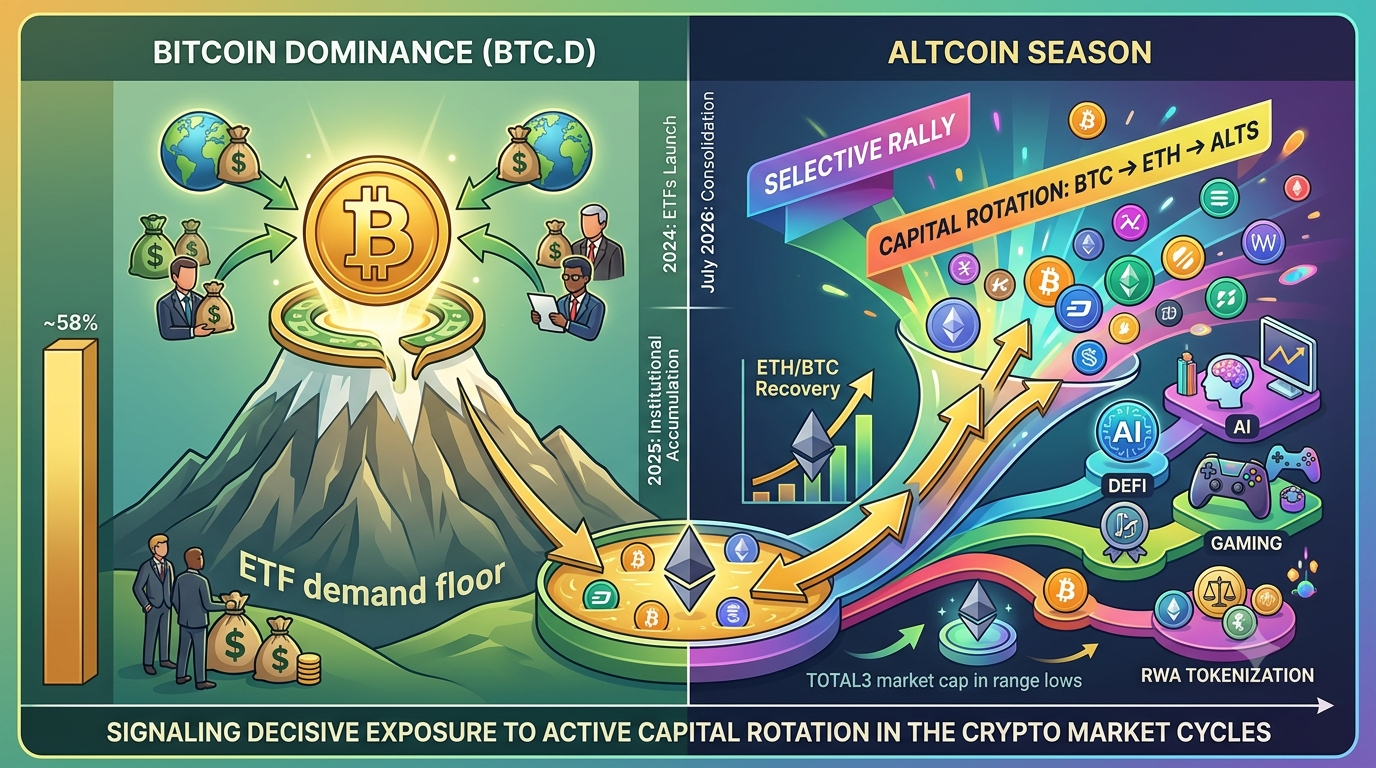
Bitcoin dominance (BTC.D) is the percentage of total cryptocurrency market capitalization held by Bitcoin. As of July 2026, BTC dominance sits at approximately 58%, meaning Bitcoin commands more than half of the entire crypto market's value.
At first glance, that seems straightforward. But here's what most guides won't tell you: the standard BTC.D reading is probably misleading.
Stablecoins—USDT, USDC, and others—now represent over $300 billion of the total crypto market cap. These aren't risk-on altcoin bets. They're parked capital. When you strip stablecoins out of the calculation, Bitcoin's adjusted dominance rises to roughly 64%, not 58%. That means Bitcoin controls nearly two-thirds of all active risk capital in crypto.
This matters because a drop in BTC.D from 60% to 55% might not mean altcoins are winning—it might just mean stablecoin supply grew. Before you declare "altseason is here," check whether the decline is driven by genuine altcoin strength or stablecoin dilution.
How Bitcoin Dominance Has Changed Over Time
Bitcoin's market share has swung dramatically across cycles:
|
Year
|
BTC Dominance
|
Key Event
|
|
2013
|
90%
|
Bitcoin essentially was the crypto market
|
|
2017
|
42%
|
ICO boom—BTC.D crashed from 85% to 37%
|
|
2018
|
55%
|
Bear market consolidation
|
|
2021
|
41%
|
DeFi summer + NFT boom—BTC.D hit 38%
|
|
2022
|
40%
|
Post-Terra bear market bottom
|
|
2023
|
51%
|
Recovery begins after ETF optimism builds
|
|
2024
|
57%
|
Spot Bitcoin ETFs launch, $35.2B in first-year inflows
|
|
2025
|
59%
|
Institutional accumulation peaks; BTC.D hits 65% in June 2025
|
|
July 2026
|
~58%
|
Consolidation phase after pullback from 60%+
|
BTC.D hasn't dropped below 50% since September 2023—the longest sustained run above that threshold since early 2017. The ETF era has created a structural demand floor that simply didn't exist in previous cycles.
The Three Signals That Have Preceded Every Altcoin Season
Before each of the two major altseasons in recent history—2017–2018 and 2020–2021—three indicators moved in sequence. None alone was sufficient. All three together have been remarkably reliable.
Signal 1: Bitcoin Dominance Peaks and Begins a Sustained Decline
The keyword is sustained. A one-week dip in BTC.D is noise. What matters is a clear, multi-week downward trend confirmed by weekly closes below key levels.
Historically, altseasons have tended to kick off when BTC.D breaks decisively below 50% and establishes a downtrend. The January 2018 altseason started around 38% BTC.D. The 2021 run began when dominance fell below 45%.
In the current cycle, analysts are watching for a sustained break below 55–57% as the first structural sign of rotation. As of July 2026, BTC.D is hovering near 58%—close, but not yet confirmed.
Signal 2: The ETH/BTC Ratio Starts Recovering
Ethereum is the altcoin bellwether. Capital moves there first before spreading to smaller assets. The ETH/BTC ratio—how much one ETH is worth in Bitcoin terms—has historically been the earliest place rotation shows up.
When ETH/BTC rises while BTC.D falls, it confirms that money isn't just leaving Bitcoin—it's actively flowing into the largest, most liquid altcoin. If BTC.D drops but ETH/BTC also drops, something is off. The alt "rally" may be narrow or fragile.
As of mid-2026, ETH/BTC has been under pressure, with Ethereum's dominance hovering around 9.5%—well below historical averages near 18%. This is one reason many analysts remain cautious about calling a broad altseason despite BTC.D's modest decline from its 65% peak.
Signal 3: TOTAL3 Begins Outperforming
TOTAL3 tracks the combined market cap of all cryptocurrencies excluding Bitcoin and Ethereum. Think of it as the pulse of the "rest of the market"—the mid-cap and small-cap altcoins where the most explosive returns (and risk) live.
In both prior altseasons, TOTAL3 started recovering two to four weeks before most retail investors noticed rotation had begun. When TOTAL3 rises while BTC.D and ETH/BTC are also declining, it confirms that capital is reaching the speculative edges of the market.
As of July 2026, TOTAL3 sits near the lower end of its 2025–2026 range. No sustained recovery has materialized yet.
|
Signal
|
Status (July 2026)
|
What to Watch
|
|
BTC.D sustained decline
|
Not confirmed—hovering near 58%
|
Weekly close below 55%
|
|
ETH/BTC recovery
|
Not confirmed—ETH/BTC still falling
|
Sustained weekly uptrend
|
|
TOTAL3 outperforming
|
Not confirmed—near range lows
|
Break above $850B resistance
|
How Capital Rotates: The BTC → ETH → Alts Funnel
When altseason arrives, it doesn't happen all at once. Capital moves in a predictable hierarchy:
Stage 1: Bitcoin Absorbs Fresh Inflows
New money entering crypto almost always starts with Bitcoin. It's the most liquid, most recognized, and—since January 2024—the only cryptocurrency with direct spot ETF access in U.S. markets. Over $56.9 billion has flowed into spot Bitcoin ETFs since their launch, and that capital stays in Bitcoin.
Stage 2: Ethereum Catches the Overflow
Once Bitcoin stabilizes and early BTC profits are taken, the first rotation target is Ethereum. ETH is the second-most-liquid crypto asset and the foundation of DeFi, NFTs, and most Layer-2 ecosystems. In previous altseasons, ETH/BTC turning higher was the green light that Stage 2 had begun.
Stage 3: Large-Cap Alts (SOL, BNB, XRP, ADA)
As ETH momentum builds, traders begin hunting for higher-beta opportunities in established large-cap altcoins. These assets have deep liquidity, exchange listings everywhere, and active ecosystems. They're the natural next stop for capital seeking more upside than ETH can offer.
Stage 4: Mid-Cap and Small-Cap Alts (The "Casino Phase")
This is where the most explosive—and risky—returns happen. During the 2021 altseason, Solana gained 11,178%, Avalanche rose 3,335%, and even Fantom returned 13,207%. Meme coins like SHIB posted gains measured in millions of percentage points. Sector narratives (AI, DeFi, gaming, RWA tokenization) rotate rapidly, and FOMO drives volume spikes across the board.
Historical altcoin returns during peak altseason:
|
Period
|
BTC Return
|
Large-Cap Alts Return
|
Key Drivers
|
|
Feb–May 2021
|
+2%
|
+174%
|
DeFi summer, NFT boom
|
|
2021 full year
|
+60%
|
SOL +11,178%, LUNA +12,000%
|
Meme coins, Layer-1 competition
|
|
Jan–Apr 2018
|
-70%
|
Many 1,000%+
|
ICO mania
|
The pattern is consistent: Bitcoin leads, Ethereum follows, and altcoins finish the cycle. Knowing where you are in this sequence is the key to positioning.
Why This Cycle Is Different: The ETF Structural Floor
The 2024–2026 market has a feature no previous cycle had: spot Bitcoin ETFs holding over $130 billion in assets. These products only hold Bitcoin. None of that capital rotates into altcoins. It just sits in IBIT, FBTC, and similar funds, creating a permanent demand floor for BTC.D.
This is why many analysts believe we won't see BTC.D return to the 30–40% territory witnessed in 2018 or 2021. The institutional money that enters through Bitcoin ETFs is structurally locked in Bitcoin. In previous cycles, new retail capital entered crypto broadly and could flow anywhere. Today, a significant portion enters exclusively through Bitcoin products.
Additionally, the field of competing tokens has grown from thousands in 2021 to over 10 million in 2026. Even if the same amount of capital rotates into altcoins, it's spread across far more assets. This suggests that any upcoming altseason is more likely to be selective—concentrated in assets with clear real-world use cases, strong ecosystems, and deep liquidity—rather than the broad "rising tide lifts all boats" dynamic of previous cycles.
Preparing for the Next Rotation on KuCoin
When altseason conditions materialize, execution matters as much as timing. KuCoin offers access to 700+ cryptocurrencies across large-cap, mid-cap, and emerging projects—making it a comprehensive platform for capitalizing on rotation across all stages of the altcoin funnel.
Key features for altseason positioning:
-
Spot trading with deep liquidity across major altcoin pairs including SOL, ADA, AVAX, LINK, and DOT
-
KuCoin Convert for instant, zero-fee swaps between assets—useful for fast rotation between altcoin positions
-
Trading Bot tools to automate accumulation strategies during volatile altcoin phases
-
Earn products to generate yield on altcoin holdings while waiting for rotation signals to confirm
As of July 2026, Bitcoin is trading near $63,374, with the total crypto market cap at approximately $2.19 trillion. The Altcoin Season Index reads in the high 40s to low 50s—improving from the extremes of Bitcoin season, but not yet confirming broad altcoin outperformance.
The setup is progressing. But rotation, when it comes, is likely to be selective and fast. Having access to a broad range of assets, low trading fees, and tools for both active trading and passive accumulation positions you to act when the signals align—not after the move has already happened.
Conclusion
Bitcoin dominance vs altseason isn't just a debate about metrics—it's a framework for understanding where capital flows in crypto market cycles. When Bitcoin stabilizes around $60,000, the conditions for rotation begin to form. But they don't materialize overnight.
The three-signal framework—BTC.D declining, ETH/BTC recovering, and TOTAL3 outperforming—has preceded every major altseason since 2017. As of July 2026, none of these signals are fully confirmed. The setup is improving, but patience remains the prudent approach.
What is different this cycle is the structural floor under Bitcoin created by ETF inflows. Any upcoming altseason is likely to be more selective, concentrated in assets with genuine utility and strong ecosystems, rather than the broad, indiscriminate rallies of 2017 or 2021.
Start tracking the metrics now. Set alerts for BTC.D at 55%, monitor ETH/BTC on your charting platform, and watch TOTAL3 for a break above resistance. When the signals align, you'll be ready to act—not wondering what you missed.
FAQs
What is Bitcoin dominance and why does it matter for altcoin season?
Bitcoin dominance (BTC.D) measures Bitcoin's share of the total cryptocurrency market capitalization. It matters because a sustained decline in BTC.D historically signals that capital is rotating from Bitcoin into altcoins—the defining characteristic of "altseason." When BTC.D falls while total crypto market cap rises, it means fresh money is flowing beyond Bitcoin and into the broader altcoin market.
How long do altcoin seasons typically last?
Historical altcoin seasons have lasted between 2 and 8 months, with an average duration of 4–5 months. The peak phase—when mid-cap and small-cap alts deliver their most explosive returns—is often much shorter, typically 4–8 weeks. Altseasons also tend to end faster than they begin, making exit timing critical for preserving gains.
What level does Bitcoin dominance need to reach for altcoin season?
There is no fixed threshold. What matters is the direction and structure of the move. Historically, a sustained weekly decline from a dominance peak above 60%, combined with ETH/BTC recovery and TOTAL3 reclaiming key levels, has been the precondition. In the current cycle, analysts are watching for a decisive break below 55% BTC.D as the key inflection point.