

What Is Atum? The Open Payments Network Backed by Variant and PayPal Ventures
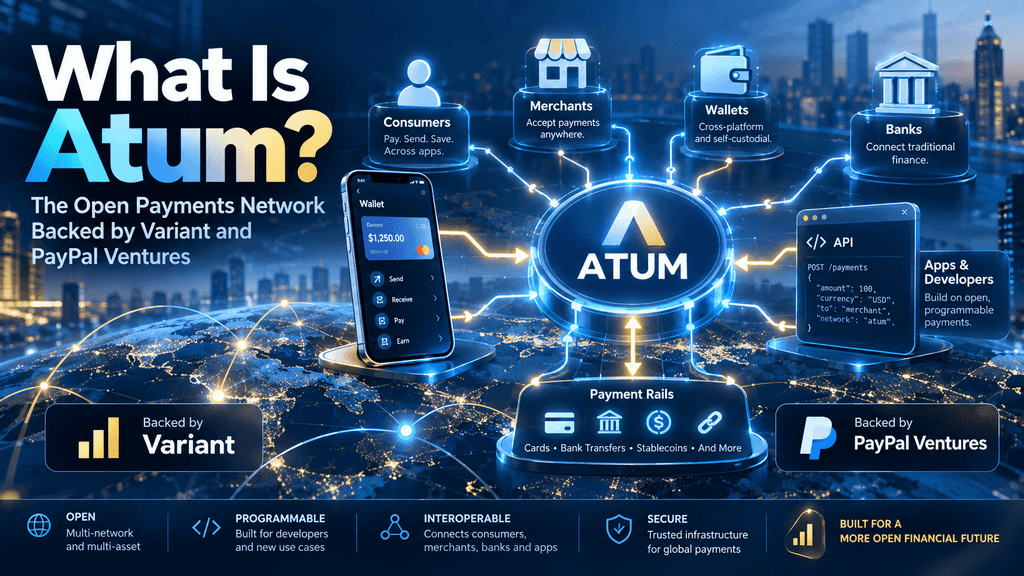
Atum has entered the digital payments market with a different approach to stablecoin infrastructure. Rather than launching another cryptocurrency, blockchain or closed payment ecosystem, the company is building an open payments network designed to connect stablecoins, blockchain-based settlement and established financial infrastructure. Atum emerged from stealth in September 2026 with $13.5 million in funding from investors including Variant and PayPal Ventures, drawing attention to a growing area of fintech focused on interoperability, programmable settlement and more efficient global money movement. The launch comes as understanding how stablecoins work becomes increasingly relevant beyond crypto trading, with these assets being explored for cross-border transfers, business payments and online commerce. At the same time, AI agents are creating demand for transactions that can occur directly between software systems. Atum is attempting to serve both trends by giving applications a way to access different settlement options through one network. Its support for emerging standards such as x402 and MPP also places the company within the developing market for automated digital commerce and machine-to-machine payments, where software may need to purchase services or digital resources without relying on a conventional checkout process.
What Is Atum? How the $13.5M Open Payments Network Works for Stablecoins and Global Money Movement
Atum is an open payments network designed to simplify global money movement across stablecoins, blockchains and traditional financial systems. The company emerged from stealth in September 2026 after raising $13.5 million from investors including Variant and PayPal Ventures. Instead of building its own blockchain or issuing a proprietary stablecoin, Atum provides infrastructure that connects developers, fintech companies, digital wallets, payment providers and enterprises with different settlement options. This approach is intended to give applications more flexibility when moving money across digital and conventional financial systems without requiring every participant to adopt the same underlying technology. It could also reduce the technical burden for businesses that want to support multiple payment methods without creating separate integrations for every blockchain or settlement provider. As stablecoin adoption expands across cross-border payments, digital commerce and fintech products, infrastructure that can coordinate between different systems may become increasingly valuable.
How the Atum Open Payments Network Works
The Atum payments network is based on a simple principle: senders and receivers should not have to manually coordinate every technical detail behind a transaction. When an application submits a payment request, independent settlement providers can compete to fulfill it using supported stablecoins, blockchain networks or other financial rails. Atum manages functions such as authorization, routing and confirmation, while the transfer itself is completed through the selected settlement infrastructure. For developers and payment companies, this structure could simplify the process of supporting several settlement methods within the same product rather than creating a separate workflow for each payment network. It also gives applications more flexibility to choose how payments are settled based on factors such as the asset, destination, network availability and transaction requirements. This can be especially useful for fintech platforms that need to support users across different regions and payment environments.
This model is intended to address a common problem in digital payments: different users often rely on separate wallets, currencies, networks and providers. A payment that appears simple to the customer may therefore require several integrations behind the scenes. Atum aims to reduce that complexity by making those systems easier to connect without requiring every participant to adopt the same blockchain or asset. The company also says it does not hold customer funds, keeping its role focused on payment infrastructure rather than custody. That distinction allows Atum to concentrate on coordinating transaction flows while settlement remains with the providers and financial rails involved in completing the payment. For businesses, this could make it easier to add stablecoin payments or blockchain-based settlement while preserving existing financial infrastructure. Over time, the value of this model will depend on how effectively Atum can connect more payment providers, settlement options and blockchain networks as demand for interoperable digital payments grows.
How Atum Routes Stablecoin Payments Across Blockchains and Payment Networks
Atum is designed to simplify stablecoin payment routing across blockchains, payment providers and settlement systems. Instead of requiring both parties to use the same asset or network, the sender can specify what it wants to pay while the receiver can define what it wants to receive. Atum then helps determine how that transaction can be completed through available providers. This model could be useful for fintech companies and developers that want access to several payment environments without maintaining a separate technical connection to every network. As digital payments expand across different blockchain ecosystems, reducing the number of individual integrations required could become increasingly important for applications serving users in multiple markets.
Stablecoin Payment Routing Across Multiple Networks
When a payment request enters the Atum network, independent settlement providers can respond with available ways to complete it. The final route can vary depending on the asset, destination, network availability and transaction requirements. Rather than locking an application into one settlement method, this structure gives businesses more flexibility to choose among compatible options while keeping the customer-facing payment process relatively simple. The underlying route may therefore change without requiring the user to manage every technical step involved in transferring value between different systems.
The approach is particularly relevant for cross-border transfers because stablecoins now operate across numerous blockchain ecosystems. A company may want to receive a particular asset on one network even when the sender begins with another form of value elsewhere. Atum is designed to help manage that mismatch at the infrastructure level. As stablecoin adoption expands, this type of payment orchestration could also reduce the number of direct technical connections that businesses need to maintain for international transactions. A more flexible routing layer may be especially useful for payment applications that need to support different assets, networks and settlement preferences across regions.
How Atum Connects Blockchain and Traditional Payment Infrastructure
Atum is not restricted to a single blockchain architecture. Its broader goal is to connect blockchain-based settlement with existing financial infrastructure so developers and payment companies can work across different systems without rebuilding their products around one network. The wider concept of blockchain interoperability similarly focuses on enabling separate networks to exchange data and value rather than remaining isolated ecosystems. This makes Atum more comparable to payment orchestration infrastructure than to a standalone cryptocurrency protocol. Businesses can potentially keep their existing payment setup while adding access to digital-asset settlement where it is useful.
That flexibility could become more important as payment technology becomes increasingly mixed. Digital wallets, stablecoins, banking systems and programmable financial services are often used together rather than in isolation. Instead of trying to replace those systems, Atum is designed to help applications move between them more efficiently. Its long-term usefulness will therefore depend on whether companies need a common infrastructure layer capable of handling transactions across both blockchain-based and conventional financial networks. The model could be particularly relevant as businesses look for ways to introduce blockchain settlement without rebuilding their existing payment architecture from the ground up.
Atum and AI Agent Payments: How x402 and MPP Enable Machine-to-Machine Transactions
Atum is also targeting a payments environment where AI agents and software applications can initiate transactions automatically. Alongside human payments, the network supports emerging machine-payment standards such as x402 and the Machine Payments Protocol (MPP). These standards are designed to let applications pay for digital services programmatically, while Atum can connect those requests with available settlement options. This capability could become increasingly relevant as autonomous software begins purchasing data, computing resources, APIs and other online services without using a traditional checkout flow. The combination of programmable payments and AI agents could create new transaction patterns where payments are triggered directly within software workflows.
How x402 Enables AI Agent Payments
x402 is an open payment protocol built around the HTTP 402 “Payment Required” status code, allowing software and AI agents to respond to payment requirements directly through web requests. Instead of redirecting a user to a conventional checkout page, an application can receive a payment instruction, satisfy it and continue accessing the requested resource. For developers, this creates the possibility of embedding payments directly into API calls, digital services and AI workflows, allowing access and payment to happen as part of the same software process. This model is particularly relevant for usage-based digital services where an AI agent may need to purchase a small amount of data, computing capacity or API access while completing a task.
How MPP Supports Machine-to-Machine Payments
The Machine Payments Protocol, or MPP, provides another framework for transactions initiated by software rather than people. Its broader purpose is to help machines exchange value using different payment methods as autonomous applications become more capable. An AI system, for example, could need to buy computing power, access specialized data or pay for a digital tool during a task. Atum's support for MPP gives developers another route for connecting these automated requests to stablecoins and other settlement infrastructure. This could become useful in an environment where AI applications interact with multiple paid services and need payment mechanisms that operate as naturally as other machine-to-machine requests.
Atum as a Coordination Layer for Agentic Payments
Atum plays a different role from x402 and MPP because those protocols define how machines can request or initiate payments, while Atum focuses on how those payments can be fulfilled across available financial systems. A software agent may trigger a transaction through one of these standards, and the Atum network can then help manage authorization, route selection and confirmation. This separation could make agentic payments easier to scale because applications would not need custom transaction logic for every blockchain, provider or settlement method they might encounter. It also gives developers more flexibility to build AI payment experiences without tying the entire application to a single settlement technology.
Why AI Agent Payments Matter for Atum
AI-driven commerce could create a new class of transactions in which software buys services, pays for information and exchanges value with other applications in real time. Atum's support for x402 and MPP gives the network exposure to this emerging market while extending its usefulness beyond conventional consumer transactions. If automated commerce grows, developers may increasingly need payment infrastructure that can connect software agents with several financial systems instead of relying on a single blockchain or payment provider. That could make programmable payment infrastructure an important part of the technology stack behind autonomous applications, particularly where agents need to interact with multiple commercial services during a single workflow.
Why Variant and PayPal Ventures Backed Atum and the Future of Digital Payments
Atum's $13.5 million funding brought together investors including Variant and PayPal Ventures, both of which have experience across digital assets, fintech and payment technology. Their participation reflects wider investor interest in infrastructure that can make blockchain-based settlement easier to integrate with existing financial products. Rather than competing for adoption through a new token or proprietary chain, Atum is focused on the connective technology needed when different payment systems have to work together. The investment also places attention on payment infrastructure as stablecoins and programmable transactions move closer to practical use cases in commerce, fintech and international money movement.
Why Investors Are Focusing on Stablecoin Payment Infrastructure
Variant has previously argued that wider stablecoin adoption will require neutral infrastructure capable of connecting wallets, payment systems and blockchain networks. Atum fits that broader thesis because its business is centered on making transactions possible across different settlement environments rather than competing directly with stablecoin issuers. That approach becomes more relevant as digital dollars move into areas such as business payments, international transfers, online commerce and programmable financial services. Infrastructure that reduces fragmentation could become increasingly valuable if companies want to use stablecoins without committing their entire payment operation to one blockchain or provider.
PayPal Ventures' participation also points to the increasing overlap between established payment companies and blockchain-based settlement technology. Stablecoins may make some transfers faster or more programmable, but businesses still require services such as authorization, integration, transaction management and compatibility with existing systems. Atum is targeting those infrastructure needs while also exploring newer forms of commerce involving AI agents. The company's progress will depend on whether developers, financial businesses and settlement providers adopt the network at sufficient scale. It will also need to demonstrate that coordinating multiple payment systems can produce meaningful improvements in cost, integration complexity or transaction experience for businesses and their customers.
🔥 Beyond the Headlines: What KuCoin 5.0 Means for You
Market news moves fast — but where you act on it matters just as much. This October, KuCoin launches KuCoin 5.0, transforming KuCoin into a rebuilt platform. Here's what actually changes for you:
-
One account for everything. Older platforms split your money across separate "spot," "margin," and "futures" accounts and expected you to understand why. KuCoin 5.0's unified account removes that entirely — deposit once, and everything is simply there (only available to VIPs for now).
-
Stocks, indices, and commodities. KuCoin 5.0 expands beyond crypto into global markets. When crypto chops sideways and equities rally (or the reverse), you rotate in minutes instead of opening a brokerage account and waiting days for fiat rails.
-
Real-world assets (RWA). Tokenized exposure to traditional assets like commodities, right inside your crypto account. One of the fastest-growing segments in global finance is no longer reserved for institutions — you access it from the same balance you trade with.
-
Earn while you learn. Not ready to trade? KCUSD lets your stablecoins earn daily, auto-compounding interest. The lowest-stress way to put your idle deposit to work for 4% yield.
-
An AI assistant in plain language. Ask questions, get market context, understand what you're looking at — built into the platform, no jargon required.
-
An app that doesn't overwhelm. Faster, cleaner, and consistent — intuitive from the first tap, not after a tutorial.
-
Safety you can check, not just trust. A MiCAR-licensed EU entity, Proof of Reserves you can verify yourself, and internationally certified security (SOC 2 Type II, ISO 27001:2022).
Create your account in minutes — and start on the platform built for where crypto is going, not where it's been.
Conclusion
Atum is entering the payments market as stablecoins, programmable settlement and AI-driven commerce become increasingly connected. Its strategy is not built around launching another digital asset. Instead, the company is developing infrastructure intended to make different financial systems easier to use together, whether a transaction starts with a blockchain application, a fintech product or an automated software agent. The $13.5 million backing from investors including Variant and PayPal Ventures gives Atum an early foundation, but adoption will ultimately determine its role in the digital payments market. Developer integrations, settlement-provider participation and real-world payment activity will be more important than funding alone. If businesses increasingly need to move value across stablecoins, blockchains and conventional financial systems, Atum's ability to simplify that process will be the main factor to watch as the broader market for interoperable and programmable payments develops.
FAQs
What is Atum used for in digital payments?
Atum is designed to help applications and payment providers coordinate transactions across stablecoins, blockchain networks, and traditional financial infrastructure. Its main role is to simplify how payments are routed between different systems, which can be useful for cross-border transfers, fintech applications, digital wallets, and programmable payment services.
Does Atum have its own token or blockchain?
Atum has not announced a native token and does not position itself as a new blockchain network. Instead, it focuses on payment infrastructure that connects existing systems. This makes Atum different from crypto projects that depend on a proprietary coin or chain to process transactions.
How does Atum support stablecoin payments?
Atum supports stablecoin payments by helping route transactions through available settlement providers and compatible payment rails. The sender and receiver do not necessarily need to use the same network or asset, which can reduce some of the technical complexity associated with moving value across different blockchain ecosystems.
Can Atum be used for cross-border payments?
Cross-border payments are one of the use cases that could benefit from Atum's architecture because international transactions often involve different currencies, networks, and settlement systems. Atum aims to make those systems easier to connect, although actual availability will still depend on supported providers, jurisdictions, and compliance requirements.
How is Atum connected to AI agent payments?
Atum supports emerging machine-payment standards such as x402 and MPP, which are designed to let software and AI agents initiate transactions programmatically. This could allow autonomous applications to pay for APIs, data, computing resources, or digital services without relying on a traditional checkout flow for every transaction.
Disclaimer: This article is for informational purposes only and does not constitute investment advice. Crypto assets can be highly volatile, and market conditions, token liquidity and project developments may change rapidly. Readers should conduct their own research and assess their risk tolerance before making financial decisions.