

AI Agent Wallets in 2026: How Crypto Is Being Rebuilt for Autonomous On-Chain AI
Introduction
At Consensus 2026 on May 9, two of the most-watched infrastructure executives in crypto said the same thing in different words: AI agents are forcing wallets to be rebuilt from scratch. Trust Wallet CEO Felix Fan and Mesh CTO Arjun Mukherjee outlined a future in which AI agents hold assets, execute on-chain transactions, and carry verifiable on-chain identities — turning crypto wallets into the default financial layer for autonomous software.
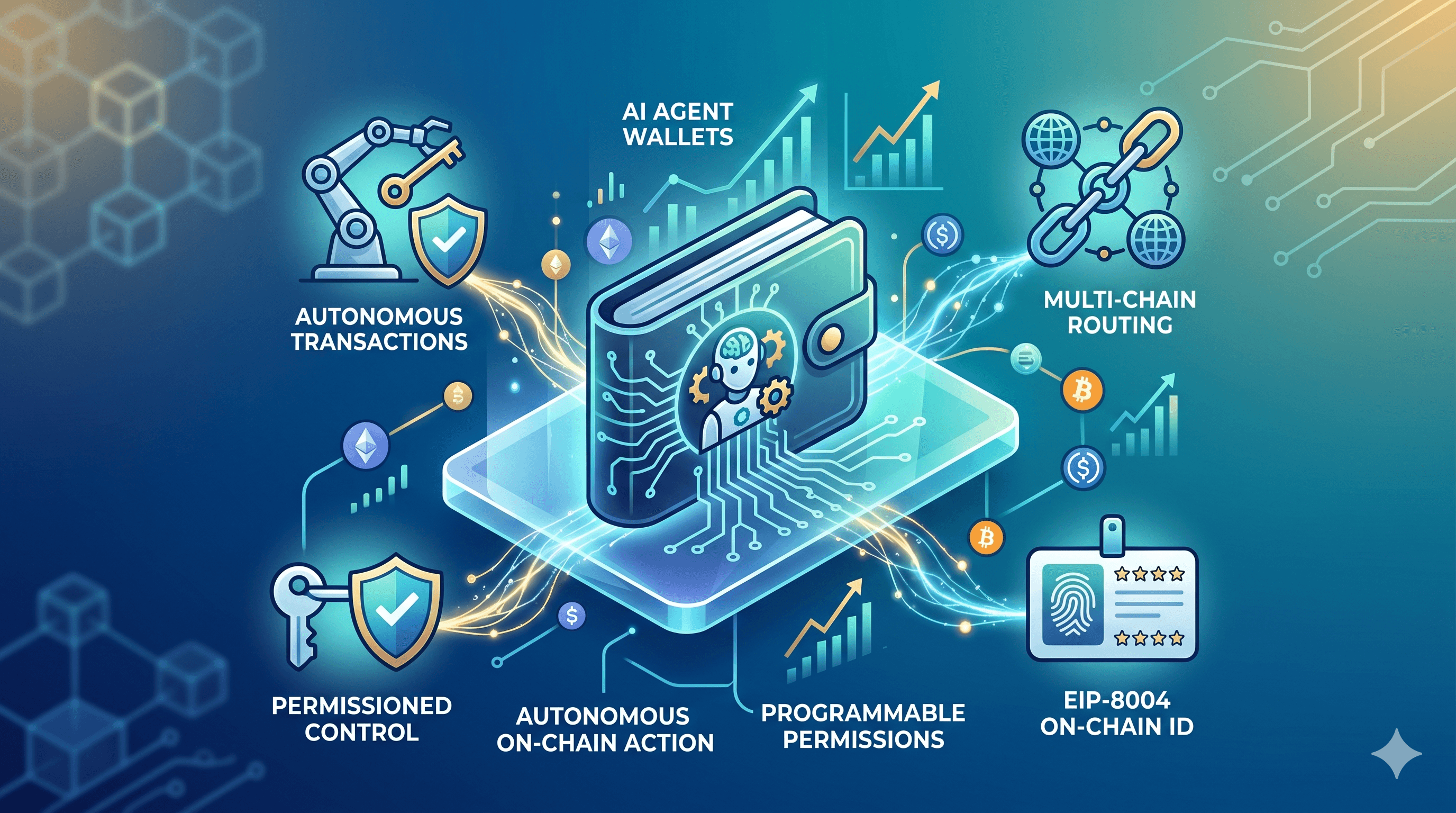
The short answer to what an AI agent wallet is: a wallet architecture that lets an AI agent independently sign transactions, route funds across chains, and accumulate an on-chain reputation, all under a permission framework defined by the human owner or developer. This is not a UX upgrade. It is a structural reset of who — or what — counts as a wallet user. Trust Wallet's newly launched Agent Kit and Mesh's Smart Funding technology are the first production-grade examples, and Ethereum's EIP-8004 proposal aims to give every AI agent a native on-chain identity and credit score.
What Is an AI Agent Wallet?
An AI agent wallet is a wallet architecture designed for autonomous software agents rather than human users, enabling an AI model to custody crypto assets, execute on-chain transactions, and build a persistent on-chain identity. The wallet still uses standard cryptographic primitives — keys, signatures, smart contract accounts — but the permission model, session handling, and identity layer are redesigned around the assumption that a non-human entity is the active operator.
The core distinction from traditional wallets is autonomy. A traditional wallet requires a human to approve each signature. An AI agent wallet operates under pre-authorized policies that let the agent act within defined limits — spend caps, allowed contracts, time windows, asset whitelists — without prompting the human for every action.
The Two-Tier Architecture
According to Felix Fan's framing at Consensus 2026, the emerging architecture splits along consumer and developer lines:
-
Consumer side: the human still holds the keys, and the AI acts as an on-chain operations assistant under progressive authorization. Each meaningful action either prompts the user or operates within tightly scoped limits.
-
Developer side: the agent operates with much broader autonomy, executing trades, transfers, and contract interactions inside its own custody domain.
This split matters because it lets the same underlying wallet stack serve very different risk profiles — a retail user trying ChatGPT-style trade assistance versus a hedge fund deploying a fully autonomous market-making agent.
Why Are AI Agents Driving Crypto Wallet Redesign?
AI agents are driving crypto wallet redesign because traditional wallet UX assumes a human is always in the loop — and that assumption breaks the moment an agent needs to act in real time without supervision. The mismatch between human-paced approval flows and machine-paced execution is the central design problem the industry is now solving.
The Cold-Start Problem
According to Mesh CTO Arjun Mukherjee at Consensus 2026, one of the biggest obstacles for AI agents is the cold-start problem: without a wallet and funds, an agent cannot actually do anything on-chain. Agents need a financial layer to operate, and crypto wallets are the most natural fit because they are programmable, permissionless to provision, and globally interoperable.
A purely off-chain AI agent can read, reason, and recommend. An on-chain AI agent can pay, transact, and commit capital. The latter is dramatically more valuable, but it requires a wallet that an agent can use natively.
The Real-Time Execution Problem
Human approval queues do not survive at machine speed. An AI agent rebalancing a portfolio, paying for inference compute, or arbitraging across venues makes hundreds of decisions per minute. A wallet that prompts the user for each signature collapses the agent's effective speed to human speed and destroys most of the value.
The solution is session keys, scoped permissions, and policy-based authorization — primitives that let the agent act independently inside a fenced area while the human retains override and revocation power outside that fence.
The Identity and Reputation Problem
An AI agent that has executed thousands of clean transactions should be more trusted than one that has never moved a token. Traditional wallets do not carry identity or reputation — they are anonymous by design. AI agents need persistent identity so counterparties can decide whether to interact with them, extend credit to them, or admit them into permissioned environments.
This is exactly the gap that Ethereum's EIP-8004 proposal is designed to fill.
What Is Trust Wallet's Agent Kit?
Trust Wallet's Agent Kit is a developer toolkit launched in 2026 that lets AI agents autonomously execute on-chain operations — including trades, transfers, and contract calls — within permission scopes defined by the developer or end user. It is one of the first production-grade attempts to standardize the wallet layer for autonomous agents.
What Agent Kit Enables
Based on the framework described by Felix Fan at Consensus 2026, Agent Kit provides:
-
Programmatic wallet provisioning for individual agents or fleets of agents
-
Session-key issuance with scoped permissions covering allowed contracts, asset caps, and time windows
-
Multi-chain execution across the networks Trust Wallet already supports
-
Integration hooks for AI model APIs so that an agent can pass natural-language intent into wallet actions
Why a Major Wallet Is Doing This
Trust Wallet's move signals that mainstream wallet providers — not just crypto-native experimental teams — are treating AI agents as a first-class user category. Fan's position is that the consumer wallet remains user-key-controlled with progressive authorization, while developer-facing infrastructure enables broader agent autonomy. The same wallet stack serves both, with different permission defaults.
What Is Mesh's Smart Funding and Why Does It Matter?
Mesh's Smart Funding is an automated routing technology that moves capital across chains, accounts, and tokens behind the scenes, eliminating the manual bridging and swapping that historically broke AI agent workflows. The product targets the operational friction that prevents agents from acting fluidly across the fragmented multi-chain environment.
The Multi-Chain Problem
An AI agent that needs to execute a strategy across Ethereum, Solana, and a Layer-2 rollup currently has to handle bridge selection, gas token management, slippage tolerance, and settlement timing on each leg. Each of these is a place where the agent can get stuck or lose money. Smart Funding abstracts the routing decisions into a single call.
Why This Unlocks Agents
According to Mukherjee, the value of Smart Funding for AI is operational — it removes the dozens of decisions an agent would otherwise make incorrectly and replaces them with a single funded outcome. The agent specifies what it wants to do; the routing layer figures out how to get the right token to the right chain at the right time.
This is the equivalent of giving an AI agent a corporate treasury function that handles cash management automatically, so the agent can focus on the strategy layer rather than the plumbing.
What Is EIP-8004 and How Does It Give AI Agents On-Chain Identity?
EIP-8004 is an Ethereum Improvement Proposal designed to give AI agents native on-chain identity and credit scoring, allowing every agent to carry a verifiable reputation that counterparties can query before transacting. Trust Wallet is among the parties actively advancing the proposal.
What On-Chain Identity Enables
An on-chain agent identity is a persistent, cryptographically verifiable record that can carry:
-
Transaction history and operational track record
-
Counterparty ratings from previous interactions
-
Compliance attestations from issuers
-
Capability descriptions — what the agent is authorized to do
-
Credit scores derived from on-chain behavior
This identity layer is what lets one AI agent decide whether to extend credit, accept a payment commitment, or open a service relationship with another AI agent. Without it, every agent-to-agent interaction starts from zero trust.
Why It Matters for the Broader Ecosystem
Agent-to-agent commerce is the largest emerging use case in this space. Two AI agents negotiating a price for compute, data, or services need a way to verify each other's reliability. EIP-8004 provides that primitive at the protocol level, which is far stronger than any platform-specific reputation system.
|
Wallet Capability
|
Traditional Wallet
|
AI Agent Wallet
|
|
Primary user
|
Human
|
AI agent or human
|
|
Signing model
|
Per-transaction approval
|
Session keys + policy scopes
|
|
Identity layer
|
Anonymous by default
|
Persistent on-chain identity (EIP-8004)
|
|
Cross-chain operation
|
Manual bridging
|
Automated routing (e.g., Smart Funding)
|
|
Speed of execution
|
Human-paced
|
Machine-paced inside scoped permissions
|
Will Major AI Platforms Launch Their Own Wallets?
Yes — major AI platforms are expected to launch their own native wallets, and the trend is already visible in announcements from X and likely extensions to Grok and other large model providers. Felix Fan stated at Consensus 2026 that X has publicly advanced X Money and that Grok is likely to ship with an embedded wallet, with the implication that Claude and other major AI assistants may eventually operate directly on-chain.
Why AI Platforms Want Their Own Wallets
For a large AI platform, owning the wallet layer is strategically equivalent to owning the payment rail. It controls the unit economics of every AI-mediated transaction, generates a defensible data moat, and allows the platform to monetize agent activity directly. The platforms that move first will set the defaults that hundreds of millions of users adopt.
What This Means for Existing Wallets
Existing wallet providers face a choice: become the infrastructure layer that AI platforms build on, or be replaced by vertically integrated competitors. Trust Wallet's Agent Kit is clearly an infrastructure-layer play — it positions Trust as the wallet stack that any AI platform can plug into rather than competing head-on with platform-owned wallets.
The likely outcome is a layered market. AI-native wallets at the consumer surface, infrastructure wallets like Trust Wallet underneath, and protocol-level identity standards like EIP-8004 binding the whole stack together.
What Are the Risks of AI Agent Wallets?
The main risks are autonomy overreach, key management at scale, exploit propagation, and unresolved liability when an agent acts incorrectly. Each of these gets worse as agents handle larger balances and more counterparties.
Autonomy Overreach
An AI agent operating outside its intended scope can drain assets faster than a human can react. Permission scopes must be defined precisely, but defining them precisely is hard — agents act on language-based intent, and language is ambiguous. A scope that says "rebalance my portfolio" leaves significant room for unintended interpretation.
Key Management at Scale
A single agent may need multiple session keys across multiple chains, each with limited lifetimes. Managing this at the scale of thousands or millions of agents is operationally complex and introduces new categories of failure mode that traditional wallet UX never had to handle.
Exploit Propagation
If a vulnerability is discovered in a popular agent framework, every wallet running that framework becomes exposed simultaneously. Unlike human users who patch at different times, agent fleets update uniformly — meaning attack surfaces concentrate rather than disperse.
Liability Ambiguity
When an AI agent makes a costly mistake — wrong contract, wrong chain, wrong counterparty — it is currently unclear who is responsible. The model provider, the wallet provider, the developer who configured the permissions, and the user who deployed the agent all have partial responsibility. Legal frameworks have not caught up.
Conclusion
AI agent wallets are the structural bridge between autonomous software and on-chain capital. Trust Wallet's Agent Kit, Mesh's Smart Funding, and Ethereum's EIP-8004 proposal — all advanced or surfaced around Consensus 2026 — sketch a coherent stack in which AI agents can hold assets, route capital across chains, and carry verifiable identities. This is not a UX refresh. It is the wallet category being rebuilt around a new primary user.
The two-tier architecture matters. Consumer wallets keep the human in the loop with progressive authorization, while developer-side infrastructure unlocks fully autonomous agent operation. The same underlying primitives — session keys, scoped permissions, on-chain identity — serve both, with different defaults.
The risks are real and unresolved. Autonomy overreach, key management at scale, exploit propagation, and liability ambiguity will shape regulation and product design over the next 12 to 24 months. But the direction is clear: every major AI platform will eventually need a wallet, and the infrastructure being built today decides whether that wallet is platform-owned, wallet-provider-owned, or protocol-native. For investors and developers, this is one of the largest emerging surfaces in crypto.
Frequently Asked Questions (FAQs)
Can I create an AI agent wallet today as a regular user?
Yes, in limited form. Developer toolkits like Trust Wallet's Agent Kit and several open-source agent frameworks let technical users provision wallets that AI agents can operate. Fully consumer-friendly versions — where a non-technical user can spin up an AI agent wallet with one click and sensible default permissions — are still in early rollout and expected to mature through 2026.
How does an AI agent wallet differ from a multisig or smart account?
An AI agent wallet typically is a smart account or uses smart-account features, but its distinguishing trait is permission scoping designed for autonomous machine operation rather than multi-human approval. Multisigs require multiple human signers; agent wallets require one or zero human signers within pre-authorized policy bounds.
What happens if an AI agent gets hacked or behaves incorrectly?
If an agent is compromised or misbehaves within its authorized scope, losses are bounded by the permission limits set when the wallet was provisioned. If the agent acts outside scope due to a bug, the loss surface depends on how tightly the wallet enforces those scopes at the cryptographic level. Best-practice deployments use hard on-chain limits rather than soft application-level limits.
Are AI agent transactions taxable?
Tax treatment of AI-agent-executed transactions follows the same rules as user-initiated transactions in most jurisdictions — the human or entity that owns the wallet is generally responsible for tax reporting. The added complexity is volume: an active agent can generate thousands of taxable events, making automated tax reporting infrastructure essential.
Which blockchains are best suited to host AI agents?
Networks with low transaction costs, fast finality, account-abstraction support, and deep developer tooling are best suited. Ethereum and its rollups lead on standards work like EIP-8004 and account abstraction, while high-throughput chains like Solana lead on raw transaction economics. Most production agent deployments are expected to be multi-chain rather than locked to a single network.