
Understanding Futures Prices
Beginner
When trading perpetual futures, you may see several prices on the trading page: Last Price, Index Price, and Mark Price.
They can be close to each other, but they do not mean the same thing. Each price has a different source and purpose. Knowing the difference helps you understand your position, avoid confusion during volatile markets, and use risk controls more effectively.
Index Price
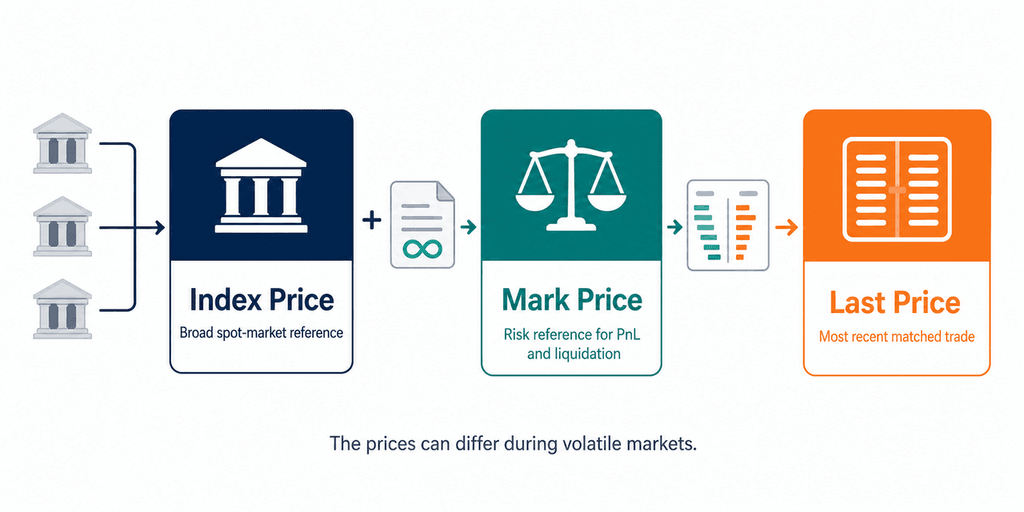
The Index Price is designed to reflect the broader spot-market value of an asset.
It is generally calculated from prices across a selected group of external spot markets, rather than from one futures order book. Using multiple market inputs helps reduce the influence of an unusual quote or temporary price move on a single venue.
Think of Index Price as an external market reference.
If BTC is trading near the same level across several major spot markets, the Index Price is intended to represent that broader consensus. Exact index constituents and calculation methods vary by platform and contract.
Last Price
The Last Price is the price of the most recently completed trade on the futures platform.
It updates whenever a buyer and seller match. This makes it useful for seeing the latest execution, but it can also be sensitive to short-term order-book conditions.
For example, during a fast market, a large market order may be executed across several price levels. If the order book is thin, the final small portion of that order may trade at a noticeably different price. The Last Price may briefly reflect that isolated execution, even if the broader market has not moved by the same amount.
Think of Last Price as the most recent transaction, not necessarily the most stable estimate of fair market value.
Mark Price
The Mark Price is a risk-management reference.
It is generally derived from the Index Price together with relevant perpetual-futures pricing conditions, such as the difference between the futures contract and the underlying spot market. Its purpose is to provide a more resilient reference during temporary dislocations in the futures order book.
On many futures platforms, Mark Price is used for key risk calculations, including:
-
Unrealized PnL
-
Liquidation price and liquidation risk
-
Some conditional-order triggers, when Mark Price is selected
This means a brief spike in Last Price does not necessarily produce the same move in unrealized PnL or liquidation risk.
Why can prices differ?
A difference between these prices is not automatically an error. It may occur when:
-
Volatility increases rapidly;
-
Futures order-book depth becomes thin;
-
A large order sweeps multiple price levels;
-
The perpetual contract trades at a temporary premium or discount to spot markets;
-
Liquidity providers adjust or withdraw quotes.
The important question is not whether the prices are identical at every moment. It is whether the difference is reasonable in size, duration, and market context.
A simple example
Suppose a perpetual contract is generally trading around 100.
A sudden market sell order moves through a thin order book, and the latest trade prints at 96. The Last Price may briefly show 96.
However, if the broader spot market remains close to 100, the Index Price may stay near 100. The Mark Price may also remain closer to that broader reference than to the isolated 96 trade.
This design helps prevent a single short-lived transaction from having an outsized impact on position-risk calculations.
What should traders check?
Before opening a leveraged position, make sure you understand:
-
Which price drives liquidation risk
Check the platform’s rules for Mark Price and liquidation calculations. -
Which price triggers your conditional order
Stop-loss and take-profit orders may use Last Price, Mark Price, or another selected trigger reference. -
Whether the market is liquid enough for your order size
Review order-book depth and recent trades, particularly for less-liquid contracts. -
Whether a price difference is temporary or persistent
A brief gap can occur in normal market conditions. A large or persistent gap deserves closer attention.
Key takeaway
Index Price looks at the broader spot market. Last Price reflects the latest futures trade. Mark Price provides a more stable reference for position-risk calculations.
These mechanisms do not remove the risks of leverage or volatile markets. But understanding how they work helps traders interpret what they see on the screen and make more informed risk decisions.
Futures trading involves substantial risk. Always understand the relevant contract rules, order-trigger settings, leverage, and liquidation mechanism before trading.
Disclaimer: The information on this page may come from third parties and does not necessarily reflect KuCoin’s views. It is provided for general reference only and should not be interpreted as financial or investment advice.
Virtual asset investments may involve risk. Please carefully assess the product risks and your own risk tolerance. For more information, please refer to our Terms of Use and Risk Disclosure.