
Beware of Bank Transfer Fraud: Protect Your Funds
Beginner
As cryptocurrency adoption continues to grow, bank transfers have become a convenient way for users to deposit funds and purchase digital assets. However, this process has also become a target for fraudsters, who use various tactics to deceive users into transferring funds or to misuse stolen bank accounts for illicit transactions. As an exchange committed to user security, we hope this guide will help you understand common fraud schemes related to bank transfers and how to prevent them, so that every transaction you make remains safe and secure.
Key Takeaways
-
Be cautious of any request to withdraw funds to an unfamiliar wallet address: No matter how trustworthy someone may appear, any request to transfer your digital assets to an external wallet should be treated as a potential scam.
-
Protect your bank account information: Never share your bank card number, password, verification codes, or online banking login details with anyone.
-
Use only your own bank account for transfers: Depositing funds using someone else’s account not only violates platform rules but may also expose you to legal risks.
-
Verify the recipient before making a transfer: Ensure that the receiving account is an officially designated account of the exchange to avoid phishing scams.
-
Contact official customer support if anything seems suspicious: Always verify information through the exchange’s official channels and never rely solely on messages from unfamiliar individuals.
Common Fraud Schemes You Should Know
Fraudsters often exploit users’ limited familiarity with cryptocurrency or their desire for high returns. Below are two common categories of scams involving bank transfers.
Type 1: Inducing Users to Transfer Funds and Withdraw to the Scammer
In these scams, you are the direct victim. Fraudsters gain your trust through carefully crafted communication and then persuade you to deposit fiat funds on the exchange, purchase cryptocurrency, and ultimately withdraw those assets to a wallet address controlled by them.
Common tactics include:
-
“Pig Butchering” Investment Scam
Fraudsters establish emotional relationships with victims through social media or dating platforms. Once trust is built, they propose a “profitable investment opportunity” and guide the victim to deposit funds on an exchange and transfer cryptocurrency to a designated wallet. Once the transfer is completed, the scammer disappears. -
Fake Investment Platforms
Scammers create fraudulent websites or apps that appear to be legitimate investment platforms, promoting themselves with slogans such as “professional analysis” or “guaranteed profits.” Victims are instructed to deposit funds via bank transfer, purchase cryptocurrency, and transfer it to the so-called investment platform. In reality, the platform is controlled by the scammer, and funds transferred there cannot be recovered. -
Impersonating Official Customer Support
Fraudsters pose as exchange customer support representatives, claiming that your account has security issues or requires “verification” or an “upgrade.” They then instruct you to transfer your assets to a “secure wallet,” which is actually controlled by the scammer. - High-Reward Commission Scams
Scammers promise large commissions for completing tasks such as making transfers or inviting new users. Victims are asked to deposit funds and withdraw cryptocurrency as part of the process, but the promised rewards never materialize.
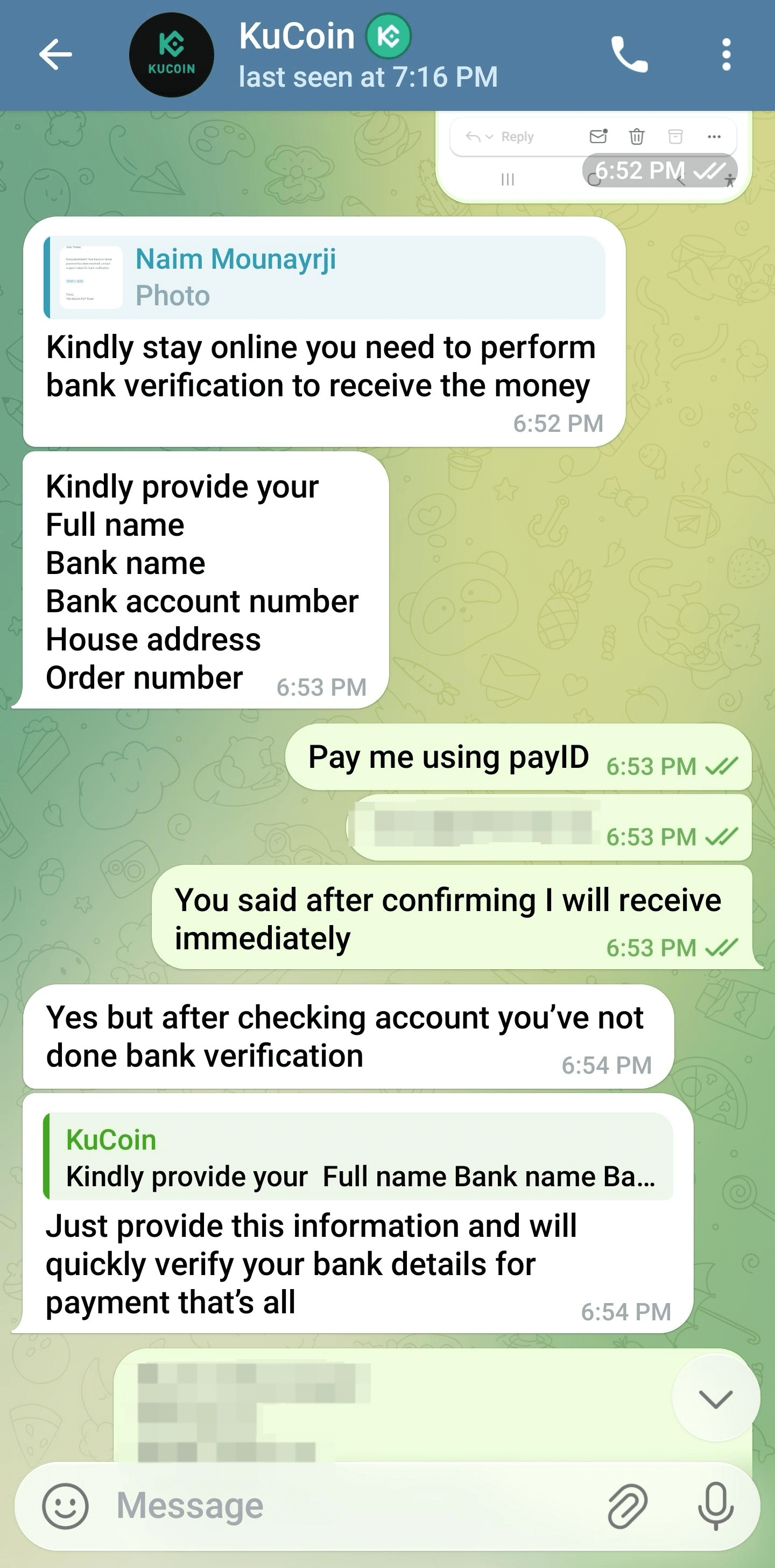
Scammers impersonating security customer service
Type 2: Using Stolen Bank Accounts for Deposits
In this type of fraud, the bank account holder is the victim, while the person using the stolen account may be the scammer or an unsuspecting individual being manipulated.
Common tactics include:
-
Phishing Websites Stealing Banking Information
Fraudsters create fake websites that imitate banks or exchanges and trick users into entering their bank card numbers, passwords, and verification codes. Once the information is obtained, the scammers use the victim’s bank account to deposit funds into an exchange and quickly withdraw the cryptocurrency.
Phishing websites set up by scammers
- Malware Stealing Banking Credentials
Through malicious links or infected software, scammers install malware on victims’ devices to capture online banking login details. They then use stolen information to conduct unauthorized transfers. - Tricking Others Into “Lending” Their Bank Accounts
Fraudsters offer payment in exchange for the use of someone’s bank account to transfer funds. The money involved often originates from illegal activities, and participants may unknowingly become accomplices in money laundering. -
Purchasing Bank Accounts for Money Laundering
Fraudsters may offer cash to buy unused bank accounts from individuals. These accounts are then used to receive illegal funds and move them through cryptocurrency transactions. Selling your account could result in legal consequences.
Real-Life Scam Cases
Case 1: The “Investment Mentor” Scam
Mr. Li met someone on social media who claimed to be an experienced cryptocurrency analyst. The person frequently shared “investment insights” and screenshots of impressive profits. After gaining Mr. Li’s trust, the scammer recommended a “guaranteed profit project” and instructed him to deposit 100,000 RMB via bank transfer to purchase USDT on an exchange. The scammer then provided a “project wallet address” and asked Mr. Li to transfer the USDT. Once the transfer was completed, the so-called mentor disappeared, and Mr. Li lost all of his funds.
Lesson: Any investment opportunity that asks you to transfer cryptocurrency to an external wallet address should be treated with extreme caution. Never rely on investment advice from strangers.
Case 2: The “Official Customer Support” Scam
Ms. Wang received a text message claiming that her exchange account had suspicious activity and required immediate assistance from customer support. She clicked a link in the message and was directed to a fake “official website,” where she contacted a supposed support representative. The scammer told her to transfer her assets to a “secure address” for verification. Following the instructions, Ms. Wang deposited funds via bank transfer, purchased cryptocurrency, and withdrew it to the address provided. She ultimately lost 50,000 RMB.
Lesson: Exchanges will never ask you to transfer assets to an external address. If you receive suspicious messages, always verify them through the official app or website.
Case 3: Bank Account Misuse
Mr. Zhang entered his bank card details on a website. Shortly afterward, he discovered a transfer of 50,000 RMB from his bank account to a cryptocurrency exchange—an action he never performed. Investigations revealed that his banking information had been stolen through a phishing website. The scammers used his account to deposit funds into the exchange and quickly withdrew the cryptocurrency. Mr. Zhang not only suffered financial losses but also had to cooperate with law enforcement and his bank in a lengthy investigation.
Lesson: Never enter banking information on unfamiliar websites. Regularly review your bank transaction records and immediately freeze your account and report to authorities if suspicious activity occurs.
Case 4: The “Borrowed Account” Trap
A university student, Xiao Chen, was persuaded by an online acquaintance to lend his bank account in exchange for 200 RMB per transfer. He provided his bank card and password. A few days later, police contacted him and informed him that his account had been used to receive funds from fraud victims. The scammer had used his account to deposit money into an exchange and convert it into cryptocurrency to facilitate money laundering. Xiao Chen was subsequently investigated for assisting in illegal online activities.
Lesson: Never lend or sell your bank account to others. Doing so may make you an accomplice to criminal activity and expose you to legal liability.
How to Protect Yourself from Bank Transfer Fraud
Preventing Fraudulent Transfer Scams
-
Be wary of “high-return” promises: Any investment claiming guaranteed profits or quick returns is almost certainly a scam. If it sounds too good to be true, it probably is.
-
Do not transfer funds to unfamiliar wallet addresses: Regardless of the reason provided, always refuse requests to withdraw cryptocurrency to unknown external addresses.
-
Verify official information: If you receive any message claiming to be from the exchange, verify it through the official app, website, or verified social media accounts.
-
Maintain control of your account: Never allow others to operate your account, and never share passwords or verification codes.
-
Stay calm under pressure: Scammers often create a sense of urgency to force quick decisions. If you are asked to transfer funds immediately, pause and evaluate the situation carefully.
Protecting Your Bank Account
-
Safeguard your banking information: Do not enter bank card numbers, passwords, or verification codes on unknown websites. Be vigilant against phishing websites and scam messages.
-
Check your bank account regularly: Make it a habit to review transaction records. If you detect suspicious activity, immediately contact your bank, freeze the account, and report the incident.
-
Do not lend or sell your bank account: Any offer to pay you for using your account could involve criminal activities.
-
Use your own account for transactions: When depositing funds on an exchange, always use a bank account registered under your own name. Using someone else’s account may lead to frozen funds or legal risks.
-
Enable banking security features: Activate transaction alerts, transfer limits, and other security measures to strengthen account protection.
Platform Security Reminder
-
Ask you to transfer cryptocurrency to an external wallet address for “verification” or “account upgrades”
-
Contact you through unofficial channels to request passwords, verification codes, or other sensitive information
-
Promise any form of guaranteed investment returns or ask you to participate in external investment programs
-
Require you to use someone else’s bank account to deposit funds
If you encounter any of the above situations, stop immediately and report the incident through official customer support channels.
Conclusion
Bank transfers provide a convenient way to fund cryptocurrency purchases, but they also require constant vigilance. Fraudsters are skilled at exploiting trust and greed to create convincing traps, and once funds are transferred, recovery can be extremely difficult. By understanding common scam tactics, protecting your account information, and maintaining a healthy level of skepticism toward suspicious activities, you can enjoy a safer cryptocurrency trading experience.
‼️ Please remember:
-
Maintain full control of your account and funds—never allow others to manage them
-
Treat any request to withdraw funds from external wallets with extreme caution
-
Protect your bank account information and never lend or sell your account
-
If something seems too good to be true, it probably is
-
Whenever in doubt, verify through official channels immediately
Protecting your assets is a shared responsibility. Stay vigilant and trade safely.
Disclaimer: The information on this page may come from third parties and does not necessarily reflect KuCoin’s views. It is provided for general reference only and should not be interpreted as financial or investment advice.
Virtual asset investments may involve risk. Please carefully assess the product risks and your own risk tolerance. For more information, please refer to our Terms of Use and Risk Disclosure.