
Stay Alert to Payment Fraud: Identify Scams and Protect Your Funds
Beginner
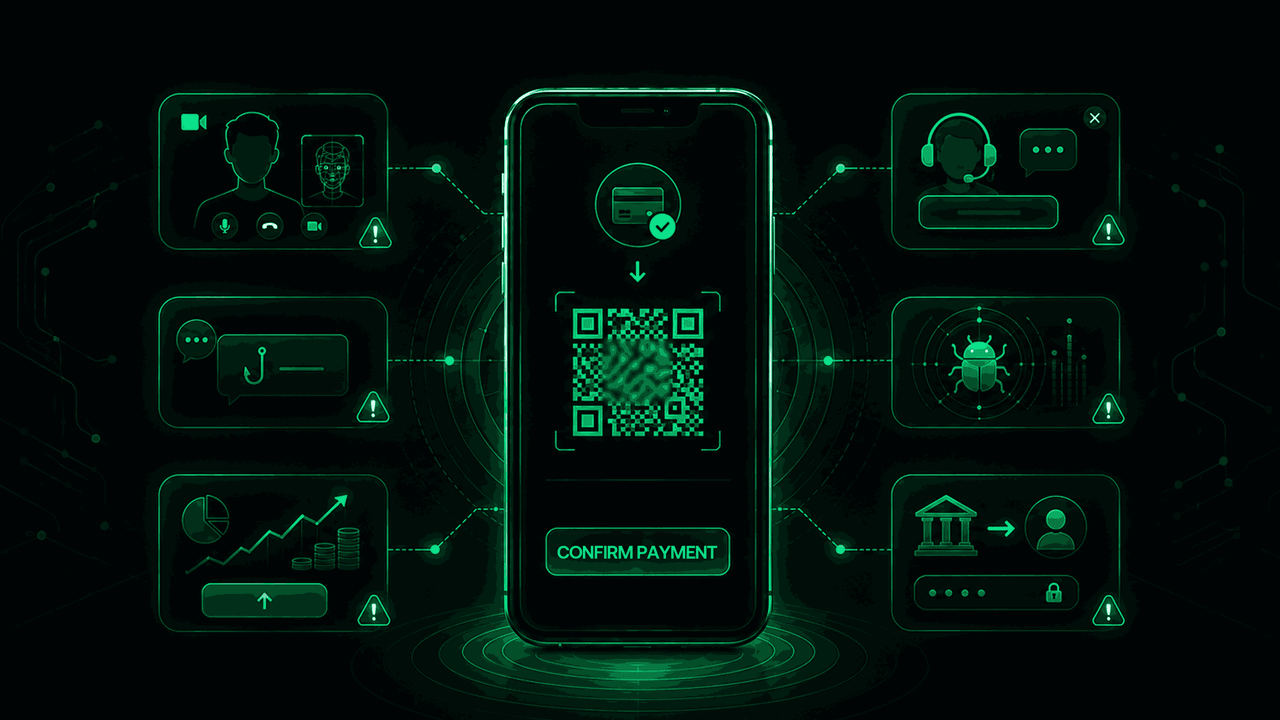
Mobile payments, bank transfers, QR code payments, online top-ups, and other forms of payment have become core methods for daily consumption, fund transfers, and investment and financial management.
While convenient and efficient, they have also become a target for fraudsters. Fraud methods are constantly evolving and upgrading, from traditional false inducements to new types of scams involving AI and Trojan viruses, with significantly increased concealment and deception, posing a serious threat to the fund security of the general public.
We hope that through this guide, we will help you fully understand the common fraud methods and new scam tactics related to various payment scenarios, as well as practical prevention methods, so that every payment you make is safe and secure.
Common Payment Fraud Methods You Need to Know
Fraudsters usually carry out fraud by taking advantage of users' trust, panic, or greed, and constantly innovate their tactics with the help of technological means, covering various payment scenarios such as transfers, QR code payments, and payment account operations. The following are three typical types of payment fraud methods:
Type 1: Inducing Users to Take the Initiative to Pay to Defraud Funds Directly
In this type of scam, the user is the direct victim. Fraudsters induce users to take the initiative to transfer funds to the accounts they control through payment methods such as transfers, QR code payments, and top-ups by means of well-designed words and scenarios, including traditional tactics and new variants.
Common methods include:
-
Pig Butchering Investment Fraud: Fraudsters establish emotional connections with users on social platforms or dating apps, pretending to be "high-net-worth individuals" or "senior investors". They share fake profit screenshots and use the gimmick of "investing together to make quick money" or "risk-free profits" to induce users to invest funds in fake investment platforms through bank transfers, payment platform top-ups, etc., and finally abscond with the money.
-
New AI Face Swapping/Voice Changing Fraud: Using AI technology, fraudsters forge the faces and voices of relatives, friends, or leaders, gain users' trust through video calls or voice calls, and ask users to make immediate payments through transfers, QR code payments, etc., on the grounds of "urgently needing money for an emergency", "project advance payment", or "paying fees on behalf". They take advantage of users' psychology of urgent help to carry out fraud, which is highly deceptive.
-
Impersonating Official/Public Servant Fraud: The traditional tactic is to impersonate bank customer support, law enforcement officers, regulators, or judicial authorities, falsely claiming that the user's payment account is "involved in money laundering", "has abnormal credit", or "has security risks"; the new variant is to impersonate financial regulatory authorities, send forged "official documents" or "police IDs", induce users to transfer funds to the so-called "safe account" for investigation, and even require screen sharing to steal payment account information.
-
Fake Insurance or Membership Renewal Scams: Fraudsters impersonate payment platform or bank customer service, falsely claiming that the user's "million-dollar protection service will be automatically deducted when it expires" or "membership renewal has not been cancelled and needs to be closed". On the pretext of "avoiding losses", they guide users to click on unfamiliar links and follow the instructions to operate, but in fact, they induce transfers or QR code payments to steal funds.
-
Fake Virtual Investment Fraud: Fraudsters set up fake investment apps under the guise of popular concepts such as "blockchain", "metaverse", and "digital collectibles", forge fake profit data, and initially allow small withdrawals to gain users' trust. After users make large investments through transfers, payment platform top-ups, etc., the app is immediately shut down and the fraudsters disappear, making it impossible for users to recover their funds.
Type 2: Stealing Users' Payment Account Information for Illegal Payments
In this type of scam, the user is a passive victim. Fraudsters steal users' payment account information (including bank accounts and mobile payment accounts) through various means and remotely control the accounts to make transfers, QR code payments, and other operations. Users often only discover the abnormality after suffering fund losses, and new Trojan virus fraud is particularly prevalent.
Common methods include:
-
Traditional Phishing Website/SMS Fraud: Fraudsters set up phishing websites imitating bank official websites or mobile payment apps, or send fraud SMS containing unfamiliar links. On the pretext of "account upgrade", "points redemption", or "receiving benefits", they induce users to enter bank card numbers, passwords, and payment verification codes. After obtaining the information, they immediately steal the accounts to make transfers or payments.
-
New Trojan Virus Remote Control Fraud: Through pornographic websites, pop-up ads, and social group chats, fraudsters spread tempting information such as "online dating", "free resources", and "earning money by doing tasks" to induce users to click on unfamiliar links or download non-official software, thereby implanting Trojan viruses with remote control functions. They deceive users into enabling high-risk permissions such as "accessibility services" and "SMS reading", and then intercept payment verification codes and remotely control the mobile phones to complete transfers, QR code payments, and other operations while the users are asleep late at night.
-
Device Monitoring/Information Theft Fraud: Fraudsters steal users' payment account information, SMS content, and even monitor calls from users' mobile phones through fake charging devices, public WiFi, Bluetooth devices, etc. After obtaining payment-related information, they steal the accounts to make illegal transfers or payments.
Type 3: Inducing the Lending/Selling of Payment Accounts to Become Accomplices in Fraud
In this type of scam, users seem to "profit", but in fact, they are used by fraudsters to become tools for money laundering and illegal payments, facing legal risks. It covers various payment-related accounts such as bank accounts and mobile payment accounts. Fraudsters use "low investment and high return" as bait to induce users to lend or sell their personal payment accounts, and then use these accounts to receive fraudulent funds and transfer illegal gains. Users may not only face account freezing and fund losses but also bear criminal liability.
Common methods include:
-
"Lending Accounts for Commission" Fraud: Through social platforms, part-time groups, campus groups, and other channels, fraudsters post advertisements such as "Lend your bank card or mobile payment account and earn 50-200 yuan in commission per day" to induce users to lend their personal payment accounts. Fraudsters will ask users to provide bank cards, mobile phone cards, WeChat/Alipay account passwords, and even require binding the mobile phone number they provide. Then they use these accounts to receive fraudulent funds and transfer them through transfers, QR code payments, etc., making the users accomplices in fraud.
-
"Selling Accounts for Cash" Fraud: Fraudsters purchase users' idle bank accounts and mobile payment accounts at a price ranging from several hundred yuan to several thousand yuan, claiming that they are "used for normal fund turnover". In fact, these accounts will be used to receive illegal funds such as fraud and gambling. Users who sell their accounts will be included in the financial punishment list, with restrictions on the use of bank cards and payment accounts. Those who are seriously involved may be investigated for criminal liability on the charge of "the crime of helping information network criminal activities".
-
"Collecting Payments on Behalf for Rebate" Fraud: Fraudsters falsely claim that "their own accounts are restricted and cannot receive payments", and use "50 yuan rebate for every 1000 yuan collected on behalf" as bait to induce users to help collect funds, and then transfer the funds to the designated account through the user's payment account. The funds collected on behalf are often the proceeds of fraud, and users who participate in the transfer of illegal funds unknowingly also face legal risks.
-
"Part-time Order-Boosting with Account Binding" Fraud: Fraudsters use the gimmick of "earning commission by boosting orders" to induce users to participate in boosting orders. Initially, they let users complete small-sum order boosting and return commissions to gain trust. Then they require users to bind their personal payment accounts and bank cards, claiming that it is "for large-sum order-boosting settlement". In fact, they steal users' account information or use users' accounts for illegal payments and money laundering operations.
Summary
Various payment methods such as mobile payments, bank transfers, and QR code payments have long been deeply integrated into our daily lives. While bringing convenience to us, they have also given fraudsters an opportunity. From AI face-swapping and fake investment scams that induce active payments, to Trojan virus and phishing scams that steal account information, and to "commission traps" that induce lending or selling accounts, fraud methods are constantly evolving and upgrading with increased concealment and deception. However, they all take advantage of users' greed, trust, or panic.
Payment security is not a single-link protection, but a habit formation that runs through every operation. Please remember: there is no free lunch, and any promise of "risk-free profits" or "easy gains" is a scam; legitimate institutions will not ask you to transfer funds to a so-called “safe account” or request sensitive information such as verification codes, passwords, or private credentials.; do not lend or sell payment accounts, keep the bottom line of the law, and do not become an accomplice in fraud.
Disclaimer: The information on this page may come from third parties and does not necessarily reflect KuCoin’s views. It is provided for general reference only and should not be interpreted as financial or investment advice.
Virtual asset investments may involve risk. Please carefully assess the product risks and your own risk tolerance. For more information, please refer to our Terms of Use and Risk Disclosure.