
How to Read Prediction Market Prices and Probabilities: A Beginner's Guide
Beginner
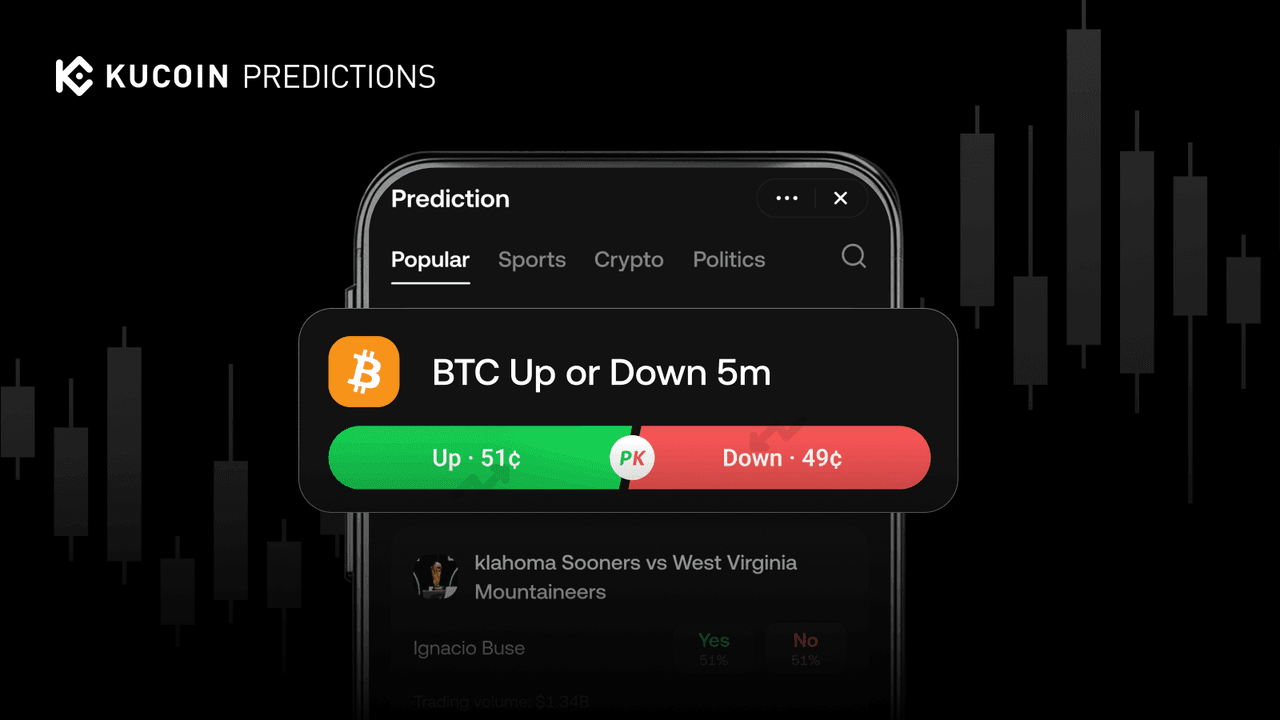
Let's say you've opened a prediction market and seen a Yes share priced at $0.65. What does that number actually mean — and how much should you trust it?
This guide explains how to read prediction market prices and implied probability using simple examples: where prices come from, why they change, why a 90% favorite can still lose, and why your executed price may differ from what you saw on screen. It's written for users exploring prediction markets on KuCoin Predictions who want to interpret prices correctly before placing an order.
Where Do Prediction Market Prices Come From?
Prices in the corresponding Polymarket market are formed through participants' buy and sell orders — nothing more, nothing less. When more traders want to buy an outcome, stronger demand may move its price higher; when demand weakens, the price may fall. Available liquidity in the corresponding Polymarket market can affect both the displayed price and your actual execution price.
It's also important to know who does what: KuCoin provides the Predictions interface, technical integration, and related account functions, but does not independently determine market prices, liquidity, order execution, or outcomes.
So a displayed price is a market signal reflecting current trading activity and participant expectations. It is not KuCoin's prediction, a guaranteed probability, an official conclusion, or investment advice.
Reading the Price as Implied Probability
Each market has a specific question and a set of possible outcomes, and Predictions displays the current price information provided for those outcomes. In a binary market, you can read the price as an implied probability:
-
A Yes share priced at $0.30 implies the market currently sees roughly a 30% chance of that outcome;
-
A Yes share priced at $0.85 implies roughly 85%;
-
Yes and No prices are usually close to $1 in total, but not guaranteed to equal exactly $1, because prices, liquidity, and applicable fees may change.
One caution before you trade on a number: always review the full market question and resolution rules. Similar-looking markets may have different deadlines, outcome definitions, or result sources — and those differences change what the price actually refers to.
Why Do Prices Change?
Because prices are formed by orders, they move whenever the balance of buying and selling shifts. Common drivers include:
-
New information — a poll release, an injury report, a macro data print;
-
Shifting demand — more participants buying Yes pushes the price up; selling pushes it down;
-
Liquidity conditions — thin liquidity can make prices move more sharply on the same order flow.
An implied probability may change at any time, and it may differ from polls, forecasts, expert opinions, or your own assessment. It is the market's current view — a snapshot, not a verdict.
Why a High Probability Is Not a Certain Outcome
This is the most important mental model for new participants. Consider a simple example:
A market's Yes share trades at $0.90 — a 90% implied probability. The market resolves... and the answer is No. Yes shares settle at $0. Holders who paid $0.90 lose that capital.
A 90% probability still contains a 10% chance of the other outcome — and that 10% happens roughly one time in ten. In a normally resolved binary market, winning shares settle at $1 each and losing shares at $0. The settlement doesn't care how confident the market was beforehand; it follows the finalized result. Treat high implied probability as "the market strongly favors this," never as "this will happen."
Why Your Execution Price May Differ From the Displayed Price
The price you see before confirming an order is an estimate, not a guaranteed execution price. Here's why:
-
Market orders only: Predictions currently supports market orders only. Between the moment you view the price and the moment your order executes, prices and available liquidity in the corresponding Polymarket market may change.
-
Price-protection limits: Market orders are subject to applicable price-protection limits. Depending on the liquidity available within those limits, an order may be fully filled, partially filled, or unfilled.
-
Check your order record: The completed order record shows the final execution price, filled amount, and number of shares received. For details, see "How Prediction Market Orders Are Executed."
In short: the display tells you where the market is; the order record tells you what you actually paid.
Price, Result, and Settlement Are Three Different Things
New participants often conflate these three concepts. Keep them separate:
| Concept | What it means |
| Market price | The current market information displayed for an outcome |
| Market result | The outcome determined under the market's published resolution rules |
| Settlement | Applying the finalized result to eligible positions |
A critical implication: the result is not determined by whichever outcome had the highest price before trading closed. Settlement follows the applicable market rules — the resolution criteria and result source published for that specific market.
A Pre-Trade Checklist
Before placing any order, take thirty seconds to check:
-
✅ The complete market question;
-
✅ The exact outcome you selected;
-
✅ The trading deadline;
-
✅ The resolution criteria and result source shown for the market;
-
✅ The latest displayed price or probability;
-
✅ The estimated execution details; and
-
✅ Any applicable fees and trading limits.
Market prices can change, and the outcome you select may not be the final resolved outcome. Review the live market page before placing each order.
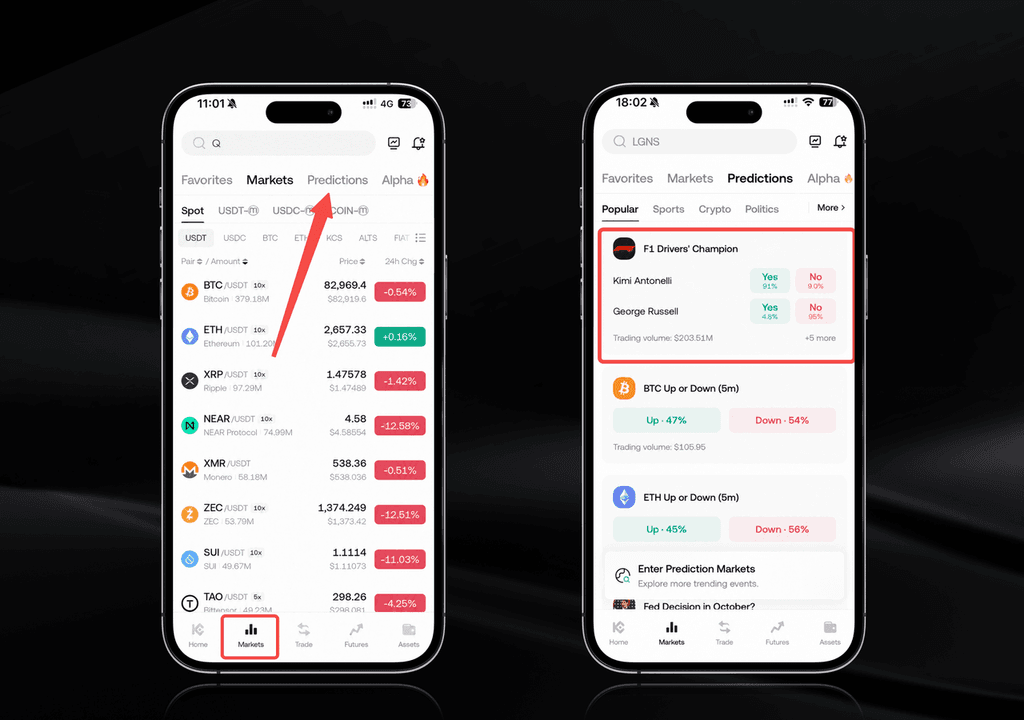
How to read a market on KuCoin Predictions: Open KuCoin App Pro, go to Markets > Predictions, and read your first market's price with fresh eyes — always reviewing the rules and risks before you trade.
Conclusion
Reading prediction market prices well comes down to four ideas: prices are formed by orders and can be read as implied probability; they move with demand, liquidity, and new information; high probability is never certainty; and your executed price is confirmed only in the order record. Keep price, result, and settlement separate in your mind, run the pre-trade checklist, and you'll interpret markets far more accurately.
FAQs
What does a prediction market price mean?
A prediction market price is a live signal formed by participants' buy and sell orders. In a binary market, it can be read as an implied probability — a Yes share at $0.65 implies roughly a 65% chance of that outcome. It reflects current market views, not any platform's prediction or guarantee.
What is implied probability in prediction markets?
Implied probability is the market's current assessment of how likely an outcome is, derived from share prices. It can change at any time with new information and trading activity, and it may differ from polls, forecasts, expert opinions, or your own assessment.
Can a high-probability outcome still lose?
Yes. A 90% implied probability still includes a 10% chance of the opposite outcome. In a normally resolved binary market, winning shares settle at $1 and losing shares at $0 — regardless of how favored the outcome was before resolution.
Why is my executed price different from the price I saw?
Predictions currently supports market orders only, and the displayed price is an estimate. Prices and liquidity may change before execution, and orders are subject to price-protection limits — so an order may be fully filled, partially filled, or unfilled. Check your completed order record for the final execution price.
Do Yes and No prices always add up to $1?
Not exactly. Before settlement, displayed Yes and No prices may be close to $1 in total, but they are not guaranteed to equal exactly $1, because prices, liquidity, and applicable fees may change.
Does the highest-priced outcome win?
No. The market result is determined under the market's published resolution rules — not by whichever outcome had the highest price before trading closed. Settlement applies the finalized result to eligible positions.
Disclaimer: The information on this page may come from third parties and does not necessarily reflect KuCoin’s views. It is provided for general reference only and should not be interpreted as financial or investment advice.
Virtual asset investments may involve risk. Please carefully assess the product risks and your own risk tolerance. For more information, please refer to our Terms of Use and Risk Disclosure.