
What Is a Prediction Market? A Beginner's Guide to Yes/No Shares and KuCoin Predictions
Beginner

If you've only ever traded spot or futures, prediction markets may be a new concept. Traditional crypto trading focuses on whether the price of an asset like Bitcoin or Ethereum will rise or fall. A prediction market focuses on something different: the possible outcome of an event — Will a candidate win an election? Will a team take the championship? Will Bitcoin break a key level by year-end?
This guide explains what prediction markets are, how events, Yes/No shares, and basic trading logic work, and how to get started with KuCoin Prediction. It is written for crypto users who are new to prediction markets and want to understand how they work before participating.
What Is a Prediction Market?
A prediction market is a marketplace where participants buy and sell shares tied to the outcomes of future events. Instead of trading company equity (stocks) or tokens (crypto exchanges), participants trade on event outcomes — spanning politics, economic data, sports results, and cryptocurrency price milestones.
What makes prediction markets distinctive is that they turn opinions into tradable instruments. When you believe an event will happen, you can buy shares representing that outcome. When enough participants back their judgment with real funds, prices aggregate into a form of collective expectation. Because participants put capital behind their views, prediction markets are often regarded as strong information-aggregation mechanisms: the price reflects funded conviction, not casual opinion.
From Trading Prices to Trading Outcomes
The fastest way to understand prediction markets is to compare them with the trading you already know:
| Dimension | Traditional Crypto Trading | Prediction Markets |
| What you trade | Assets like BTC and ETH | The outcome of an event |
| Core question | Will the price go up or down? | Will this event happen? |
| Source of P&L | Difference between buy and sell price | Share price movement + final settlement |
| How it ends | Continuous pricing, no endpoint | Settlement after the event is resolved |
Consider an example: a market asks, "Will Bitcoin exceed $100,000 by the end of the year?" You don't need to forecast BTC's daily price path — you only need to answer a binary question: yes or no. This shift from trading prices to trading outcomes is the essential difference between prediction markets and spot or derivatives trading.
Events, Yes/No Shares, and Basic Trading Logic
Events (Markets)
Every market in a prediction market corresponds to a specific event, with a clearly defined question and settlement rules. "Will a certain team win this season's championship?" is one such event. Before participating, the most important step is to carefully read the rules displayed on the individual market page — including how the outcome will be determined, which information source applies, and when settlement occurs.
Yes/No Shares
Most prediction markets use a binary structure: you can buy shares representing "Yes" or "No." Share prices typically fluctuate between $0 and $1:
-
If a Yes share trades at $0.65, the market is roughly implying a 65% probability of that outcome;
-
Once the event's result is finalized, shares on the correct side are typically settled according to the market's rules, while shares on the wrong side lose their value (subject to each market's rules);
-
Before settlement, you can also sell your shares at any time to lock in profit or limit loss — you don't have to wait for the event to conclude.
How Are Prices Formed?
It's important to understand that prices and probability-related information in a prediction market are formed through participants' buy and sell orders in the corresponding market. Prices shift as new information emerges — breaking news, a fresh poll, or an injury report can move share prices quickly.
In other words, prices reflect the current collective views of market participants — not any platform's prediction or guarantee that an outcome will occur. In KuCoin Prediction, prices and liquidity come from the corresponding Polymarket market; they do not represent KuCoin's prediction or guarantee of any outcome.
KuCoin Predictions: Access Prediction Markets Inside the KuCoin App
With the basics covered, here's how to participate on KuCoin. KuCoin Predictions are a feature powered by KuCoin's integration with Polymarket. Through the KuCoin App, eligible users can access supported Polymarket markets related to popular events, crypto, sports, and politics — subject to regional and account eligibility.
In KuCoin Predictions, eligible users can:
-
Browse markets: Explore supported crypto, sports, and politics markets in the KuCoin App;
-
Participate with USDT: Access Prediction using USDT in your Funding Account. If you select your Financial Account or Trading Account as the source account, the required USDT will be transferred automatically to your Funding Account;
-
Manage orders and positions: View orders, positions, and trading history;
-
View settlement records: View applicable settlement proceeds and settlement records after the corresponding Polymarket market's result has been finalized.
The markets, regions, payment assets, and trading rules available to you are those displayed on the relevant product and market pages.
How to Get Started with KuCoin Predictions
Getting started takes just four steps:
-
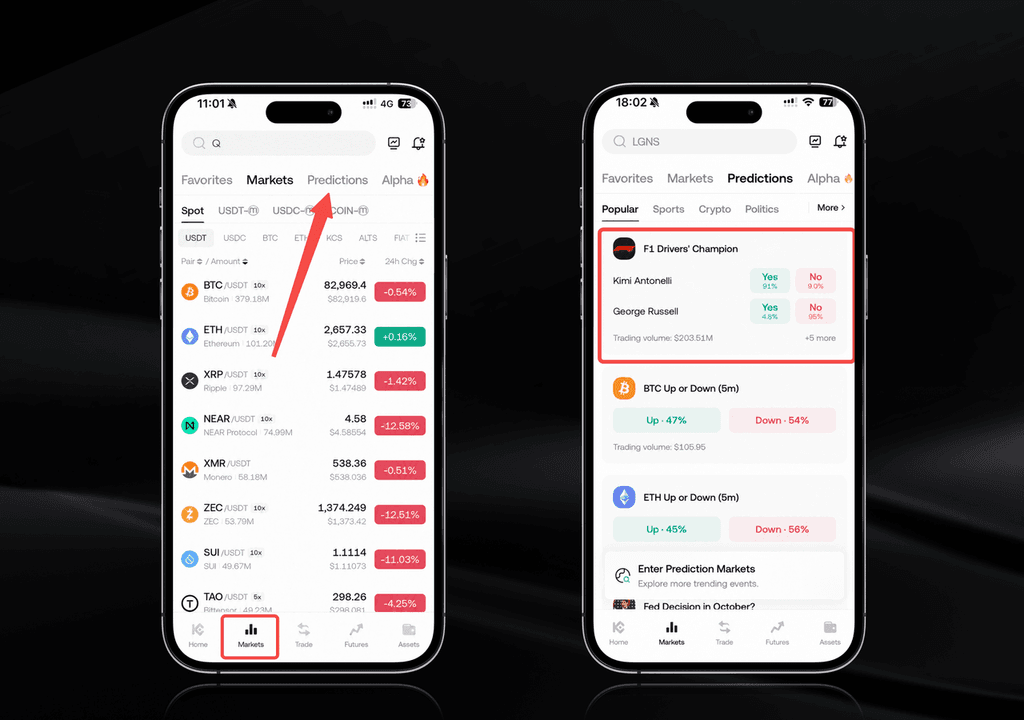
Open the KuCoin App Pro (make sure it's updated to the latest version);
-
Go to Markets > Predictions;
-
Browse the supported prediction markets available to you;
-
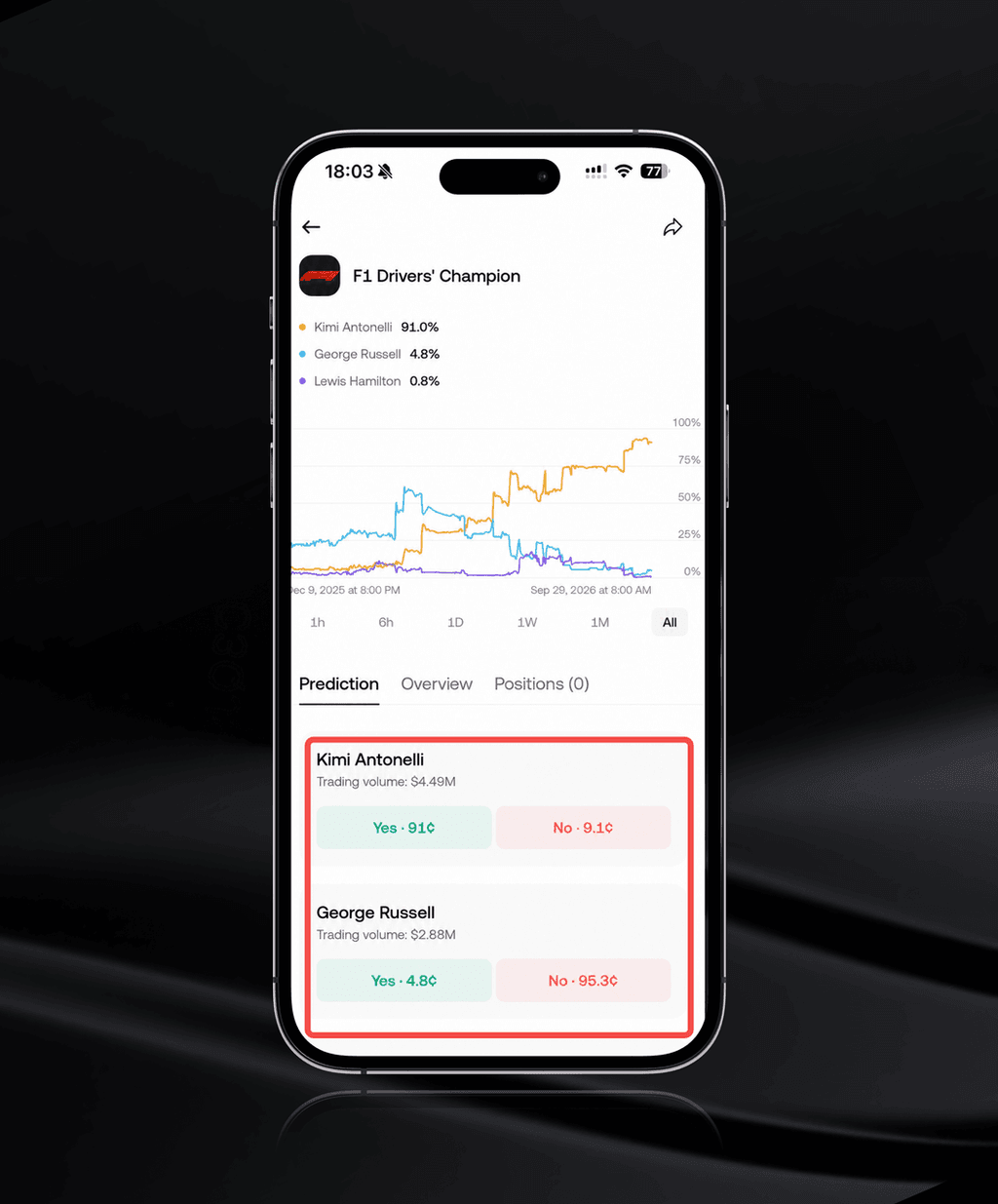
Open a market and review its outcome options, displayed information, and rules.
Conclusion
Prediction markets turn views about the world into tradable instruments — a shift from trading price movements to trading event outcomes. Once you understand events, Yes/No shares, and the idea of price-as-probability, you can experience it directly inside the KuCoin App through KuCoin Prediction: open KuCoin App Pro, go to Markets > Prediction, and start by browsing your first market. Remember — prices are the market's collective view, not a promise. Reading the rules and assessing the risks is always step one.
FAQs
What is a prediction market?
A prediction market is a marketplace where participants buy and sell shares tied to the outcomes of future events. Shares are typically priced between $0 and $1, and the price reflects the market's collective estimate of an outcome's probability. Once the result is finalized, positions are settled according to the market's rules.
What does a prediction market price represent?
Prices are formed by participants' buy and sell orders and can be read as a real-time estimate of an outcome's probability. A Yes share at $0.65 roughly implies a 65% chance of that outcome. However, prices are market views — not any platform's prediction or guarantee of a result.
What is the relationship between KuCoin Prediction and Polymarket?
KuCoin Prediction is powered by KuCoin's integration with Polymarket. KuCoin provides the in-app interface, technical integration, and account functions, while the specific prediction markets are provided by Polymarket. Market rules, prices, liquidity, and result determination are not independently determined by KuCoin and are governed by the relevant product terms and market rules.
What do I need to use KuCoin Prediction?
Eligible users open the KuCoin App Pro, go to Markets > Prediction, and participate using USDT in their Funding Account. If you select your Financial or Trading Account as the source, the required USDT is transferred automatically. Available markets and rules are those shown on the relevant pages.
Are prediction markets risky?
Yes. Prices fluctuate with changing market views and are not certain forecasts. Once an event's result is finalized, shares on the wrong side may lose their value. Always review each market's rules and assess your own risk tolerance before participating.
Disclaimer: The information on this page may come from third parties and does not necessarily reflect KuCoin’s views. It is provided for general reference only and should not be interpreted as financial or investment advice.
Virtual asset investments may involve risk. Please carefully assess the product risks and your own risk tolerance. For more information, please refer to our Terms of Use and Risk Disclosure.