
What is the Different Between Sidechain vs Rollup?
Key Takeaways
-
Security Source: Rollups inherit the full cryptographic security of the Ethereum mainnet, whereas sidechains rely on their own independent validator sets.
-
Data Availability: Rollups post transaction data to Layer 1, ensuring the state can always be reconstructed; sidechains store data locally, creating external trust assumptions.
-
Capital Finality: Sidechains offer faster local finality for low-value transactions, but rollups provide the "gold standard" for high-value DeFi and institutional settlement.
-
Bridge Architecture: Rollup bridges are secured by Ethereum smart contracts, while sidechain bridges often depend on a multisig or a smaller group of external validators.
As the blockchain world moves toward a multi-chain future, the infrastructure supporting this expansion has split into two dominant schools of thought: Sidechains and Rollups. To understand the core Sidechains vs. Rollups: Security Trade-offs, one must look beyond transaction speeds and focus on where the "truth" of the network resides.
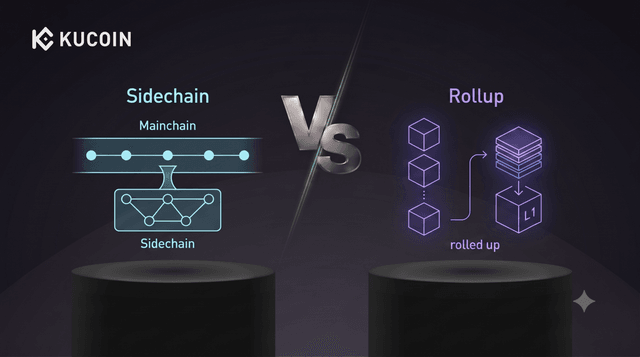
While both technologies aim to scale Ethereum by processing transactions off the main congested highway, they do so with fundamentally different philosophies. A sidechain is like an independent neighboring city with its own laws and police force. A rollup is an extension of the main city itself. It operates in a specialized district but is still governed and protected by the main city's supreme court. Whether you are tracking the latest L2 tokens on KuCoin Markets or reading deep-dive technical analysis on the KuCoin Blog, understanding these differences is vital for long-term asset management.
The 6W Framework of Blockchain Scaling
To categorize the unique value propositions of these scaling methods, we apply the 6W principles:
-
Who: Sidechains (e.g., Polygon PoS) are favored by high-frequency gaming and social apps; Rollups (e.g., Arbitrum, zkSync) are the choice for DeFi and institutional finance.
-
What: Scaling Solutions—one functioning as an independent network and the other as a dependent execution layer.
-
Where: Sidechains run parallel to the main chain; rollups sit directly on top of the main chain as a "Layer 2."
-
When: These technologies represent the evergreen evolution of blockchain, providing a spectrum of choices between cost-efficiency and maximum security.
-
Why: To solve the "Scalability Trilemma" by moving the heavy lifting of transaction execution away from the expensive Ethereum Mainnet.
-
How: Sidechains use their own Proof of Stake (PoS); rollups use fraud proofs or validity proofs to verify state changes on Layer 1.
Sidechains vs. Rollups: Security Trade-offs
The "different" between a sidechain and a rollup is primarily a question of trust. In the world of decentralized finance, security is the ultimate currency.
-
Inherited Security vs. Sovereign Security
-
Rollups (Inherited): The most significant advantage of a rollup is that it does not need to build its own security from scratch. It uses the Ethereum mainnet for settlement. If the rollup's own operators disappear or act maliciously, the users' funds are still protected by Ethereum smart contracts. This "trust-minimized" model is why rollups are considered the most secure way to scale.
-
Sidechains (Sovereign): A sidechain has its own validator set. If you use a sidechain, you trust that specific group of validators not to collude and steal funds. While many sidechains are highly decentralized, they inherently possess a lower security "budget" than the Ethereum mainnet itself.
-
The Data Availability Problem
Data availability refers to the ability for any user to reconstruct the state of blockchain.
-
Rollup Data: Rollups are required to post a compressed version of their transaction data (calldata or "blobs") to the Ethereum mainnet. This ensures that even if the rollup servers go offline, the data needed to recover funds is permanently etched into the Ethereum blockchain.
-
Sidechain Data: Sidechains do not post their full transaction data to the mainnet. They only send periodic "snapshots." If the sidechain's local nodes fail and they haven't shared the data, it may be impossible to prove your account balance, leading to potential loss of access to funds.
For retail users who want to switch between these ecosystems without the headache of managing multiple bridges, the KuCoin Lite Version provides a secure and simplified gateway to manage assets across both sidechains and rollups effortlessly.
Performance, Costs, and User Experience
While rollups win on security, sidechains often offer superior performance and lower costs.
Why Sidechains Still Thrive
Sidechains do not have to pay "rent" to the Ethereum mainnet for every transaction batch. Because they don't post data to L1 as frequently or as comprehensively as rollups, they can offer near-zero transaction fees. This makes them the perfect home for:
-
Blockchain Gaming: Where thousands of micro-transactions occur per hour.
-
NFT Minting: Where the cost of the transaction shouldn't exceed the value of the digital collectible.
-
Social Media: Where decentralized interactions require instant feedback.
The Institutional Appeal of Rollups
Institutions and large-scale DeFi protocols prefer rollups because the risk of a "chain halt" or validator collusion is mitigated by underlying Ethereum security. For high-value transactions, paying a slightly higher fee (compared to a sidechain) is a worthwhile trade-off for the peace of mind that the transaction is mathematically verified. Major updates regarding institutional rollup deployments are frequently highlighted in the official announcement section for global traders.
Summary Comparison Table
| Feature | Sidechains | Rollups (Layer 2) |
| Security Mechanism | Independent (Own Validators) | Inherited (L1 Mainnet) |
| Data Availability | Off-chain | On-chain (Posted to L1) |
| Transaction Fees | Extremely Low (Sub-cent) | Low (Cents to Dollars) |
| Withdrawal Speed | Usually Fast (Minutes) | 15 min (ZK) to 7 Days (Optimistic) |
| Risk Factor | Validator Collusion | L1 Congestion / Prover Complexity |
| Main Use Case | Gaming, Social, Small Tx | DeFi, RWAs, Large Settlement |
Conclusion: The Difference Between Sidechain vs Rollup
In the final analysis, the comparison of Sidechains vs. Rollups: Security Trade-offs is not about finding a "winner," but about choosing the right tool for the task. Sidechains provide the high-performance, low-cost parallel lanes needed for the consumer-facing internet. Rollups provide the high-security, trust-minimized extensions needed for the world's financial layer. As the industry matures, we are seeing a convergence where some sidechains are transitioning into rollups to capture the best of both worlds.
FAQs
Is Polygon a sidechain or a rollup?
Polygon originally launched as a PoS sidechain. However, the ecosystem has since evolved into a "multi-stack" solution, launching its own zkEVM (a ZK-Rollup) and developing the AggLayer to unify both sidechains and rollups into a single network.
What happens if a sidechain validator goes offline?
If a majority of validators go offline, the sidechain may halt. Because it doesn't store all its data on the mainnet, users might be unable to move their funds back to the main chain until the sidechain validators return to consensus.
Why are rollups considered "Layer 2" but sidechains are not?
A Layer 2 is defined by its ability to inherit the security of Layer 1. Because rollups use the mainnet for data availability and proof verification, they are true L2s. Sidechains are "parallel" chains because they operate their own independent security.
Can I lose money on a rollup?
While rollups are highly secure, they are still smart-contract-based. Risks include bugs in the rollup's code or "sequencer" centralization. However, the risk of losing funds due to a chain-wide security breach is significantly lower than on most sidechains.
Where can I buy tokens for these different networks?
You can find the native tokens and ecosystem assets for all major sidechains and rollups on KuCoin Markets. For a deeper understanding of the fundamental value of these projects, visit the KuCoin Blog.
Join 30 million global users on the world’s leading crypto exchange by signing up for your free account now. Register Now!
Further reading


