
What is the Different Between Rollup Comparison?
Key Takeaways
-
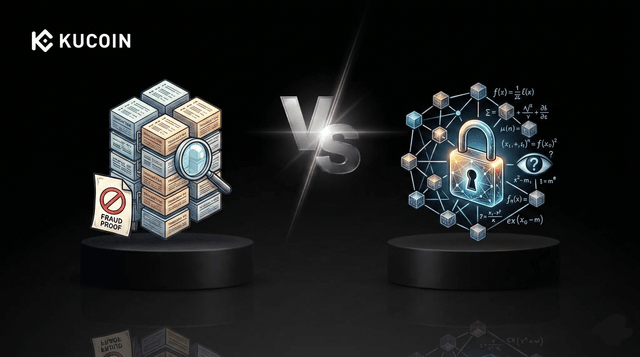
Validation Methods: Optimistic Rollups rely on "fraud proofs" and a challenge period, while ZK-Rollups use "validity proofs" for immediate mathematical confirmation.
-
Finality Timelines: ZK-Rollups offer near-instant cryptographic finality, whereas Optimistic Rollups require a 7-day window for assets to be fully settled on Ethereum Layer 1.
-
Data Efficiency: ZK-Rollups are more data-efficient as they only post "state diffs" to the mainnet, while Optimistic Rollups must post the entire transaction data.
-
EVM Compatibility: Optimistic Rollups currently lead in "EVM Equivalence," making them easier for developers to deploy existing dApps with zero code changes.
In the quest to scale Ethereum, the industry has converged on two primary technologies: Optimistic Rollups and Zero-Knowledge (ZK) Rollups. To understand the fundamental Optimistic Rollups vs. ZK-Rollups: Efficiency and Finality trade-offs, one must view them as two different security philosophies. While both aim to move execution away from the congested Ethereum mainnet, they handle "trust" in entirely different ways.
As traders and investors navigate the diverse offerings on KuCoin Markets, the choice of which Layer 2 (L2) to use often comes down to capital efficiency.
The 6W Framework of Rollup Technology
To categorize the current state of L2 scaling, we can apply the 6W principles:
-
Who: Optimistic Rollups are the current market leaders in TVL (e.g., Arbitrum, Base); ZK-Rollups are the preferred choice for high-security and instant-withdrawal applications (e.g., zkSync, Starknet).
-
What: Scaling Solutions that "roll up" thousands of off-chain transactions into a single batch that is settled on Ethereum.
-
Where: These protocols function as independent execution environments that inherit the decentralized security of the Ethereum base layer.
-
When: As evergreen solutions, they represent the core of Ethereum's "Rollup-Centric Roadmap" for the next billion users.
-
Why: To eliminate high gas fees and network congestion while maintaining the censorship resistance of a global blockchain.
-
How: By either assuming transactions are valid until proven otherwise (Optimistic) or proving they are valid through math (ZK).
Optimistic Rollups vs. ZK-Rollups: Efficiency and Finality
The "different" in these technologies impact two critical areas for users: how fast their money is "safe" and how cheaply those transactions can be processed.
-
Finality: The Speed of Trust
Finality is the point at which a transaction cannot be altered or reversed.
-
Optimistic Rollups (Economic Finality): These networks work on a "guilty until proven innocent" basis. When a batch is posted to Ethereum, there is a 7-day challenge period. During this time, any network validator can submit a "fraud proof" to roll back a malicious transaction. Hard finality—the point where you can bridge back to Layer 1—takes a full week.
-
ZK-Rollups (Cryptographic Finality): These use Validity Proofs (SNARKs or STARKs). The moment a proof is verified by the Ethereum mainnet contract, the transaction is finalized. This usually happens within minutes or an hour, allowing for near-instant withdrawals.
-
Efficiency: Data Availability and Costs
Efficiency is determined by how much data the L2 must "rent" from the Ethereum Layer 1.
-
Optimistic Efficiency: They must post full transaction data to the mainnet so that anyone has enough information to generate a fraud proof. While simple to implement, this makes them more sensitive to Ethereum's "calldata" prices.
-
ZK Efficiency: They only need to post the "state changes" (e.g., Alice's balance went down by 1, Bob's went up by 1). This is significantly more data-efficient, allowing ZK-Rollups to scale much further in a high-traffic environment.
For retail users who want to avoid the complexities of these technical layers, the KuCoin Lite Version provides a simplified interface to interact with any L2 asset without manually managing the underlying finality windows.
Developer Adoption: EVM Equivalence vs. Compatibility
A major factor in the "Rollup Comparison" is how easy it is for developers to build.
-
Optimistic Rollups have achieved "EVM Equivalence." This means their code is an identical twin to Ethereum's. A developer can copy and paste their smart contract from Layer 1 to an Optimistic L2 in seconds.
-
ZK-Rollups traditionally used custom languages (like Cairo). However, the rise of "zkEVMs" has bridged this gap. While slightly more complex to build, zkEVMs are rapidly catching up in developer adoption. Significant updates regarding these infrastructure milestones are often shared in the official announcement section for the global community.
Trading Insights: How Finality Affects Your Strategy
For a trader, the Optimistic Rollups vs. ZK-Rollups: Efficiency and Finality debate is not just academic; it affects your bottom line:
-
Liquidity Movement: If you need to move large amounts of capital between chains quickly to catch an arbitrage opportunity, ZK-Rollups are superior due to their fast finality.
-
Standard Bridging: If you use an official bridge on an Optimistic Rollup, be prepared for the 7-day wait. To bypass this, many traders use KuCoin as a central hub—depositing L2 assets and withdrawing them to L1 (or another L2) instantly.
-
Complex Smart Contracts: If your strategy involves very complex logic, Optimistic Rollups currently offer the most stable environment for execution, though ZK-Rollups are the future of high-security DeFi.
Summary Comparison Table
| Feature | Optimistic Rollups | ZK-Rollups |
| Trust Model | Economic (Fraud Proofs) | Mathematical (Validity Proofs) |
| L1 Finality Time | ~7 Days | ~15 min to 1 hour |
| Data Efficiency | Lower (Full Data) | Higher (State Diffs) |
| Withdrawal Speed | Slow (7-day delay) | Fast (Instant) |
| Computational Cost | Low (Simple) | High (Generating Proofs) |
| Primary Use Case | Broad DeFi, NFTs | High-value Settlement, Privacy |
Conclusion: The Different Between Rollup Comparison
In the final analysis, the choice between Optimistic vs. ZK-Rollups is a choice between "Ease of Implementation" and "Mathematical Certainty." Optimistic Rollups have dominated the early scaling era because they are easy to build and highly compatible with existing Ethereum tools. However, ZK-Rollups represent the long-term "end-game" due to their superior efficiency and instant finality.
FAQs
Why do Optimistic Rollups have a 7-day withdrawal period?
This is the "Challenge Window." It exists to ensure that "honest" validators have enough time to spot a fraudulent transaction posted by a sequencer and submit a fraud proof to the Ethereum mainnet to revert it.
Are ZK-Rollups more expensive than Optimistic Rollups?
Generating a Zero-Knowledge proof requires significant "off-chain" computing power, which can be expensive. However, because they save money on Ethereum "data costs," they can often be cheaper for the end-user when network traffic is high.
What is a "Hybrid Rollup"?
A Hybrid Rollup is a newer technology that uses the fast execution of an Optimistic Rollup but uses ZK-proofs to shorten the 7-day challenge period to just a few hours or minutes.
Can I use my same wallet for both?
Yes. Since both types of rollups are EVM-compatible, you can use the same Ethereum address and wallets (like MetaMask) for both. You simply switch the "Network" in your wallet settings.
Where can I find tokens for these L2 ecosystems?
You can trade the native tokens and ecosystem dApp tokens for all major rollups on KuCoin Markets. For a deeper understanding of the specific projects leading each category, visit the KuCoin Blog.
Join 30 million global users on the world’s leading crypto exchange by signing up for your free account now. Register Now!
Further reading


