
What is the Different Between Gaming L2s?
Key Takeaways
-
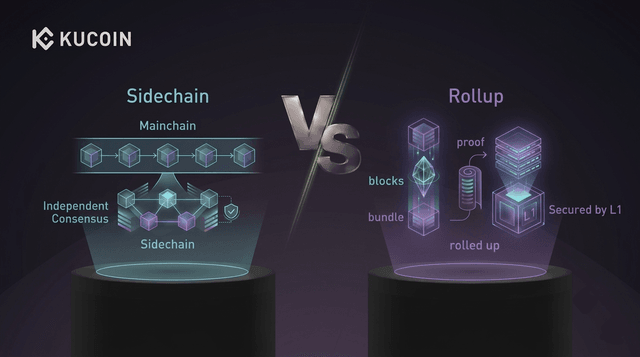
Security Inheritance: Rollups inherit the full security of the Ethereum Layer 1, while Sidechains rely on their own independent validator sets and consensus.
-
Data Availability: Rollups post transaction data to the mainnet, ensuring transparency; Sidechains manage data locally, which offers higher speed but introduces trust assumptions.
-
Finality and Costs: Sidechains generally offer lower fees and faster local finality for gaming, whereas Rollups provide superior protection for high-value in-game assets.
-
Ecosystem Choice: The choice between a Sidechain and a Rollup depends on whether a project prioritizes massive transaction volume (Sidechain) or maximum asset security (Rollup).
The Web3 gaming sector has become the primary driver for blockchain scalability. As millions of players interact with on-chain assets, the underlying infrastructure must balance speed, cost, and safety. This has led to a critical debate: Sidechains vs. Rollups: Security Trade-offs. To understand the "different" between these gaming L2s, one must look at how they handle "trust."
In the gaming world, a Sidechain acts as a sovereign territory with its own rules, while a Rollup acts as a highly specialized district that remains under the legal and military protection of the Ethereum "Mainland." For traders tracking gaming tokens on KuCoin Markets, these architectural choices determine the long-term viability of a gaming ecosystem.
The 6W Framework of Gaming Infrastructure
To categorize the current scaling landscape, we can apply the 6W principles:
-
Who: Game developers and players are the primary users; sidechains are often chosen for high-velocity games, while rollups are favored for high-fidelity, high-value asset platforms.
-
What: Scaling Solutions that offload transaction processing from Ethereum to a secondary layer.
-
Where: These technologies exist "on top of" or "parallel to" the Ethereum mainnet.
-
When: As evergreen solutions, they represent the permanent infrastructure required for mass adoption of Web3 gaming.
-
Why: To eliminate gas fees and latency, allowing for seamless gameplay that rivals traditional gaming experiences.
-
How: Sidechains utilize independent Proof of Stake (PoS); Rollups utilize Validity Proofs (ZK) or Fraud Proofs (Optimistic).
Sidechains vs. Rollups: Security Trade-offs
The "different" between a sidechain and a rollup is fundamentally about where the security comes from and who is responsible if something goes wrong.
-
The Source of Security
-
Rollups (Inherited Security): Rollups are "trust-minimized." They bundle thousands of transactions and send proof back to Ethereum. Because Ethereum verifies these proofs, the rollup inherits the massive security of the Ethereum validator set. If the rollup operator tries to cheat, the Ethereum smart contract will reject the transaction.
-
Sidechains (Independent Security): A sidechain has its own security budget. It relies on its own set of validators. If you trade on a sidechain, you trust that specific (and often smaller) group of validators. If they collude, they could theoretically halt the chain or reverse transactions.
-
Data Availability (DA)
Data availability is the insurance policy of a blockchain. It ensures that the information needed to reconstruct the state of the chain is always accessible.
-
Rollup DA: Rollups are required to post transaction data to the Ethereum mainnet. This means even if the rollup's own servers go offline, the assets are safe because the history is stored on Ethereum.
-
Sidechain DA: Sidechains keep their data locally. They only send periodic "headers" to the mainnet. If the sidechain's data nodes are compromised, users might lose the ability to prove their balances and withdraw their funds to the mainnet.
For users who want to switch between these various gaming environments without the technical friction, the KuCoin Lite Version provides a simplified interface to manage and trade assets across both Sidechains and Rollups.
Performance vs. Safety: The Gaming Paradox
In gaming, a delay of even a few seconds can ruin the user experience. This is where sidechains often gain an advantage despite the security trade-offs.
-
Sidechain Performance: Because they don't have to wait for Ethereum to confirm their data batches, sidechains can offer sub-second finality and near-zero gas fees. This is essential for "on-chain gaming" where every action (moving, attacking, harvesting) is a transaction.
-
Rollup Finality: Rollups are getting faster, especially ZK-Rollups, but they still carry a "settlement lag" while waiting for proofs to be verified on Layer 1. For a game involving high-value NFT land or rare items, this extra layer of security is often worth the small trade-off in speed.
Traders looking for the latest technical milestones in these networks can monitor the official announcement page to see which networks are implementing new "Data Availability" solutions like Celestia or Avail to lower costs further.
Bridging Risks and Asset Portability
The bridge is the most vulnerable point in any scaling solution. When comparing Sidechains vs. Rollups, the bridge design is a major differentiator.
-
The Sidechain Bridge: Most sidechains use a "Lock and Mint" bridge. You lock ETH on the mainnet, and a set of validators mints a wrapped version on the sidechain. If the bridge validators are compromised, the locked funds on the mainnet could be drained.
-
The Rollup Bridge: Rollups use a "Native Bridge" that is part of the rollup protocol itself. The security of the bridge is enforced by the same cryptographic proofs that secure the rollup, making it significantly more difficult to exploit.
Summary Comparison Table
| Feature | Sidechains | Rollups (L2) |
| Security Model | Independent (Own Validators) | Inherited (Ethereum L1) |
| Data Availability | Off-chain (Local) | On-chain (Posted to L1) |
| Withdrawal Speed | Usually Fast (Minutes) | 15m - 1h (ZK) / 7 Days (Optimistic) |
| Transaction Cost | Extremely Low | Low (Higher than Sidechains) |
| Trust Assumption | Trust Sidechain Validators | Trust Ethereum Mainnet |
| Best For | High-velocity micro-transactions | High-value assets and DeFi |
Conclusion: Choosing the Right Gaming L2
The comparison of Sidechains vs. Rollups: Security Trade-offs shows that there is no one-size-fits-all solution for Web3 gaming. Sidechains remain the go-to choice for games that require massive scale and instant feedback with low-value assets. Rollups are becoming the gold standard for ecosystems where asset security and long-term value preservation are paramount. As the modular stack continues to evolve, the "different" between these layers will continue to blur, providing a richer, safer, and faster environment for the global gaming community.
FAQs
Why are most gaming chains called "Sidechains"?
Historically, sidechains were easier to build and offered the zero-fee experience that gamers demand. However, as ZK-Rollup technology has matured, many gaming projects are now migrating to Rollup architectures to improve security.
Can a Rollup be as fast as a Sidechain?
With the advent of "App-Chains" and specialized ZK-provers, rollups are reaching speeds that rival sidechains. However, the requirement to post data to Ethereum will always create a slight cost and finality difference between the two.
What happens if a gaming Sidechain goes down?
If the validators stop producing blocks, the games on that chain will be unplayable, and you may be unable to withdraw your assets until the validators are back online. In a Rollup, you generally have an "escape hatch" to withdraw funds even if the operator goes offline.
Do I need different wallets for Sidechains and Rollups?
No. Both are usually EVM-compatible, meaning you can use the same address and wallet (like MetaMask) for both. You simply need to switch the network settings within the wallet.
Where can I buy tokens for these gaming networks?
You can find the native tokens for all major gaming sidechains and rollups on KuCoin Markets. For deep-dive analysis on which gaming ecosystems are leading active users, visit the KuCoin Blog.
Join 30 million global users on the world’s leading crypto exchange by signing up for your free account now. Register Now!
Further reading


