
What is the Different Between CEX vs DEX?
Key Takeaways
-
Custody Framework: CEXs are custodial, managing private keys for users, while DEXs are non-custodial, requiring users to manage their own wallets and keys.
-
Execution & Liquidity: CEXs offer near-instant off-chain matching with deep liquidity; DEXs rely on on-chain liquidity pools (AMMs) which can be subject to network congestion and slippage.
-
Accessibility: CEXs serve as the primary gateway for fiat-to-crypto on-ramping, whereas DEXs provide permissionless access to early-stage tokens and DeFi protocols.
-
Regulatory Compliance: CEXs generally require KYC (Know Your Customer) verification to ensure global compliance, while DEXs operate via smart contracts without traditional identity verification.
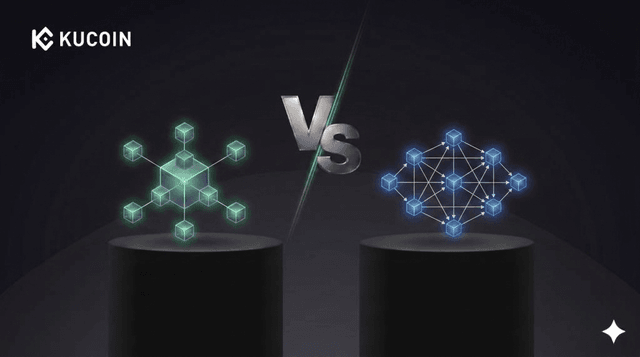
The choice of where to trade is the most fundamental decision any participant in the digital economy must make. To understand Centralized vs. Decentralized Exchanges (CEX vs. DEX), one must look past the user interface and examine the underlying architecture of trust, custody, and speed. In a modern portfolio, these two exchange models are rarely mutually exclusive; rather, they serve distinct strategic purposes.
A Centralized Exchange (CEX) like KuCoin acts as a sophisticated financial intermediary, offering a high-performance environment for price discovery and fiat management. Conversely, a Decentralized Exchange (DEX) removes the intermediary, allowing for peer-to-peer swaps directly on the blockchain.
The 6W Framework of Exchange Models
To categorize the unique value of these two paradigms, we apply the 6W principles:
-
Who: CEXs are operated by centralized organizations; DEXs are governed by open-source code and decentralized autonomous organizations (DAOs).
-
What: Trading Infrastructures—one offering a managed brokerage experience (CEX) and the other providing a trustless protocol (DEX).
-
Where: CEXs utilize private servers for matching trades; DEXs operate on public blockchains like Ethereum, Solana, or BNB Chain.
-
When: CEXs are the first stop for fiat entry; DEXs are the primary destination for native on-chain activities and "yield farming."
-
Why: To provide a balance between institutional-grade liquidity/support (CEX) and total asset sovereignty/privacy (DEX).
-
How: CEXs use Central Limit Order Books (CLOB); DEXs use Automated Market Makers (AMM).
Centralized Exchanges (CEX): The Engine of Global Liquidity
The CEX remains the cornerstone of the crypto industry for a simple reason: efficiency. For most traders, the centralized model provides the tools necessary to compete in a high-speed market.
-
High Performance and Institutional Tooling
The primary advantage of a CEX is its matching engine. Because trades happen off-chain on private servers, execution is near-instant. This allows for advanced features like high-frequency trading, complex futures, and algorithmic orders that are difficult to replicate on-chain. Professional analysis of these tools is frequently updated on the KuCoin Blog, providing traders with the insights needed to navigate volatile markets.
-
Fiat Support and On-Ramping
For a decentralized economy to grow, it needs a bridge to traditional finance. CEXs provide the essential service of fiat on-ramps, allowing users to buy digital assets with credit cards, bank transfers, and P2P markets. The KuCoin Lite Version is designed specifically to simplify this process, making the transition from fiat to crypto as seamless as possible for retail users.
-
Safety Nets and Customer Support
In the world of self-custody, a lost password can mean a permanent loss of funds. CEXs mitigate this risk by providing account recovery services and 24/7 customer support. Furthermore, centralized platforms often implement insurance funds and rigorous security audits, which are regularly highlighted in the official announcement section to maintain transparency with their global user base.
Decentralized Exchanges (DEX): The Sovereign Frontier
As blockchain technology has matured, DEXs have moved from niche experiments to multi-billion dollar protocols that challenge the traditional status quo.
-
Non-Custodial Security
The phrase "Not your keys, not your coins" is the core tenet of the DEX movement. On a DEX, you do not deposit your funds into an exchange-controlled wallet. Instead, you trade directly from your own hardware or software wallet. This eliminates "counterparty risk"—the possibility that an exchange might become insolvent or freeze your assets.
-
Privacy and Permissionless Access
DEXs do not require account creation or identity verification. This permissionless nature allows anyone with an internet connection and a wallet to trade. It also makes DEXs the primary laboratory for innovation; new projects often launch their tokens on DEXs long before they meet the listing requirements of a centralized platform.
-
On-Chain Transparency
Every transaction on a DEX is recorded on a public ledger. This level of transparency ensures that the exchange's liquidity is real and verifiable in real-time. Unlike the "black box" of some private entities, the solvency of a DEX is always visible to any user who can read blockchain data.
Summary Comparison Table: CEX vs. DEX
| Feature | Centralized Exchange (CEX) | Decentralized Exchange (DEX) |
| Custody | Custodial (Platform holds keys) | Non-Custodial (User holds keys) |
| Execution Speed | Ultra-Fast (Milliseconds) | Slower (Block-time dependent) |
| Trading Model | Order Book | Automated Market Maker (AMM) |
| Fiat Access | Full Support (Bank/Card) | No Native Fiat Support |
| KYC/Verification | Required for most features | None (Wallet connection only) |
| Transaction Fees | Low Trading Fees | Variable Gas Fees (to Miners/Stakers) |
Conclusion: Balancing Efficiency and Autonomy
The comparison of Centralized vs. Decentralized Exchanges (CEX vs. DEX) demonstrates that both are essential to a thriving ecosystem. CEXs provide the speed, liquidity, and fiat bridges required for mass adoption and professional trading. DEXs provide privacy, security, and permissionless innovation that align with the original vision of blockchain technology.
In a mature trading strategy, users often leverage KuCoin for high-liquidity trading and managing core holdings, while utilizing DEXs to explore emerging DeFi protocols. By understanding the "different" between these two models, you can better navigate the complexities of the digital asset market.
FAQs
Which is safer, a CEX or a DEX?
It depends on the risk you are willing to manage. A CEX carries the risk of the centralized entity failing, while a DEX carries the risk of smart contract bugs or the user losing their private keys. For most beginners, a reputable CEX is considered the safer starting point.
Why do some tokens only trade on DEXs?
DEXs are permissionless, meaning anyone can create a liquidity pool for a token. CEXs have strict listing standards for security and volume, which acts as a filter for quality but means newer tokens are often found on DEXs first.
Can I buy crypto with USD on a DEX?
No. DEXs only process on-chain swaps (crypto-to-crypto). To get your first digital assets using a bank account or card, you must use a CEX like KuCoin.
Are DEX fees cheaper than CEX fees?
Not necessarily. While CEX fees are fixed, DEX fees include "gas," which can become very expensive when the blockchain network is busy. For small trades, a CEX is usually much more cost-effective.
Where can I find the latest market trends for both?
You can monitor institutional-grade data and cross-chain trends on KuCoin Markets. For a deeper dive into how DEXs are evolving, the KuCoin Blog provides comprehensive industry reports.
Join 30 million global users on the world’s leading crypto exchange by signing up for your free account now. Register Now!
Further reading


