
What is the difference between VASP License?
Key Takeaways
-
Regulatory Definition: A Virtual Asset Service Provider (VASP) is any entity that conducts exchange, transfer, or custodial services for digital assets as a professional business.
-
Prudential Standards: Licensing requirements vary by jurisdiction but generally include minimum capital mandates, local substance (physical offices), and qualified personnel.
-
Compliance Integration: Global VASP frameworks are centered on the Financial Action Task Force (FATF) "Travel Rule," requiring the transmission of originator and beneficiary data.
-
Jurisdictional Tiers: Regulatory environments are categorized by their intensity, ranging from comprehensive frameworks in major financial hubs to streamlined registration processes in emerging markets.
The transition of the cryptocurrency industry from an unregulated frontier to a structured financial sector is defined by the implementation of the Virtual Asset Service Provider (VASP) licensing regime. Established under the guidance of the Financial Action Task Force (FATF), the VASP framework ensures that entities dealing with digital assets adhere to the same anti-money laundering (AML) and counter-terrorism financing (CTF) standards as traditional banks.
Understanding "VASP License Requirements in Different Jurisdictions" is essential for institutional participants and developers navigating the global blockchain economy. While the core objective—preventing illicit financial flows is universal, the technical and operational mandates differ significantly depending on the local regulator. These regulatory shifts directly impact the availability of assets in the crypto markets. Comprehensive analyses of these global compliance trends are a recurring feature on the KuCoin blog.
What is a VASP License?
A VASP license is a legal authorization granted by a national regulator that allows a company to provide specific services involving virtual assets. According to FATF standards, a VASP is any natural or legal person that conducts one or more of the following activities:
-
Exchange between virtual assets and fiat currencies.
-
Exchange between one or more forms of virtual assets.
-
Transfer of virtual assets.
-
Safekeeping or administration of virtual assets (custody).
-
Participation in and provision of financial services related to an issuer’s offer or sale of a virtual asset.
The acquisition of this license signifies that an entity has met the necessary benchmarks for security, transparency, and consumer protection. For participants in the KuCoin ecosystem, these licenses represent the foundational layer of trust that enables secure trading and asset management.
VASP License Requirements in Different Jurisdictions
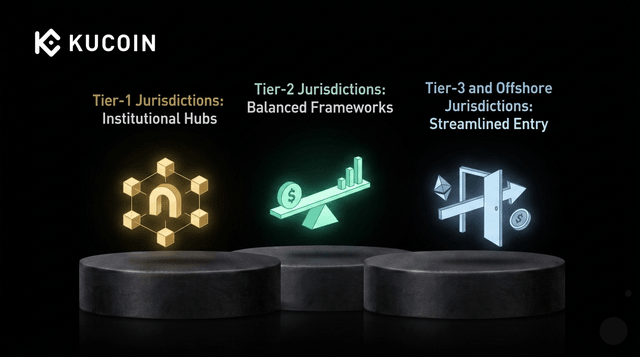
Regulatory environments are typically categorized into three tiers based on the complexity of their requirements and the prestige of the license.
-
Tier-1 Jurisdictions: Institutional Hubs
Tier-1 hubs, such as Singapore, Hong Kong, and the European Union, feature the most rigorous requirements. These jurisdictions aim to integrate virtual assets into the formal financial system.
-
Capital Mandates: Entities often must maintain significant paid-up capital, sometimes exceeding $200,000, to ensure operational resilience.
-
Local Substance: Regulators require a physical office and resident "fit and proper" directors, including a dedicated Anti-Money Laundering Reporting Officer (MLRO).
-
The MiCA Standard: In the European Union, the Markets in Crypto-Assets (MiCA) regulation introduces a unified "CASP" (Crypto-Asset Service Provider) license, allowing for passporting rights across all member states.
-
Tier-2 Jurisdictions: Balanced Frameworks
Countries like Australia, Lithuania, and certain jurisdictions in the Middle East provide structured but slightly more accessible frameworks.
-
Registration Focus: These jurisdictions often focus heavily on AML/KYC registration rather than full-scale prudential supervision.
-
Operational Speed: The application process is generally faster than in Tier-1 hubs, making them attractive for established startups.
-
Compliance Reporting: Despite faster entry, these VASPs must provide regular transaction reports to national financial intelligence units.
-
Tier-3 and Offshore Jurisdictions: Streamlined Entry
Emerging markets and offshore financial centers provide specialized VASP regimes designed for ease of entry and tax efficiency.
-
Lower Barriers: Requirements for local staff and physical offices are often less stringent.
-
Specific Use-Cases: These licenses are frequently used by decentralized finance (DeFi) projects or smaller exchange platforms that do not require Tier-1 banking access.
Technical Standards: The FATF Travel Rule
A universal requirement for any VASP license is the implementation of the "Travel Rule." This technical standard requires VASPs to obtain, hold, and transmit required originator and beneficiary information, immediately and securely, when performing virtual asset transfers.
-
Information Requirements: This includes the name of the sender, their account number (or wallet address), and their physical address or national ID number.
-
Interoperability: VASPs must use specialized protocols to communicate this data between different wallet architectures and jurisdictions.
-
Thresholds: Most jurisdictions apply this rule to transactions exceeding $1,000, though some have eliminated the threshold entirely to ensure total transparency.
For users of the KuCoin lite version, these backend compliance measures ensure that transfers remain within the legal boundaries of global finance, protecting the user from interaction with high-risk or sanctioned addresses. For updates on how these rules affect specific asset classes, refer to official announcements.
Comparative Analysis of Requirements
| Requirement | Tier-1 (e.g., Singapore) | Tier-2 (e.g., Lithuania) | Tier-3 (e.g., Cayman Is.) |
| Min. Paid-up Capital | High ($150k - $250k+) | Moderate ($50k - $125k) | Low / Variable |
| Physical Office | Mandatory | Mandatory | Optional / Minimal |
| Local Personnel | Multiple Senior Roles | Resident MLRO | Often Not Required |
| Audit Frequency | Annual External Audit | Periodic Reporting | Minimal Oversight |
| Time to License | 6 - 18 Months | 2 - 6 Months | 1 - 3 Months |
The Strategic Importance of VASP Licenses
For a digital asset platform, a VASP license serves several critical functions beyond mere legal compliance.
-
Banking Relationships
Traditional banks are often reluctant to provide services to crypto-native firms without a clear regulatory status. A VASP license acts as a "seal of approval," facilitating the opening of corporate bank accounts and the integration of fiat currency on-ramps.
-
User and Institutional Trust
Professional and institutional traders require assurance that their counterparty is subject to regulatory oversight. A license implies that the platform has undergone rigorous checks regarding its cybersecurity protocols, asset segregation, and financial stability.
-
Market Expansion
Under frameworks like the EU's MiCA, a single license can unlock an entire economic zone. This "passporting" capability is a major driver for firms seeking to scale their operations globally without applying for dozens of individual national licenses.
Conclusion
The global landscape of VASP licensing represents the formalization of the cryptocurrency industry. While requirements in different jurisdictions range from the strict prudential oversight of Tier-1 hubs to the streamlined registration processes of Tier-3 markets, the trend is toward greater standardization. The universal adoption of the FATF Travel Rule and the implementation of regional frameworks like MiCA indicate that the future of virtual asset services is inherently tied to transparency and institutional accountability.
As the industry continues to evolve, the VASP license remains the primary tool for distinguishing legitimate, long-term service providers from unregulated entities. For participants in the digital economy, these licenses provide the necessary framework for secure, compliant, and efficient asset management.
FAQs
What happens if an entity operates without a VASP license?
Operating as a VASP without a license in a regulated jurisdiction can lead to severe penalties, including heavy fines, the freezing of assets, and criminal prosecution. It also results in the termination of banking relationships.
Can a single VASP license be used globally?
Generally, no. Most licenses are national and only authorize operations within that specific country. The exception is the EU’s MiCA framework, which allows a license from one member state to be "passported" across the entire European Union.
Does a VASP license guarantee the safety of my funds?
While a license indicates that an exchange meets specific security and capital standards, it does not provide absolute protection against all risks. However, licensed entities are more likely to have asset segregation and insurance protocols in place.
Is the Travel Rule mandatory for all VASPs?
Yes, the FATF Travel Rule is a global standard. Most jurisdictions that have implemented a VASP framework require compliance with the Travel Rule as a condition for maintaining the license.
How can I verify if an exchange has a VASP license?
Most national regulators maintain a public registry of licensed and registered VASPs. For example, the SFC in Hong Kong or the MAS in Singapore provide searchable databases of authorized entities. You can also monitor KuCoin for information regarding its global compliance and operational status.
Create a free KuCoin account to discover the next crypto gems and trade over 1,000 global digital assets today. Create Now!
Further reading


