
What is the Difference Between Technical Analysis and Fundamental Analysis?
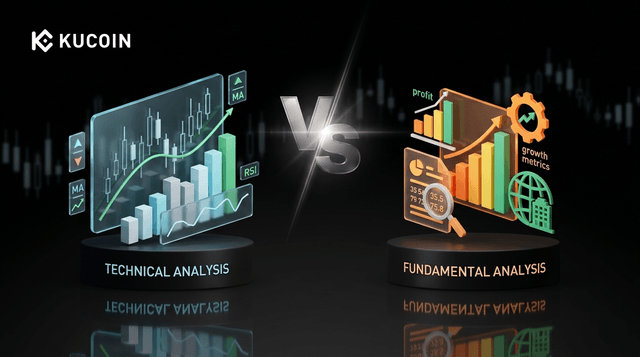
Key Takeaways
-
Fundamental Analysis (FA) evaluates a cryptocurrency's intrinsic value by examining project health, tokenomics, and team strength to determine long-term viability.
-
Technical Analysis (TA) utilizes historical price action, volume, and chart patterns to predict future price movements, primarily for short-term entry and exit timing.
-
The Hybrid Approach is widely considered the gold standard in 2026; use FA to identify what to buy and TA to decide when to buy.
-
KuCoin Integration: Both methodologies can be executed seamlessly using KuCoin’s Spot Market tools for TA and KuCoin Earn for long-term FA-based staking.
Market Context: Navigating the 2026 Crypto Landscape
As we move through 2026, the cryptocurrency market has transitioned from speculative "wild west" cycles into a more mature, institutional-grade financial ecosystem. With the widespread adoption of digital asset treasury (DAT) standards and the integration of blockchain into global payments, the "noise" in the market has reached an all-time high.
For traders on KuCoin, distinguishing between price manipulation and genuine value is more critical than ever. In this high-velocity environment, understanding the duality of market analysis isn't just a luxury—it is the foundation of capital preservation. Whether you are scalping volatility on a Tuesday afternoon or building a retirement portfolio with blue-chip assets, the lens through which you view the market determines your ultimate ROI.
Deep Dive: Fundamental Analysis (FA)
Fundamental Analysis is the art of looking "under the hood." It ignores the flickering red and green candles of the daily chart to ask one central question: Is this project actually worth something?
Core Value Proposition
In crypto, FA isn't about quarterly earnings reports like it is in the stock market. Instead, it focuses on Network Utility. A project’s value is derived from its ability to solve a problem—be it decentralized identity, cross-border liquidity, or AI-integrated smart contracts. If a project has high user retention and growing developer activity, its "intrinsic value" is likely rising, regardless of the current market price.
Technical Edge & Economic Model (Tokenomics)
A rigorous fundamental deep dive must analyze the Tokenomics ($Economic Structure$):
-
Supply Dynamics: Is the token inflationary or deflationary? Look for "burn" mechanisms or hard caps.
-
Distribution: Are the tokens held by a few "whales," or is the distribution decentralized?
-
Utility: Does the token have a purpose (gas fees, governance, staking), or is it purely speculative?
How to Trade/Stake Based on FA on KuCoin Lite
For beginners who prefer the fundamental route, KuCoin Lite offers a streamlined interface.
-
Identify Quality: Use the "Market" tab to find projects with high market caps and proven track records.
-
Accumulate: If your FA suggests a project is undervalued, use the "Fast Trade" feature to accumulate assets.
-
HODL & Earn: Since FA is a long-term play, don't let your assets sit idle. Transfer them to KuCoin Earn to generate passive yield through Flexible or Fixed savings while the market catches up to the project's true value.
Deep Dive: Technical Analysis (TA)
Technical Analysis operates on the premise that "the chart knows all." TA practitioners believe that all fundamental information, news, and insider knowledge are already baked into the current price.
Strategic Advantage
The primary advantage of TA is Precision. While FA tells you that Bitcoin is a good investment, TA tells you that buying at $72,500 is risky because it’s hitting a historical resistance level. TA helps you avoid "buying the top" and "selling the bottom" by identifying market psychology through visual patterns.
Ecosystem Growth & 2026 Outlook
In 2026, TA has evolved beyond simple trendlines. Professional traders now use advanced indicators such as:
-
RSI (Relative Strength Index): To identify if an asset is overbought (>70) or oversold (<30).
-
MACD (Moving Average Convergence Divergence): To spot momentum shifts before they happen.
-
Volume Profiles: To see at which price levels the most trading activity occurred.
Maximizing Returns with KuCoin Spot Market
To execute TA effectively, the KuCoin Spot Market provides a professional-grade TradingView integration.
-
Chart Setup: Switch to the "Professional" view to access dozens of technical indicators.
-
Set Alerts: Use TA to find your "entry zone" and set price alerts so you don't have to stare at the screen all day.
-
Risk Management: Use TA-defined support levels to set Stop-Loss orders, ensuring that a minor correction doesn't turn into a portfolio-ending event.
Comparison Analysis: FA vs. TA
To help you decide which method to prioritize, here is a direct comparison of how these strategies function in the current market.
| Feature | Fundamental Analysis (FA) | Technical Analysis (TA) |
| Primary Goal | Find the "True Value" | Predict "Price Direction" |
| Data Source | Whitepapers, Team, Roadmap | Price Charts, Volume, Indicators |
| Time Horizon | Long-term (Months to Years) | Short-term (Minutes to Weeks) |
| KuCoin Tool | KuCoin Earn | KuCoin Spot Market |
| Main Strength | Identifies high-growth projects | Optimizes entry and exit timing |
| Main Weakness | Ignores short-term volatility | Can be fooled by "fakeouts" |
Trading Insights: Which Fits Your Portfolio?
The "best" analysis depends entirely on your goals and personality.
-
The "Set and Forget" Investor: If you have a full-time job and want to build wealth over 5 years, focus 80% on FA. Find projects with massive 2026 utility and use KuCoin Earn to compound your holdings.
-
The Active Swing Trader: If you enjoy the thrill of the market and want to profit from weekly fluctuations, focus 80% on TA. Use the technical tools in the KuCoin Spot Market to catch waves and exit before the crash.
-
The Professional Hybrid: The most successful traders use FA to filter out "junk" coins and then use TA to buy the "good" coins at a discount.
Conclusion & Strategic Guidance
In the 2026 crypto market, Technical and Fundamental analyses are not enemies; they are two sides of the same coin. Fundamental Analysis provides the conviction to hold during a market crash, while Technical Analysis provides the discipline to take profits when the market is overextended.
For any trader looking to achieve consistent success, the path is clear: Use FA to build a watchlist of high-quality assets on KuCoin, then apply TA to execute your trades with surgical precision.
FAQs for Technical and Fundamental Analysis
Which analysis is better for crypto beginners?
Fundamental Analysis (FA) is generally better for beginners. It is more intuitive to understand why a project is valuable than to interpret complex "Head and Shoulders" chart patterns. Beginners should start by researching projects and using KuCoin Lite for simple purchases.
Can technical analysis predict "Black Swan" events?
No. TA is based on historical data.Sudden events—like a major regulatory shift or a protocol hack—often override technical patterns. This is why using a Stop-Loss on the KuCoin Spot Market is mandatory regardless of your analysis.
Why does a coin's price fall when its fundamentals are good?
This is a common market phenomenon called "Divergence." The market may be overbought, or there may be a macro liquidity crunch. Eventually, price tends to follow value, but TA helps you identify these temporary disconnects so you don't panic-sell.
Does technical analysis work for small-cap "memecoins"?
TA is less reliable for low-liquidity coins because they are easily manipulated by single large trades. For small-cap assets, "Social Sentiment" (a branch of FA) is often more predictive than chart patterns.
How often should I re-evaluate my fundamental analysis?
In the fast-paced 2026 ecosystem, you should review your FA quarterly. Check for roadmap updates, team departures, or changes in tokenomics that might affect the long-term thesis of your investment.
Further Reading:


