
What is the Difference Between Tangem vs. OneKey?
Key Takeaways
-
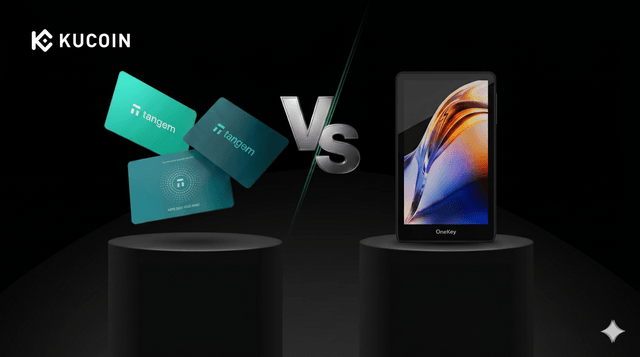
Form Factor & Design: Tangem uses a revolutionary card-based NFC design that eliminates batteries and screens, while OneKey provides a traditional hardware interface with high-resolution touchscreens and biometric security.
-
Security Philosophy: Tangem focuses on a seedless experience, generating private keys within the chip that cannot be exported. OneKey emphasizes transparency through open-source firmware and utilizes a dual-chip architecture (EAL6+).
-
Connectivity & Interaction: Tangem relies exclusively on NFC for mobile-first connectivity. OneKey offers versatile options including USB-C, Bluetooth, and QR-based air-gapped communication for desktop and mobile environments.
-
Ecosystem Utility: Both wallets offer deep integration with DeFi, but OneKey is tailored for power users requiring extensive dApp connectivity, while Tangem is ideal for those seeking maximum physical durability and simplicity.
In the evolution of digital asset custody, a new generation of hardware wallets has emerged to challenge the status quo. To understand Tangem vs. OneKey: New Generation Cold Storage. One must look at the convergence of high-level encryption and user accessibility. As investors move their assets from KuCoin Markets to long-term cold storage, the choice between a card-based system and an open-source terminal defines their daily interaction with blockchain.
The "different" between these two lies in their fundamental approach to private key management. Tangem simplifies the experience of a physical tap, whereas OneKey provides a robust, transparent terminal for the decentralized web. Both serve as essential tools for securing wealth in an increasingly complex digital landscape.
The 6W Framework of Cold Storage
To categorize these next-gen leaders, we apply the 6W principles:
-
Who: Tangem is a Swiss-based technology company pioneering NFC hardware; OneKey is a global leader in open-source hardware security.
-
What: Hardware Security Modules (HSM)—physical devices that keep private keys isolated from online environments.
-
Where: Used globally to secure assets across hundreds of blockchains and thousands of tokens.
-
When: As permanent infrastructure, they provide 24/7 protection against remote hacking, phishing, and software vulnerabilities.
-
Why: To fulfill the core crypto tenet of self-sovereignty: absolute control over one's own private keys.
-
How: Tangem uses NFC-enabled EAL6+ smart cards; OneKey utilizes dual-chip architecture and open-source code.
Tangem: The Revolution of Simplicity
Tangem has redefined the hardware wallet by stripping away every non-essential component. There are no cables, no batteries, and no recovery sheets to hide.
-
The Seedless Logic
The most significant "different" with Tangem is the option to go "seedless." Upon initialization, the private key is generated inside the card's chip and can never be extracted or viewed. Backup is achieved by linking two or three cards together, which "clone" the access rights. This eliminates the risk of a user losing a paper recovery phrase—a common point of failure discussed in the KuCoin Blog.
-
Physical Durability and NFC
Because it lacks a screen or battery, a Tangem card is essentially a high-security slab of plastic and silicon. It is IP68-rated (waterproof and dustproof) and can survive extreme environmental conditions. For users who prioritize a mobile-first lifestyle, the KuCoin Lite Version paired with Tangem offers a seamless transition from exchange liquidity to physical custody with a simple tap of the phone.
OneKey: The Open-Source Powerhouse
OneKey caters to the "Don't Trust, verify" crowd. Their philosophy is built on total transparency and versatile connectivity.
-
100% Open-Source Transparency
Unlike many competitors, OneKey’s hardware schematics and software firmware are entirely open-source. This allows the global security community to audit the code for backdoors. For traders who monitor official announcements regarding protocol security, this transparency provides a level of psychological and technical comfort that proprietary systems cannot match.
-
Air-Gapped Communication (OneKey Pro)
The flagship OneKey Pro introduces the ultimate security layer: QR-based air-gapped communication. By using a camera to scan QR codes for transaction signing, the device never needs to be physically connected to a computer or phone. This creates a "dead air" gap that prevents any digital malware from jumping from a compromised PC to the hardware wallet.
Summary Comparison Table: Tangem vs. OneKey
| Feature | Tangem Card | OneKey (Pro/Classic) |
| Form Factor | NFC Smart Card | Terminal with Screen |
| Security Chip | EAL6+ Certified | Dual Chip (MCU + SE) |
| Connection | NFC (Tap to Phone) | USB-C, Bluetooth, QR Code |
| Backup Method | Card-to-Card (Seedless) | 12/24 Word BIP39 Seed |
| Open Source | App (Yes) / Firmware (No) | Fully 100% Open Source |
| Best For | Beginners & Portability | Power Users & Developers |
Conclusion: The Difference Between Tangem vs. OneKey
Comparing Tangem vs. OneKey: New Generation Cold Storage reveals two paths to the same destination: safety. Tangem is the choice for those who want a wallet that feels like a bank card and eliminates the stress of managing a recovery phrase. OneKey is the choice for professionals who demand a transparent, air-gapped terminal to interact with complex DeFi protocols.
By selecting the tool that fits your lifestyle and utilizing the liquidity found on KuCoin Markets, you can ensure that your digital journey remains secure, sovereign, and efficient.
FAQs
What happens if I lose my Tangem card?
If you have a backup card (standard in 2 or 3-card sets), you can use the backup to access your funds and set up a new security protocol. If you lose all cards and don't set up a recovery phrase, the funds are permanently lost.
Is OneKey safer because it is open source?
Open source allows for community auditing, which can catch bugs earlier. However, safety also depends on physical handling and how you store your recovery seed.
Can I use these wallets on a PC?
OneKey has excellent desktop support via USB and a dedicated browser extension. Tangem is primarily designed for mobile use via NFC, though some desktop NFC readers may work with specialized software.
Do they support all tokens on KuCoin?
Both support all major chains (Ethereum, Solana, BNB Chain, etc.). OneKey has a slight edge in supporting niche EVM chains due to its deep integration with MetaMask. For the latest on token support, check the official announcement page.
Where can I learn about securing my seed phrase?
You can find comprehensive security guides and "best practices" for hardware wallet management on the KuCoin Blog.
Join 30 million global users on the world’s leading crypto exchange by signing up for your free account now. Register Now!
Further reading


