
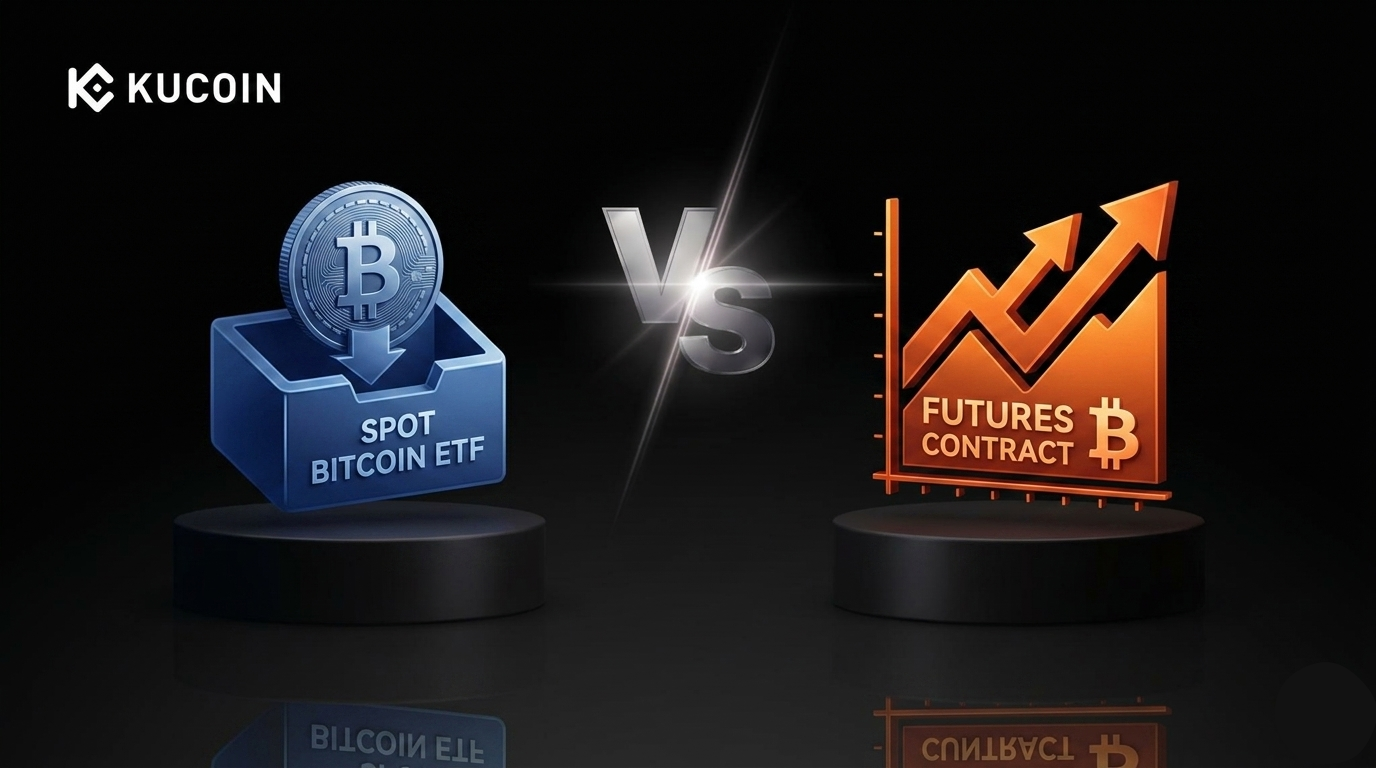
What is the difference between Spot Bitcoin ETFs and Futures Bitcoin ETF?
Key Takeaways
-
Spot Bitcoin ETFs are investment vehicles that directly buy and hold actual, physical Bitcoin in institutional-grade cold storage vaults managed by regulated third-party custodians.
-
Futures Bitcoin ETFs do not own any underlying physical cryptocurrency; instead, they invest entirely in standardized, cash-settled futures contracts traded on regulated derivatives platforms.
-
The structural cost models differ because futures-based funds incur monthly contract replacement expenses, known as "roll costs," which can trigger performance tracking discrepancies over time.
-
Investment horizons dictate the selection, making physically backed spot funds optimal for long-term portfolio allocation, whereas futures funds are suited for short-term tactical trading and market hedging.
-
Traditional financial security rules apply to both exchange-traded funds, enabling retail investors to gain exposure to digital asset price movements without managing cryptographic wallets or private keys.
What Are Spot Bitcoin ETFs and Futures Bitcoin ETFs?
The global financial landscape reached a historic milestone with the widespread regulatory approval and mainstream adoption of cryptocurrency exchange-traded products. Today, investors seeking to add digital assets to their traditional investment portfolios no longer face the administrative burdens of decentralized exchanges or the security anxieties of self-custody storage solutions. Instead, the equity market has consolidated around two primary financial instruments: Spot Bitcoin ETFs and Futures Bitcoin ETFs.
While both financial products enable participants to execute trades through standard brokerage accounts on major equity exchanges, their structural architectures, underlying assets, and pricing efficiencies are vastly different. Selecting the correct asset vehicle requires a thorough operational analysis of how these funds manage wealth behind the scenes. This comprehensive guide breaks down the core structural differences between a physically backed Spot Bitcoin ETF and a derivatives-based Futures Bitcoin ETF, providing the essential technical insights needed to optimize your portfolio layout.
How Spot Bitcoin ETFs Work
A Spot Bitcoin ETF is a traditional exchange-traded product designed to acquire, hold, and maintain actual, physical Bitcoin as its primary reserve asset. When a retail or institutional investor buys shares of a spot fund, those shares represent direct, fractional ownership of a pool of real cryptocurrency managed by the fund sponsor.
Direct Asset Backing and Real-Time Price Replication
The foundational mechanic of a Spot Bitcoin ETF is its strict 1:1 physical backing requirement. When new capital flows into the fund, the issuer collaborates with specialized market makers, known as Authorized Participants (APs), to purchase equivalent amounts of real Bitcoin from established spot exchanges. This physical asset accumulation guarantees that the fund's net asset value (NAV) directly mirrors the real-time spot price of Bitcoin. Aside from a fixed annual management expense fee, the fund replicates the performance of the live cryptocurrency market with high precision, ensuring minimized price tracking divergence.
How Futures Bitcoin ETFs Work
A Futures Bitcoin ETF operates without holding any physical cryptocurrency reserves in digital vaults. Instead of interfacing with raw spot crypto markets, the fund manager allocates investor capital into standardized, cash-settled derivatives contracts that are listed and traded on traditional, highly regulated derivatives markets like the Chicago Mercantile Exchange (CME).
Derivatives Contract Structure and Pricing Settlement
A Bitcoin futures contract is a legally binding financial derivative agreement to buy or sell the underlying asset at a predetermined price on a designated future calendar date. Consequently, the net asset value of a Futures Bitcoin ETF is driven by speculative market expectations of where the cryptocurrency's price will land at contract expiration, rather than what it is valued at right now on the spot market. The fund manager continuously trades, balances, and realigns these paper derivative contracts, maintaining market exposure through standard institutional clearinghouses without ever touching an actual blockchain network.
Spot Bitcoin ETFs vs Futures Bitcoin ETFs: Key Differences
To help visualize how these two digital asset instruments diverge, the following data table isolates their core operational parameters, cost profiles, and structural risks:
| Operational Dimension | Spot Bitcoin ETFs | Futures Bitcoin ETFs |
| Underlying Holding Asset | Physical Bitcoin ($BTC$) tokens | CME Bitcoin futures derivative contracts |
| Asset Custody Mechanism | Institutional cryptographic cold storage | Standard traditional clearinghouses |
| Price Tracking Accuracy | High proximity to real-time spot market | Subject to futures curve premiums/discounts |
| Inherent Drag Expenses | Standard flat annual management fee | Management fee plus monthly contract roll costs |
| Market Volatility Factors | Directly tied to physical supply and demand | Strongly influenced by Contango and Backwardation |
| Long-Term Capital Efficiency | High; no structural rebalancing friction | Low; eroded by recurring derivative rebalancing |
Spot vs Futures Bitcoin ETFs: Detailed Comparison
-
Asset Custody Frameworks and Counterparty Safety
The structural dividing line between Spot Bitcoin ETFs and Futures Bitcoin ETFs centers on asset custody administration. A spot fund requires an advanced digital asset storage layout. Fund issuers must hire regulated institutional custodians who deploy multi-signature authorization protocols, geographical distribution, and disconnected offline "cold storage" vaults to guard the physical tokens against security vulnerabilities.
In contrast, a futures-based fund manages paper derivative contracts rather than cryptographic tokens, facing zero crypto-specific custody challenges. Its counterparty risk is distributed entirely through the clearinghouse systems of traditional commodity exchanges. This makes its operational security profile identical to conventional equity or commodity futures funds.
-
The Drag of Monthly Contract Roll Costs and Tracking Discrepancies
A critical drawback to maintaining a position in a Futures Bitcoin ETF over an extended timeline is a hidden market friction known as "roll costs." Because futures contracts carry explicit expiration dates, a fund manager cannot simply buy a contract and hold it indefinitely. To maintain constant market exposure, the manager must implement a monthly rebalancing routine: selling the active contract nearing its expiration date and using the proceeds to buy the next consecutive month's contract.
When a futures market is in a state of contango—a scenario where the future price of an asset trades higher than the immediate spot price—the fund manager is structurally locked into selling cheaper expiring contracts and purchasing more expensive future contracts every month. This continuous cycle creates an ongoing capital drag. Over multiple quarters, this structural friction generates a tracking discrepancy, causing the futures fund's performance to lag behind the actual upward price trajectory of physical Bitcoin. Spot Bitcoin ETFs are immune to roll costs because their physical holdings are held continuously without expiration timelines.
-
Total Expense Ratios and Ongoing Account Maintenance
Due to intense competition among major financial firms, the Total Expense Ratios (TER) for top-tier Spot Bitcoin ETFs have stabilized at highly competitive rates, often floating between 0.15% and 0.25% annually.
Conversely, a Futures Bitcoin ETF generally features higher internal maintenance fees. Beyond the baseline sponsor management fee, the active trading architecture required to constantly roll over derivatives contracts produces structural costs—such as brokerage commissions, exchange transaction adjustments, and margin preservation charges. These hidden expenses are implicitly absorbed by the fund's capital base, quietly reducing net yields for shareholders over time.
-
Portfolio Allocation Strategy and Investor Timelines
When deciding between these two instruments, your intended holding duration and portfolio strategy should guide your selection:
-
The Strategic Accumulation Approach: For retirement planning accounts, multi-year wealth portfolios, or systematic dollar-cost-averaging strategies, a spot fund is mathematically more efficient. It yields unadulterated exposure to the underlying spot asset price appreciation without the compounding decay of derivatives management.
-
The Tactical Trading Approach: For active day traders, momentum swing traders, or portfolio managers looking to hedge against spot market corrections, a futures fund offers significant utility. The futures market naturally facilitates specialized trading designs, such as short exposure via inverse ETFs, allowing market participants to secure capital gains even during crypto bear markets.
Summary of Spot Bitcoin ETFs and Futures Bitcoin ETFs
Gaining exposure to the cryptocurrency market via exchange-traded products requires aligning your investment goals with the underlying fund mechanics. Spot Bitcoin ETFs connect investors directly to the live cryptocurrency market by purchasing and holding physical Bitcoin inside secure institutional cold storage installations. This direct asset architecture limits pricing tracking errors and avoids derivative trading frictions, making it the preferred approach for long-term investors focused on low holding costs and simple spot price replication. In contrast, Futures Bitcoin ETFs build market exposure through regulated paper derivative contracts, avoiding crypto custody logistics entirely. While this derivatives framework introduces recurring monthly roll costs that make it less efficient for multi-year holding strategies, it delivers the structural flexibility, shorting alternatives, and trading liquidity needed for short-term market speculation and tactical asset hedging.
FAQs: Analyzing Spot Bitcoin ETFs and Futures Bitcoin ETFs
Do I receive physical cryptocurrency if I redeem shares of a Spot Bitcoin ETF?
No, retail investors cannot redeem fund shares for actual Bitcoin. The physical redemption process is strictly restricted to institutional market makers (Authorized Participants). When you sell your shares on a stock exchange, the transaction settles entirely in cash through your standard brokerage account.
Why do some institutional traders prefer a Futures Bitcoin ETF over a spot fund?
Many institutional managers operate under corporate charters that prohibit investing directly in spot commodities or using digital asset custody providers. Because a Futures Bitcoin ETF holds standardized paper contracts cleared through legacy exchanges like the CME, it seamlessly fits within traditional regulatory and risk parameters.
How does market contango affect a long-term investment in a Futures Bitcoin ETF?
Contango acts as a compounding tax on your capital. When future contracts are more expensive than the current spot price, the fund manager loses small percentages of capital every month by selling low and buying high during contract rollover. Over time, these recurring roll losses cause the fund to significantly underperform raw Bitcoin.
Are Spot Bitcoin ETFs safer than Futures Bitcoin ETFs during severe market crashes?
Neither fund protects you from a market crash, as both track the highly volatile price of Bitcoin. However, during a liquidity crisis, a Spot Bitcoin ETF offers clearer transparency because its value is tied directly to physical vault assets, whereas a futures fund can experience extreme tracking errors if the derivatives curve decouples from the spot market.
Create a free KuCoin account to discover the next crypto gems and trade over 1,000 global digital assets today. Create Now!
Further Reading:


