
What is the difference between solo staking and pool staking?
Key Takeaways
-
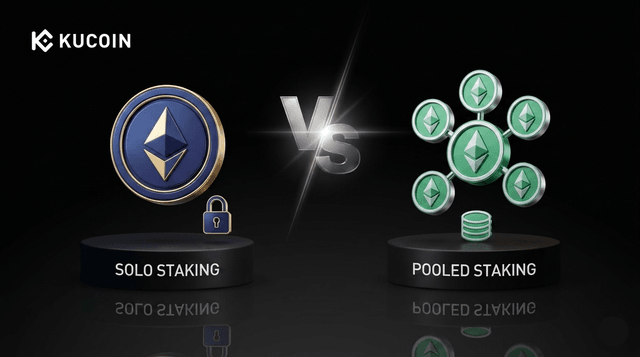
Infrastructure & Custody: The primary technical divide is in operational control; solo staking requires setting up and maintaining a dedicated node (with at least 32 ETH), whereas pool staking delegates node operation to a third party or decentralized network.
-
Capital Requirements: Solo staking demands a strict 32 ETH minimum to activate a validator, while pool staking (or liquid staking) allows users to participate with fractions of an ETH, democratizing yield generation.
-
Liquidity & Ecosystem: Pool staking typically issues Liquid Staking Tokens (LSTs) like stETH or rETH, which unlock liquidity for DeFi composability, whereas solo staked ETH is locked on the beacon chain until a manual exit.
-
Risk Profiles: Both approaches carry unique risks; solo stakers bear the full brunt of slashing penalties for offline nodes or misconfigurations, while pool stakers face smart contract vulnerabilities and counterparty risks.
The race to secure Ethereum and generate passive yield has led to a major shift in the validator landscape. To understand Solo Staking vs. Pool Staking, one must look beyond the surface level of "earning APY" and examine the engineering philosophies and risk-reward ratios that power billions of dollars in network security.
Both models allow users to support the blockchain's consensus mechanism and earn newly issued tokens plus network fees. However, the "different" in their approach impacts everything from capital efficiency to the overall decentralization of the network.
The 6W Framework of Staking
To categorize the positioning of these two staking avenues, we can apply the 6W principles:
-
Who: Operated by individual home validators (solo stakers) versus professional node operators, DAOs, or centralized exchanges managing massive liquidity (pool stakers).
-
What: The process of locking up ETH to secure the Proof-of-Stake (PoS) network, earning block rewards and MEV in exchange for honest validation.
-
Where: Solo staking occurs directly on the Ethereum Beacon Chain via self-hosted hardware, whereas pool staking operates through smart contracts or custodial platform layers.
-
When: As an evergreen mechanism since The Merge, staking represents the foundational yield of the crypto ecosystem, evolving with network upgrades like Pectra.
-
Why: To solve the balance between network decentralization (encouraged by solo staking) and capital efficiency/accessibility (solved by pooled liquid staking).
-
How: By utilizing a 32 ETH deposit for direct node activation, or by depositing any amount into a smart contract that aggregates funds to spin up validators on behalf of the pool.
Solo Staking vs. Pool Staking: Structural Differences
The core technical differences lie in how they handle custody, how they integrate with the broader DeFi ecosystem, and how they manage the responsibilities of hardware upkeep.
The Custody and Infrastructure Model (Direct vs. Delegated)
This is the most significant technical "different."
-
Solo Staking (Direct Control): You hold the withdrawal keys, run your own execution and consensus clients, and maintain a 24/7 internet connection. You are fully sovereign. There is no middleman taking a cut of your rewards, but you are completely responsible for preventing slashing (penalties for malicious behavior or extreme downtime).
-
Pool Staking (Delegated Operations): You deposit funds into a protocol (like Lido or Rocket Pool) or a centralized exchange. The protocol pools your funds with others to reach the 32 ETH threshold and assigns it to professional node operators. You bypass hardware maintenance but pay a commission (typically 5–15%) on your earned rewards.
Capital Efficiency and Liquid Tokens
-
Solo Staking (Locked Capital): Once your 32 ETH is staked natively, it cannot be used elsewhere. To access your capital, you must trigger an exit from the validator queue, a process that can take days depending on network congestion. The Pectra upgrade optimizes operations for large solo whales by increasing the maximum effective balance up to 2048 ETH, but the capital remains illiquid.
-
Pool Staking (Liquid Staking Tokens - LSTs): When you use a decentralized pool, you usually receive a receipt token (e.g., stETH, rETH) representing your staked deposit plus accrued yield. For a DeFi user, if a token has liquidity, it can be used as collateral to borrow, lend, or provide liquidity on other platforms, effectively stacking yields.
Ecosystem Strategy: Complete Control vs. Liquid Convenience
The market has rewarded these two paths in different ways.
Solo Staking: The Decentralized Purist
By 2026, solo staking remains the "gold standard" for Ethereum's security. Because of its trustless nature, it is championed by Ethereum core developers to keep the network decentralized and resilient against regulatory capture. If you are looking for maximum sovereignty and maximum base-layer yield (0% fee drag), you will likely find it in a home staking setup.
Pool Staking: The Capital Efficiency Play
Pool staking has taken a broader, more integrated approach. Through Liquid Staking Tokens (LSTs) and Liquid Restaking Tokens (LRTs), protocols allow users' capital to remain fluid across the DeFi landscape. This modularity makes it a favorite for retail users and aggressive yield farmers alike.
Trading Insights: Staking Dynamics in 2026
For a trader or investor, Solo Staking vs. Pool Staking translates into specific on-chain behaviors:
-
Yield Generation and Fees: Solo stakers keep 100% of block rewards, priority fees, and MEV (Maximal Extractable Value). Pool stakers sacrifice a small percentage but gain the ability to deploy their LSTs elsewhere.
-
Market Volatility: During high volatility, LSTs can sometimes "de-peg" slightly from their underlying ETH value on secondary markets. Traders tracking indicators like the Average True Range (ATR) might exploit these arbitrage opportunities.
-
Unstaking Times: Both networks require navigating the Ethereum exit queue, which fluctuates based on demand.
For retail users who prefer a more streamlined experience, the KuCoin Lite Version provides a simplified interface to manage staked assets and earn passive yield without needing to manually deal with node infrastructure or smart contract interactions.
Summary of Key Differences
| Feature | Solo Staking | Pool Staking (Liquid/Exchange) |
| Capital Requirement | 32 ETH Minimum | Any fraction of ETH |
| Node Maintenance | Required (24/7 Uptime) | Delegated to Node Operators |
| Liquidity | Locked until withdrawal | Liquid via LSTs or Exchange Trading |
| Reward Distribution | 100% of Yield (No fees) | Yield minus protocol/exchange commission |
| Primary Risk | Hardware failure & Slashing | Smart contract bugs & De-pegging |
Conclusion: The Future of Ethereum Staking
In the debate of Solo Staking vs. Pool Staking, the "winner" is the end-user. Solo staking provides a high-sovereignty environment for the most dedicated Ethereum supporters, while pool staking builds the infrastructure for an accessible, capital-efficient DeFi ecosystem. As we look forward, both models continue to push the boundaries of what is possible on Ethereum, ensuring that the network remains the world’s most secure and scalable settlement layer.
FAQs
Is one staking method more secure than the other?
Both inherit the base security of the Ethereum protocol, but the "different" lies in the risk vectors. Solo staking eliminates smart contract and third-party risk but introduces hardware and internet stability risks. Pool staking eliminates hardware risks but relies on the security of the underlying smart contracts and the honesty of the protocol's node operators.
Why do I have to wait to unstake my ETH?
This is due to the network's "Exit Queue." Because the network must ensure stability, only a limited number of validators can enter or exit the active set per epoch. This delay is the trade-off for maintaining network consensus. Liquid staking bypasses this by letting you sell your receipt token to another buyer.
Can I run a validator with less than 32 ETH?
Native solo staking strictly requires 32 ETH. However, innovations like Distributed Validator Technology (DVT) and decentralized minipools (like Rocket Pool) allow operators to run nodes with smaller bonds (e.g., 8 ETH) by pairing their funds with community deposits.
Which one has higher overall yields?
Solo stakers earn the highest base yield because they pay zero commission fees to a middleman. However, savvy pool stakers can sometimes achieve higher aggregate APYs by taking their LSTs (like stETH) and deploying them into complex DeFi strategies, albeit at a higher risk profile.
How do I start pool staking quickly?
You can easily purchase liquid staking tokens or participate in direct exchange staking on KuCoin Markets. Ensure you select the correct staking product that aligns with your liquidity needs and risk tolerance when allocating from your self-custody wallet or exchange account.
Join 30 million global users on the world’s leading crypto exchange by signing up for your free account now. Register Now!
Further reading:


