
What is the Difference Between Privacy Regulations (GDPR) and Blockchain Immutability?
Key Takeaways
-
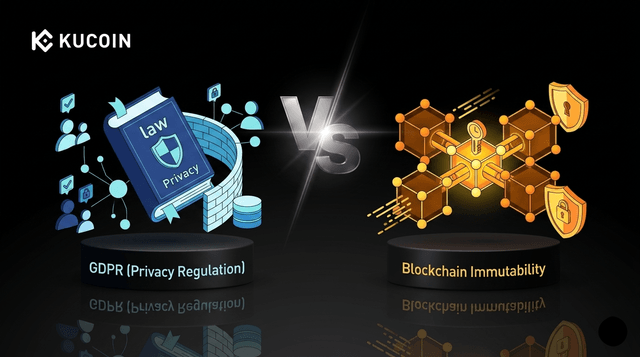
Fundamental Conflict: GDPR mandates the "Right to be Forgotten" (data erasure), while blockchain is architecturally designed to be permanent and "append-only."
-
Data Control: GDPR relies on identifying a "Data Controller," whereas decentralized blockchains distribute authority across global nodes.
-
2026 Solutions: Privacy-preserving technologies like Zero-Knowledge Proofs (ZKP) and off-chain hashing are bridging the gap between regulation and decentralization.
-
KuCoin Advantage: Using institutional-grade platforms like KuCoin Lite allows traders to benefit from blockchain transparency while ensuring their personal data is handled by a compliant, centralized gateway.
Market Context: The Privacy Paradigm Shift in 2026
As we move through 2026, the digital asset landscape has entered the "Institutional Era." The tension between European privacy standards (GDPR) and the inherent transparency of Distributed Ledger Technology (DLT) is no longer a theoretical debate—it is a frontline operational challenge.
With the rise of "Secrets-as-a-Service" and the mass adoption of Layer 2 privacy rollups, the market has transitioned from "Code is Law" to "Compliance is Scale." For traders on KuCoin, understanding this intersection is vital. Modern portfolios are increasingly exposed to "Privacy-by-Design" assets that satisfy regulators while maintaining the trustless nature of the blockchain. In 2026, privacy is not just a feature; it is a competitive moat for blockchain ecosystems.
Deep Dive: Privacy Regulations (GDPR)
Core Value Proposition
The General Data Protection Regulation (GDPR) is the global "gold standard" for data sovereignty. Its primary goal is to return power to the individual, ensuring that personal data (PII) is processed lawfully, transparently, and only for specific purposes.For a crypto investor, GDPR represents the legal safety net that prevents service providers from mishandling their sensitive KYC/AML information.
Technical Edge & Regulatory Model
The GDPR operates on a "Centralized Accountability" model. It requires a Data Controller—a specific entity that decides why and how data is used.
-
Article 17 (Right to Erasure): Allows users to demand the permanent deletion of their data.
-
Article 16 (Right to Rectification): Grants the right to correct inaccurate data.
-
Data Minimization: Organizations must only collect what is strictly necessary.
How to Navigate Privacy on KuCoin
When you interact with the KuCoin Spot Market, you are engaging with a centralized interface that acts as your data guardian. KuCoin manages the complex interface between your private identity and the public blockchain. By using KuCoin Lite, beginners can trade without needing to manage the privacy implications of direct on-chain interactions, as the exchange handles the regulatory heavy lifting.
Deep Dive: Blockchain Immutability
Strategic Advantage
Immutability is the bedrock of blockchain’s value. It ensures that once a transaction is verified and added to the ledger, it cannot be altered, deleted, or spoofed.This "tamper-proof" nature creates Trustless Integrity, allowing two parties to trade assets without a middleman verifying the ledger’s validity.
Ecosystem Growth & 2026 Outlook
In 2026, immutability has evolved. We are seeing the rise of Chameleon Hashes and Pruning Protocols that allow for "functional erasure" without breaking the cryptographic chain. Investors are now looking at "Mutable-Immutable" hybrids—blockchains that remain permanent for financial audits but allow for the "burning" of private data links. This ensures that the history of a token remains intact while the identity of the holder stays protected.
Maximizing Returns with KuCoin Earn
For long-term holders, the immutability of the blockchain provides the security needed to stake assets. Through KuCoin Earn, users can deploy their assets into various proof-of-stake (PoS) protocols. The immutability of these networks ensures that your staked principal and generated rewards are governed by smart contracts that cannot be arbitrarily changed by any single party.
Comparison Analysis: Regulation vs. Technology
| Dimension | GDPR (Privacy Regulation) | Blockchain Immutability |
| Data Philosophy | "Right to be Forgotten" | "Right to be Remembered" |
| Control Model | Centralized (Data Controller) | Decentralized (Node Consensus) |
| Security Mechanism | Legal Penalties & Encryption | Cryptographic Hashing & PoW/PoS |
| Modifiability | High (Data must be editable) | Zero/Low (Data is permanent) |
| Investor Value | Personal Identity Protection | Asset Integrity & Transaction Trust |
Trading Insights: Which Fits Your Portfolio?
Understanding the gap between privacy and immutability helps in selecting the right assets:
-
The Privacy-Centric Investor: Focus on assets utilizing Zero-Knowledge Proofs (ZKP).These protocols allow for transaction validation on an immutable ledger without revealing the underlying data, satisfying the spirit of GDPR while maintaining blockchain integrity.
-
The Institutional Trader: Look for "Permissioned" or "Consortium" blockchains.These networks have identifiable controllers, making them more likely to be fully GDPR-compliant and suitable for large-scale corporate adoption.
-
The DeFi Power User: If you prioritize "Code is Law," your portfolio will lean toward permissionless, fully immutable chains. However, be aware that your on-chain footprint is permanent and public.
Conclusion & Strategic Guidance
The "conflict" between GDPR and blockchain immutability is the engine of innovation in 2026. While GDPR demands the ability to delete, blockchain provides the inability to lie. The future belongs to hybrid solutions: Off-chain storage for personal data and on-chain hashing for transaction proof.
For the average trader, the best strategy is to utilize a secure, compliant gateway. By trading on KuCoin, you gain the benefits of blockchain's immutable ledgers for your assets while enjoying the data privacy protections provided by a world-class exchange.
Join 30 million global users on the world’s leading crypto exchange by signing up for your free account now. Register Now!
FAQs for GDPR and Blockchain Immutability
-
Can a blockchain ever be 100% GDPR compliant?
Strictly speaking, a public, permissionless blockchain cannot be 100% compliant if personal data is stored directly on-chain.However, use cases can be compliant by storing personal data off-chain and only recording non-identifiable hashes on the blockchain.
-
What happens if I want to "delete" my transaction history?
On a public blockchain, you cannot delete transaction history due to immutability.However, GDPR-compliant exchanges like KuCoin can delete your account-associated personal data from their internal servers upon request, "de-linking" your identity from the on-chain addresses.
-
Are Zero-Knowledge Proofs (ZKPs) the solution to this problem?
ZKPs are a massive step forward. they allow a user to prove they have the funds for a trade without revealing their wallet balance or identity, effectively bridging the gap between the need for privacy and the need for immutable proof.
-
How does KuCoin protect my data under these regulations?
KuCoin employs "Privacy-by-Design," utilizing advanced encryption and secure silos for KYC data. While your trades are recorded on immutable ledgers, your personal identity is shielded behind institutional-grade security layers.
-
Does immutability make my data more or less secure?
It depends on the data. For financial records, immutability increases security by preventing fraud. For personal details, immutability is a risk, which is why 2026 standards dictate that PII should never be stored directly on an immutable ledger.
Learn More:


