
What is the difference between On-chain vs. Off-chain Governance (DAO)?
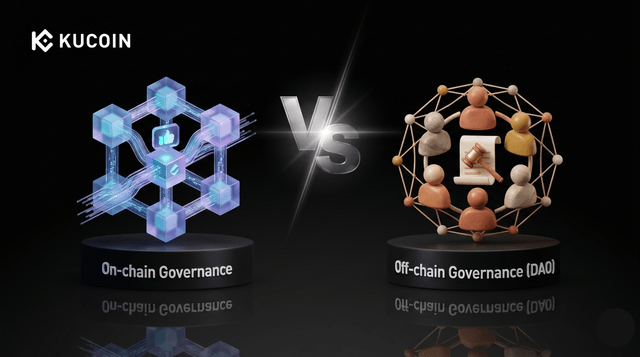
Key Takeaways
-
Execution vs. Discussion: On-chain governance enables automated, trustless code execution, while off-chain governance prioritizes human collaboration and flexible consensus.
-
The Hybrid Standard: Most modern DAOs utilize a "Blended Flow"—off-chain signaling for debate (e.g., Snapshot) followed by on-chain execution for binding actions.
-
Scalability & Cost: Off-chain models lower the barrier to entry by eliminating gas fees for voting, whereas on-chain models provide the highest level of transparency and immutability.
-
KuCoin Ecosystem Access: Participants can engage with both governance models by holding and staking assets across the KuCoin ecosystem, which supports diverse DAO-led tokens.
As decentralized ecosystems mature, the "invisible hand" of governance has become the defining factor for long-term sustainability. The fundamental question for any Decentralized Autonomous Organization (DAO) is where decision-making power resides: within the immutable logic of a smart contract or the social layer of the community.
The debate of On-chain vs. Off-chain Governance represents a trade-off between "Trustless Automation" and "Human Flexibility." In an era where DAOs are managing billions of treasury assets, the choice of governance architecture dictates everything from security resilience to the speed of innovation. For developers and institutional traders alike, understanding these dynamics is key to evaluating the crypto markets and the underlying health of decentralized protocols.
Overviews: The Two Pillars of DAO Governance
What is On-Chain Governance?
On-chain governance is a system where the rules for instituting changes are encoded directly into the blockchain protocol. Proposals are submitted as code, and if a vote passes the required threshold, the smart contract automatically executes the change. There is no human intermediary to "approve" the result; the code is the final arbiter.
-
Core Tools: Tally, Governor Alpha/Bravo, Compound-style contracts.
-
Philosophy: "Code is Law."
What is Off-Chain Governance?
Off-chain governance resembles traditional social coordination. Discussions happen in forums (Discourse), chat rooms (Discord), and signaling platforms (Snapshot). Once a community reaches a consensus, the actual implementation is carried out manually by core developers or a multi-sig committee.
-
Core Tools: Snapshot, Discord, Commonwealth, GitHub.
-
Philosophy: "Social Consensus."
Key Differences: Governance Developer Experience (DX)
The developer experience (DX) differs significantly when building these two models. A developer on an on-chain protocol must account for every edge case in code, while an off-chain developer focuses on building a resilient social framework.
-
Verification and Trust
In an on-chain model, trust is derived from the protocol's cryptography. Every vote and execution is verifiable by anyone. In contrast, off-chain governance requires trust in the "implementers" (the people holding the keys to the protocol) to follow the community's will. For the latest official announcements on how major protocols handle these implementations, transparency remains a top priority.
-
Speed and Adaptability
Off-chain governance excels in crisis management. Because it relies on human judgment, it can quickly pivot in response to a hack or an unforeseen market event. On-chain governance often involves "Timelocks"—mandatory waiting periods designed to prevent malicious "governance attacks", which can make the protocol slow to react to emergencies.
-
Participation Costs
One of the biggest hurdles for on-chain governance is the "Gas Barrier." Voting on-chain requires a transaction fee, which can lead to "voter apathy" among smaller holders. Off-chain signaling via Snapshot allows for gasless, signature-based voting, significantly increasing community engagement.
Pros and Cons
| Feature | On-Chain Governance | Off-Chain Governance |
| Execution | Automated: No human intervention needed. | Manual: Relies on multi-sig or dev team. |
| Transparency | Highest: Every step is on the ledger. | Moderate: Discussion may happen in private. |
| Cost | Higher: Requires gas for every vote. | Negligible: Usually gasless signaling. |
| Flexibility | Rigid: Only executes what is coded. | Fluid: Can handle nuanced human debate. |
| Vulnerability | Code Exploits: Flash loan attacks on voting. | Centralization: Trust in key-holders. |
Use Cases: The Hybrid Paradigm
Most successful DAOs are moving away from binary choice and toward a Hybrid Governance Model:
-
Sentiment Phase (Off-chain): The community uses Snapshot to gauge interest in a proposal. This stage is free, inclusive, and allows for multiple iterations of an idea.
-
Binding Phase (On-chain): Once a proposal is refined, it is moved to an on-chain vote. Passing this vote triggers the Timelock and subsequent automatic execution.
-
Emergency Outlets: Some DAOs implement "Veto" powers for specialized security councils to halt malicious on-chain proposals, combining the safety of a human layer with the efficiency of code.
As projects evolve, their governance needs change. You can follow these shifts and their impact on tokenomics through the KuCoin Blog.
Conclusion
The evolution of DAO governance is a move toward Modular Governance. The industry has realized that while automation provides security, human coordination provides wisdom. The most resilient organizations are those that use on-chain logic to protect the treasury and off-chain discussion to foster innovation.
For participants, the goal is to identify protocols that have found the right balance—where governance is transparent enough to trust, but flexible enough to survive. As the KuCoin ecosystem continues to list high-potential DAO tokens, understanding the underlying governance structure is one of the most effective ways to assess long-term project viability.
FAQs
What is a "Governance Attack"?
A governance attack occurs when an actor acquires a large amount of voting power (often via flash loans) to force through a proposal that benefits them at the expense of the protocol, such as draining the treasury.
Why is Snapshot so popular if it’s off-chain?
Snapshot allows users to vote with their tokens without spending money on gas. It provides a "signal" of what the community wants, which is often respected by the core team as a mandate for change.
Can off-chain governance be "legally binding"?
In most jurisdictions, the legal status of DAOs is still evolving. However, many DAOs are now forming "Legal Wrappers" (like LLCs or Foundations) to bridge off-chain social consensus with traditional legal accountability.
What is Liquid Democracy in DAOs?
Liquid democracy allows token holders to either vote directly or delegate their voting power to a "delegate" who is more knowledgeable about specific technical or financial topics.
How do I participate in DAO governance?
Most DAOs require you to hold their native governance token. You can then connect your wallet to platforms like Snapshot or Tally to cast votes. You can find many of these governance tokens on KuCoin.
Join 30 million global users on the world’s leading crypto exchange by signing up for your free account now. Register Now!
Further reading


