
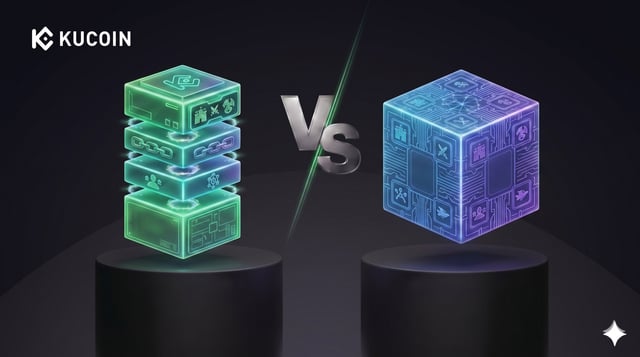
What is the difference between Modular vs Monolithic?
Key Takeaways
-
Design Philosophy: Monolithic blockchains integrate all functions into one layer for simplicity, while modular blockchains decouple tasks into specialized layers for infinite scaling.
-
Performance Trade-offs: Monolithic chains like Solana offer atomic composability and low latency; modular stacks like Ethereum/Celestia focus on data availability and horizontal expansion.
-
Future Outlook: The industry is moving toward a hybrid model where modularity provides the "Lego blocks" for custom execution environments while maintaining decentralized security.
-
Ecosystem Access: The KuCoin ecosystem provides seamless liquidity for both integrated L1s and specialized modular rollup tokens.
In the quest to solve the "Blockchain Trilemma"—balancing security, decentralization, and scalability, two distinct architectural schools of thought have emerged. On the one hand, we have Monolithic Blockchains, the "all-in-one" powerhouses that aim to handle every function within a single integrated stack. On the other hand, the Modular Blockchain movement proposes a "divide and conquer" strategy, breaking the blockchain into specialized layers that work in tandem.
For developers, the choice of architecture dictates the complexity of their tools and the reach of their applications. For participants in the crypto markets, these architectural shifts signal where long-term value and network effects are likely to settle. Understanding the difference between modular and monolithic is no longer a technical luxury; it is a fundamental requirement for navigating the future of decentralized infrastructure.
Overviews: Monolithic and Modular Defined
Every blockchain must perform four core functions:
-
Execution: Processing transactions and updating the state of the account.
-
Settlement: Providing a layer for dispute resolution and finality.
-
Consensus: Ensuring nodes agree on the order of transactions.
-
Data Availability (DA): Ensuring the transaction data is published and accessible to all.
Monolithic Architecture
A monolithic blockchain handles all four functions on a single layer. Networks like Solana or the original Ethereum design are prime examples. In this model, every node in the network must execute every transaction, reach consensus, and store the data. This "integrated" approach ensures that all components are perfectly tuned for each other, often leading to incredible speed and simplicity in the early stages.
Modular Architecture
A modular blockchain unbundles these functions. It delegates execution to one layer (like a Rollup), settlement to another (like Ethereum L1), and data availability to a specialized layer (like Celestia or Avail). By allowing each layer to specialize, the entire system can scale far beyond the limits of a single chain.
Key Differences: Future Architecture
The transition from monolithic to modular represents a shift from "vertical scaling" (stronger hardware) to "horizontal scaling" (more specialized layers).
-
Composability and Latency
-
Monolithic: Since everything happens on one layer, applications enjoy atomic composability. A single transaction can interact with multiple protocols (e.g., a flash loan across three different DEXs) instantly. This leads to extremely low "internal" latency.
-
Modular: Interacting between different modules (e.g., moving assets from one Rollup to another) involves asynchronous communication. While cross-chain protocols are improving, the user experience can feel fragmented compared to a single-chain environment.
-
Scalability and Throughput
-
Monolithic: Scaling is often limited by the hardware requirements of the nodes. As transaction volume grows, the cost of running a node increases, which can lead to centralization.
-
Modular: Execution is moved off-chain to Rollups, which only post small proof or compressed data to the base layer. This allows the network to handle 100x more throughput without increasing the burden on the main validator set.
-
Developer Flexibility
The KuCoin Blog frequently highlights how modularity allows for "App-chains." Developers can launch their own execution environment—perhaps using a Non-EVM language like Rust—while still relying on the massive security of the Ethereum settlement layer. This level of customization is much harder to achieve on a rigid monolithic chain.
Pros and Cons
| Feature | Monolithic Blockchains | Modular Blockchains |
| Pros | Simple Design: Easier to audit and deploy; Atomic Transactions: Instant cross-app interaction; Proven Tech: Most legacy L1s are monolithic. | Infinite Scaling: Add layers as needed; Customizability: Tailor-made execution environments; Shared Security: New chains don't need to find their own validators. |
| Cons | Scalability Ceiling: Hard to scale without hardware centralization; Resource Contention: One viral dApp can spike gas fees for everyone. | Complexity: Harder for developers to manage multiple layers; Fragmentation: Liquidity is split across many Rollups; Security Dependencies: Reliability depends on every layer in the stack. |
Use Cases: Architectural Fit
-
Consumer High-Frequency Apps: Monolithic chains are often preferred for action-heavy games or high-frequency trading platforms where sub-second latency and atomic execution are non-negotiable.
-
Enterprise and Sovereign Chains: Modular stacks are ideal for companies that need a private execution layer but want to anchor their security to a public, decentralized network.
-
Mass-Scale DeFi: As DeFi matures, modularity allows for specialized "Lending Rollups" or "DEX Rollups" that can handle millions of users without being affected by the congestion of NFT mints on the same network.
To stay informed on which architectural projects are gaining institutional support, developers and participants should regularly check official announcements regarding ecosystem grants and technical integrations.
Conclusion
The debate between modular and monolithic is not about finding a single winner, but about matching the architecture to the use case. Monolithic chains provide the seamless, high-speed environment needed for synchronous applications. Modular chains provide the flexible, scalable infrastructure required for a global, multi-chain future.
As modularity becomes the industry standard for scaling, we are seeing a "best of both worlds" emergence where monolithic chains adopt modular components (like data sharding) and modular stacks work to unify their user experience. In either case, the focus remains on making blockchain invisible, efficient, and accessible to everyone.
FAQs
Why is Ethereum considered modular now?
Ethereum has shifted its roadmap to be "Rollup-centric." Instead of trying to process every transaction on the main chain (L1), it now serves primarily as a security and settlement layer for Layer 2 Rollups, which handle heavy execution work.
Which is more secure: Modular or Monolithic?
Monolithic chains have a simpler security model—one set of validators protects everything. Modular chains are technically more complex, but they allow new, smaller projects to "inherit" the multi-billion dollar security of established chains like Ethereum, which is a massive upgrade for new dApps.
Does modularity make gas fees cheaper?
Yes. By moving execution to specialized layers and using data compression techniques, modular blockchains can reduce the cost of a transaction by 90% or more compared to traditional monolithic L1s.
What is a "Data Availability" (DA) layer?
A DA layer is a specialized blockchain (like Celestia) that only stores transaction data to prove it was published correctly. It doesn't execute the code; it just ensures that everyone can see the data needed to verify the state of the network.
Can I trade modular ecosystem tokens on KuCoin?
Absolutely. The KuCoin markets list a wide variety of tokens from the modular stack, including DA layers, Rollup governance tokens, and interoperability protocols.
Join 30 million global users on the world’s leading crypto exchange by signing up for your free account now. Register Now!
Further reading


