
What is the Difference Between Intent-Centric Protocols and Traditional Trading?
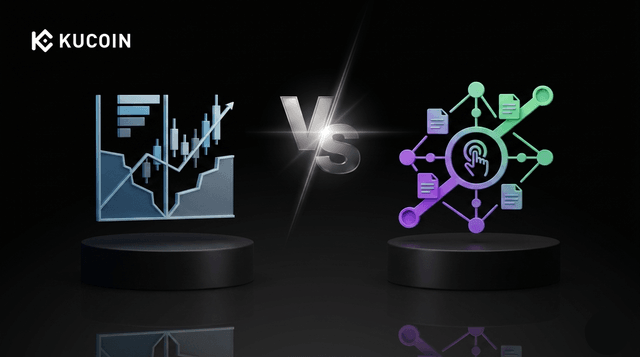
Key Takeaways
-
Traditional Trading is "imperative," requiring users to manually specify every step (route, gas, slippage), which often leads to execution errors or front-running.
-
Intent-Centric Protocols are "declarative," where users simply state a desired outcome (e.g., "Swap 1 ETH for at least 3,000 USDT") and leave the execution to professional "solvers."
-
Solvers compete in a decentralized marketplace to fulfill these intents, often finding better prices and providing native MEV protection by hiding transactions from the public mempool.
-
In 2026, the shift toward Account Abstraction and AI-driven agents has made intent-centricity the standard for cross-chain and high-frequency trading.
-
Traders can access the leading tokens of this revolution, such as WARD or OWL, directly via the KuCoin Spot Market.
Market Context: The Shift to "Goal-Oriented" Finance in 2026
By early 2026, the cryptocurrency market has matured beyond the "Wild West" era of manual on-chain interactions. The complexity of a multi-chain world—encompassing hundreds of Layer 2s, modular DA layers, and fragmented liquidity—has made traditional manual trading increasingly inefficient for the average user.
The rise of Intent-Centric Protocols represents a fundamental paradigm shift: moving from "Transaction-Centric" (how to do it) to "Intent-Centric" (what to achieve). This evolution is driven by the need for Chain Abstraction, where the underlying technical hurdles of bridging and gas management are hidden. For users on KuCoin, this means the focus has shifted from managing "plumbing" to optimizing "portfolio strategy."
Deep Dive: Intent-Centric Protocols
Core Value Proposition
Intent-centric protocols function like a high-end concierge service for DeFi. Instead of signing a transaction that says, "Go to DEX A, swap X for Y, pay Z gas," a user signs Intent. This intent is a cryptographic message stating a goal and a set of constraints (e.g., minimum output, maximum time). This removes the cognitive load from the user and places the technical burden on the network.
Technical Edge & Economic Model (Tokenomics)
The engine of an intent-centric system is the Solver (or Searcher). Solvers compete to find the most efficient path to satisfy your intent.
-
Efficiency: Because solvers are professional actors with sophisticated algorithms, they can batch trades, find "Coincidence of Wants" (CoW), and source liquidity from off-chain and on-chain venues simultaneously.
-
Tokenomics: Protocols in this space, such as Warden Protocol (WARD) or Owlto Finance (OWL), use their native tokens to incentivize solvers, secure the intent-mempool, and facilitate governance. For example, WARD acts as a security deposit for AI agents fulfilling intents, creating a "locking effect" that scales with network usage.
Deep Dive: Traditional Trading
Strategic Advantage
Traditional trading—whether on a Centralized Exchange (CEX) like the KuCoin Spot Market or a traditional Automated Market Maker (AMM)—remains the gold standard for transparency and direct control. In this model, the user is the pilot. You see the order book, you set the limit price, and you decide exactly when to execute.
Ecosystem Growth & 2026 Outlook
In 2026, traditional trading evolved through "Smart Order Routing." While it remains imperative, the tools available to traders on KuCoin have become more powerful.
-
Institutional Grade: For high-net-worth and institutional traders, the traditional model is preferred for large-block trades where specific execution paths are required for compliance or tax reasons.
-
Liquidity Depth: Traditional spot markets still host the deepest liquidity for major pairs like BTC/USDT and ETH/USDT, serving as the "settlement layer" for intent-centric solvers.
Maximizing Returns with KuCoin Earn
Even if you prefer traditional manual trading, you can maximize the value of your idle assets.
-
Savings & Staking: While waiting for the perfect market entry, assets can be placed in KuCoin Earn.
-
Dual Investment: Advanced traders use traditional tools to hedge their positions, earning high yields by predicting price ranges for major assets.
Comparison Analysis: The Trading Matrix
| Feature | Intent-Centric Protocols | Traditional Trading |
| User Input | Declarative ("I want X") | Imperative ("Do A, then B") |
| Execution | Outsourced to Solvers/AI | Manual/User-Defined |
| Gas Management | Often abstracted (Gasless) | User pays native chain tokens |
| MEV Protection | Built-in (Private Mempools) | Vulnerable without specialized tools |
| Best For | Complex/Cross-chain tasks | Direct price control/Limit orders |
Trading Insights: Which Fits Your Portfolio?
-
The "Passive Optimizer" Profile
If you are a beginner or a busy professional, Intent-Centric Protocols are your best fit. They allow you to participate in complex DeFi strategies (like cross-chain yield farming) without needing to understand the underlying bridges or gas requirements.
-
The "Active Alpha Hunter" Profile
If you enjoy analyzing order flow, reading charts, and timing the market to the second, Traditional Trading on the KuCoin Spot Market is irreplaceable. Direct control allows for precision that intent-based systems might smooth over in exchange for convenience.
-
The "2026 Hybrid Strategy"
The most successful traders in 2026 use a hybrid approach. They hold "Intent-centric" infrastructure tokens (like WARD) for long-term growth while using traditional spot and futures markets on KuCoin to hedge their exposure and capitalize on short-term volatility.
Conclusion & Strategic Guidance
The difference between Intent-Centric Protocols and Traditional Trading is essentially the difference between hailing a taxi and driving the car. Traditional trading gives you the steering wheel but requires you to know every turn and traffic rule. Intent-centric protocols let you state the destination while the protocol handles the navigation.
As we move deeper into 2026, the "Intent" model is expected to capture the majority of retail volume due to its superior user experience. However, the "Traditional" model remains the bedrock of market liquidity. By maintaining a diverse portfolio on KuCoin, you can benefit from the efficiency of intents while leveraging the depth and security of the world's leading exchange.
FAQs for Intent-Centric Protocols
Are Intent-Centric Protocols more expensive?
Not necessarily. While solvers take a small fee for their service, they often save users money by finding better execution prices and avoiding "failed transaction" gas costs, which are common in traditional trading.
Is "Gasless Trading" real in Intent protocols?
Yes. Many intent protocols allow you to pay fees in the token you are selling (e.g., paying for a swap with USDT instead of ETH). This is a hallmark of intent-centric design.
Can solvers steal my funds?
Intent-centric protocols use "conditional settlement." The solver only gets paid if they provide the exact outcome you signed for. If they cannot meet your price or time constraints, the transaction simply doesn't execute, and your funds remain in your custody.
Why is everyone talking about "Intents" in 2026?
Because of the "Fragmentation Trap." With so many blockchains now existing, manual trading has become too hard for the average person. Intents solve this by making the entire crypto ecosystem feel like a single, unified app.
Sign up for KuCoin today to buy, sell, and manage your entire crypto portfolio in one simple dashboard. Register Now!
Learn More:


