
What is the Difference Between HK and Singapore Crypto?
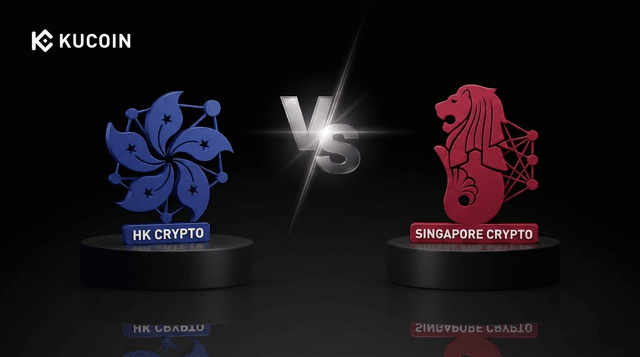
In the race to become the preeminent "Crypto Capital of Asia," two titans dominate the landscape: Hong Kong and Singapore. As we navigate the 2026 market cycle, the distinction between these two hubs has shifted from mere regulatory posturing to profound differences in market philosophy, investor access, and institutional integration. For users on KuCoin, understanding these nuances is critical for optimizing portfolio allocation and choosing the right products, from KuCoin Lite for retail simplicity to KuCoin Earn for sophisticated yield generation.
Key Takeaways
-
Regulatory Focus: Hong Kong has pivoted toward a "Retail-First" and "Institutional Gateway" model, while Singapore emphasizes "Responsible Innovation" with a focus on institutional infrastructure and B2B tokenization.
-
Tax Efficiency: Hong Kong maintains a significant edge with 0% capital gains tax on crypto, whereas Singapore applies a 9% Goods and Services Tax (GST) on certain service fees, though it remains a haven for family offices.
-
Asset Availability: Hong Kong's 2026 framework has expanded to include virtual asset derivatives and stablecoin integration, while Singapore’s MAS has tightened retail access to leverage.
-
KuCoin Utility: Traders can leverage KuCoin’s diverse ecosystem to access the high liquidity of Hong Kong-adjacent projects or the stable yield products favored in the Singaporean DeFi scene.
Market Context: The Dual-Hub Evolution of 2026
The digital asset landscape in 2026 is no longer a "winner-takes-all" scenario. Instead, Asia has bifurcated into a specialized ecosystem. Hong Kong has successfully positioned itself as the regulated testing ground for mainland Chinese capital and global institutional liquidity. With the 2025-2026 implementation of the Stablecoin Ordinance and the introduction of virtual asset perpetual contracts for professional investors, the city has become a high-octane trading hub.
Conversely, Singapore has doubled down on its reputation as a "Fortress of Prudence." The Monetary Authority of Singapore (MAS) has transitioned from a pure crypto hub to a Tokenization Leader. In 2026, Singapore dominates in Real-World Assets (RWAs) and cross-border payment utility. For the average trader, this means Hong Kong is where you go for market depth and volatility, while Singapore is where you look for structural stability and institutional-grade DeFi.
Deep Dive: HK Crypto (The Trading Powerhouse)
Core Value Proposition
Hong Kong’s core strength lies in its Zero-Tax Environment and its unique role as the "China Gateway." For traders, this translates to maximum capital efficiency. The Securities and Futures Commission (SFC) has moved aggressively to allow licensed platforms to offer a wider array of assets, including spot ETFs and, as of early 2026, margin financing for eligible tokens.
Technical Edge & Economic Model
Hong Kong’s model is built on Liquidity Aggregation. By allowing retail participation in "large-cap" assets (like BTC and ETH) under strict surveillance, it creates a massive pool of localized liquidity. The 2026 economic focus is on the Hong Kong Dollar-pegged stablecoin (HKDR), which serves as a compliant bridge between traditional finance and the Web3 economy.
How to Trade/Stake HK-Linked Assets on KuCoin Lite
For beginners looking to capitalize on the Hong Kong market momentum, KuCoin Lite offers the most streamlined path:
-
Direct Purchase: Use the "Buy Crypto" feature to acquire high-liquidity assets favored by HK institutional desks.
-
Simplified Interface: KuCoin Lite removes the complexity of order books, allowing you to execute trades based on real-time Hong Kong market sentiment.
-
One-Tap Staking: Many projects within the HK ecosystem are integrated into the Lite version’s earn features, providing a low-barrier entry to passive income.
Deep Dive: Singapore Crypto (The Infrastructure Hub)
Strategic Advantage
Singapore’s advantage is Legal Finality. Under the Payment Services Act (PSA) and the Financial Services and Markets Act (FSMA), every transaction in Singapore is backed by one of the world's most transparent legal frameworks. In 2026, Singapore became the global center for Institutional Custody and Regulated Stablecoins.
Ecosystem Growth & 2026 Outlook
The focus in Singapore is currently on the "Project Guardian" evolution—integrating wholesale CBDCs with private sector blockchains. While retail trading is more restricted (e.g., no credit card purchases or high leverage for retail), the city-state has become the R&D lab for the next generation of DeFi protocols.
Maximizing Returns with KuCoin Earn
To tap into the stability of the Singaporean-style "Prudent Growth" model, users turn to KuCoin Earn:
-
Stablecoin Yields: Stake MAS-compliant or G10-pegged stablecoins to earn consistent APR.
-
Dual Investment: Utilize KuCoin’s Spot Market data to set up Dual Investment plans that thrive on the "range-bound" stability often seen in Singapore-backed institutional tokens.
-
Shark Fin & Snowball: These structured products are ideal for the risk-averse profile that the Singaporean market attracts.
Comparison Analysis: HK vs. Singapore (2026)
| Feature | Hong Kong Crypto (HK) | Singapore Crypto (SG) |
| Primary Focus | Trading Depth & Retail Access | RWA Tokenization & Payments |
| Taxation | 0% Capital Gains / 0% GST | 0% Capital Gains / 9% GST on Fees |
| Retail Leverage | Available (Regulated) | Strictly Prohibited for Retail |
| Stablecoin Model | HKMA-Licensed (Fiat-backed) | MAS-Regulated (SCS Framework) |
| Market Behavior | High Volatility / High Volume | Low Volatility / Institutional Flow |
| Investor Value | Maximum Profit Retention | Maximum Asset Security |
Trading Insights: Which fits your Portfolio?
-
The "Alpha Hunter" (HK Profile)
If your strategy revolves around high-frequency trading, capitalizing on news from the East, and maximizing tax-free gains, your portfolio should lean toward the Hong Kong ecosystem.
-
Strategy: Utilize the KuCoin Spot Market to trade mid-to-large cap gems that are recently licensed for HK retail.
-
The "Wealth Preserver" (Singapore Profile)
If you are an intermediate investor focused on long-term wealth preservation and low-risk yields, the Singaporean model is your template.
-
Strategy: Allocate 60% of your portfolio to KuCoin Earn structured products and 40% to tokenized assets that mimic the stability of the Singaporean financial sector.
-
The "Hybrid Strategist"
Most successful traders in 2026 use a dual-approach: they trade the volatility of HK-linked tokens on KuCoin but move their profits into Singapore-adjacent stablecoin yields for "parking" capital between cycles.
Conclusion & Strategic Guidance
In 2026, the question isn't which city is "better," but which city serves your specific financial goal. Hong Kong is the engine of Asian crypto liquidity, offering a tax-efficient, high-access environment for those who want to actively grow their wealth. Singapore is the vault, providing the regulatory gold standard for those who want to build and protect institutional-grade portfolios.
Regardless of your preference, KuCoin provides the necessary bridge. By integrating professional-grade liquidity with user-friendly tools like KuCoin Lite and KuCoin Earn, traders can navigate both jurisdictions from a single, secure dashboard.
FAQs for HK and Singapore Crypto
-
Can retail traders in Hong Kong trade all cryptocurrencies?
No. In 2026, the SFC maintains a "White List" of large-cap assets available for retail. However, professional investors have access to a much broader range, including crypto derivatives and perpetual contracts.
-
Is crypto income taxable in Singapore?
While there is no capital gains tax in Singapore, businesses that trade crypto as their primary source of income are subject to corporate tax. Additionally, a 9% GST applies to certain payment services and trading fees.
-
Which city is safer for storing large amounts of crypto?
Both are highly secure, but Singapore’s Major Payment Institution (MPI) license requires more rigorous asset segregation and "cold wallet" storage mandates, making it a favorite for institutional custody.
-
How does the Hong Kong stablecoin license affect KuCoin users?
The 2026 licensing ensures that stablecoins like HKDR are fully backed by reserves. This provides KuCoin users with safer, regulated "on-ramp" and "off-ramp" compared to unregulated offshore stablecoins.
-
Why did Hong Kong overtake Singapore in retail trading volume?
Hong Kong’s decision to allow retail access to spot ETFs and its 0% tax policy on all crypto transactions made it more attractive for active traders compared to Singapore’s more restrictive retail leverage rules.
Create a free KuCoin account to discover the next crypto gems and trade over 1,000 global digital assets today. Create Now!
Further Reading:


