
What is the Difference Between GameFi vs. Traditional Gaming?
Key Takeaways
-
Ownership Structure: Traditional gaming utilizes a licensing model where the developer retains asset control, whereas GameFi uses blockchain technology to provide verifiable player ownership.
-
Economic Mechanics: Traditional games rely on closed-loop microtransactions, while GameFi incorporates open-market liquidity and decentralized finance (DeFi) elements.
-
Asset Portability: GameFi enables interoperability, allowing assets to function across different platforms, a feature generally absent in centralized traditional gaming environments.
-
Governance Models: Decisions in traditional gaming are made by centralized corporate entities, whereas GameFi protocols often utilize decentralized autonomous organizations (DAOs).
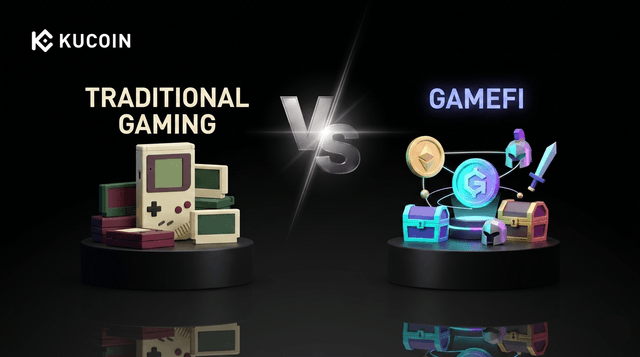
The interactive entertainment industry is categorized into two primary structural models: traditional gaming and GameFi. The distinction between these two sectors is fundamentally rooted in the management of digital property rights and the distribution of economic value. As the crypto markets expand, the integration of distributed ledger technology into gaming has introduced a shift from consumer-based models to ownership-based models.
To understand the comparison of "GameFi vs. Traditional Gaming: Ownership Analysis," it is necessary to examine the underlying technical architectures. Traditional gaming operates within centralized "walled gardens," while GameFi functions on public blockchains where assets are represented as non-fungible tokens (NFTs).This structural difference impacts everything from how a player interacts with an in-game item to how the value of that item is determined on a global scale. Educational resources on the KuCoin blog further detail the technical convergence of gaming and finance.
Traditional Gaming: Centralized Licensing
Traditional gaming encompasses the established industry model where software developers and publishers maintain absolute control over the game environment and its contents.
-
Custodial Control
In this model, all in-game assets—such as character skins, virtual currency, and experience points—are stored on private servers owned by the developer. Players do not own these items in a legal or technical sense; instead, they are granted a limited, non-transferable license to use them under a specific End-User License Agreement (EULA). If the developer terminates a player’s account or ceases operation of the game servers, the player loses access to all acquired digital items.
-
Closed Economies
The economic value within traditional gaming is typically unidirectional. Players spend fiat currency or earned points to acquire items, but these items cannot be legally exchanged for external value. This creates a "sunk cost" economy where the capital invested in the game remains trapped within that specific software ecosystem. While third-party secondary markets sometimes exist, they often operate outside the developer’s terms of service and lack institutional security.
GameFi: Decentralized Ownership
GameFi, a portmanteau of "gaming" and "finance," refers to the integration of blockchain technology and DeFi protocols into gaming environments.The core objective of this model is to provide players with sovereign control over their digital assets.
-
Non-Fungible Tokens (NFTs) and Verifiable Ownership
In GameFi, in-game assets are minted as NFTs on a blockchain.This technical implementation ensures that the record of ownership is transparent, immutable, and independent of the game developer’s servers. Even if the game itself becomes inaccessible, the NFT remains in the player’s private wallet, serving as a verifiable digital deed. This shift from "licensed access" to "cryptographic ownership" is the primary driver of the GameFi sector.
-
Open-Market Liquidity
Because GameFi assets exist on public ledgers, they can be traded on decentralized and centralized exchanges.This creates a "liquid" economy where digital items have a market price determined by global supply and demand. Players can sell, trade, or even use their in-game assets as collateral for loans within broader DeFi ecosystems.Participants often monitor official announcements to track the launch of new asset classes or utility updates within these gaming protocols.
Comparative Analysis: Economic Logic and Utility
| Feature | Traditional Gaming | GameFi (Blockchain Gaming) |
| Asset Ownership | Licensed (Developer Custody) | Sovereign (Player Custody) |
| Asset Format | Proprietary Database Entry | NFT (Non-Fungible Token) |
| Market Access | Internal / Closed | Global / Permissionless |
| Interoperability | Non-existent | Possible across protocols |
| Governance | Centralized Corporate | Decentralized (DAO) |
| Value Transfer | Sunk Cost (Unidirectional) | Bi-directional (Real-world value) |
Interoperability and Cross-Chain Utility
A significant technical difference lies in interoperability. Traditional game assets are coded to work only within a single software title. GameFi, through the use of standardized token formats (such as ERC-721 or ERC-1155), allows for the possibility of using a single digital asset across multiple different games and platforms.This creates a multi-layered utility where the value of an item is not limited to its performance in a single game environment.
Governance and Community Influence
The management of the game’s evolution differs between these two models. In traditional gaming, the developer decides on all updates, economic balances, and rules. In GameFi, governance is often decentralized through the use of governance tokens.Holders of these tokens can propose and vote on changes to the game’s mechanics, reward distribution, and treasury spending. This provides the community with a level of influence that is structurally impossible in the traditional corporate gaming model.
Users engaging with the KuCoin ecosystem frequently observe the role of these governance tokens in the market. The KuCoin lite version offers an accessible interface for tracking the performance of these gaming-related tokens, while professional markets provide deeper liquidity for those analyzing the sectoral growth of GameFi.
Conclusion
The distinction between GameFi and traditional gaming is defined by the location of power and ownership. Traditional gaming prioritizes a centralized, curated experience where players act as consumers within a licensed framework. GameFi introduces a model where players act as owners and stakeholders within a decentralized economy.
While traditional gaming remains the dominant model for mass-market entertainment, GameFi offers a technical alternative for those seeking sovereign control over their digital assets.The evolution of this space depends on the continued development of blockchain scalability and the ability of developers to integrate complex economic models without compromising the interactive quality of the game. For the global interactive entertainment industry, this represents a fundamental transition in how digital value is created, stored, and transferred.
FAQs
What is the primary difference between a game item and an NFT?
A standard game item is a line of code on a private server that the player is licensed to use. An NFT is a unique digital asset on a public blockchain that the player owns and can transfer outside of the game environment.
Why do GameFi assets have real-world value?
The value is derived from the asset's utility within the game, its scarcity (verified by the blockchain), and the demand from other players on open markets. Because these assets can be sold for cryptocurrency, they have a direct link to fiat-equivalent value.
Can traditional games incorporate blockchain?
Yes, some developers are experimenting with hybrid models where the core gameplay remains centralized for performance, but rare or high-value items are tokenized as NFTs to provide players with ownership rights.
Is GameFi more secure than traditional gaming?
GameFi utilizes the security of the underlying blockchain (such as Ethereum or specialized sidechains) to protect ownership records.While this removes the risk of a developer deleting an item, it places the responsibility of wallet security on the player.
Where can I trade tokens related to GameFi projects?
Tokens used for governance and utility in GameFi projects are available for trading on KuCoin. Analyzing the volume and market data of these tokens can provide insight into the active participation and economic health of a specific gaming ecosystem.
Join 30 million global users on the world’s leading crypto exchange by signing up for your free account now. Register Now!
Further reading


