
What is the Difference Between Fully Homomorphic Encryption (FHE) and ZK Proofs?
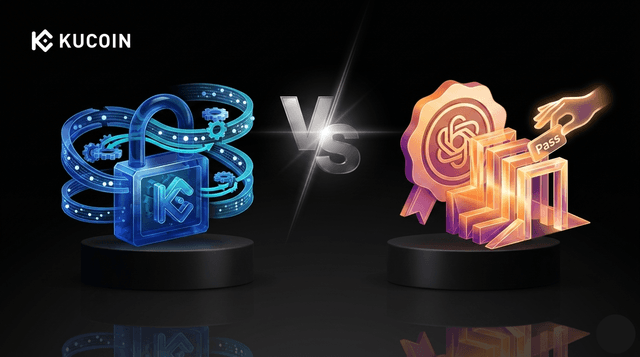
As we move through 2026, the demand for privacy-preserving technologies has shifted from a "nice-to-have" feature to a core requirement for institutional and retail participation in decentralized finance (DeFi). While the crypto market has matured, two heavyweights in cryptography—Fully Homomorphic Encryption (FHE) and Zero-Knowledge Proofs (ZKPs)—have emerged as the pillars of this new era.
Though often grouped together under the "privacy" umbrella, they serve entirely different roles in an investor’s portfolio. One proves the truth without showing the data, while the other processes data without ever seeing it. Understanding these nuances is critical for navigating the current market landscape on platforms like KuCoin Spot Market.
Key Takeaways
-
Zero-Knowledge Proofs (ZKPs) focus on verifying the validity of a statement (like a transaction) without revealing the sensitive data behind it.
-
Fully Homomorphic Encryption (FHE) allows for computation on encrypted data, enabling private smart contracts where the network never sees the underlying values.
-
Market Utility: ZKPs are currently the industry standard for scalability (ZK-Rollups), while FHE is the "Holy Grail" for confidential DeFi and private AI.
-
Investor Value: ZK tokens (like ZKsync) offer exposure to network scaling, whereas FHE-related projects are speculative bets on the future of private data processing.
Market Context: The Privacy Super-Cycle of 2026
In 2026, the "Privacy Super-Cycle" is driven by a convergence of TradFi institutions and modular blockchain architectures. With the rise of Real-World Asset (RWA) tokenization, institutions require technologies that satisfy both regulatory transparency and commercial confidentiality.
The current market has moved beyond simple "anonymity" coins. Today’s leaders are infrastructure plays. ZK technology has achieved massive scale through projects like Starknet and ZKsync, which dominate Ethereum’s Layer 2 landscape. Meanwhile, FHE has transitioned from academic theory to live testnets, with the first generation of "Confidential EVMs" beginning to attract liquidity.
Deep Dive: Fully Homomorphic Encryption (FHE)
Core Value Proposition
FHE is the only cryptographic technique that allows a third party to perform mathematical operations on encrypted data and produce an encrypted result that—when decrypted—matches the result of the same operations performed on the original data.
The "Black Box" Analogy: Imagine putting gold inside a locked box with gloves attached to the sides. A worker can reach inside the gloves and craft the gold into jewelry without ever having the key to the box. They finish the work, and only you (the key holder) can open it to see the final product.
Technical Edge & Economic Model
From a technical standpoint, FHE solves the "shared state" problem in privacy. In traditional ZK-based privacy, it is difficult for multiple people to interact with the same private data at once. FHE allows for Confidential Smart Contracts.
-
Market Behavior: FHE tokens often carry a "technology premium" due to the high computational overhead required for "bootstrapping" (a process to clean noise from encrypted data).
-
Investor Value: As hardware acceleration (ASICs for FHE) matures in late 2026, the cost of these computations is dropping, making the underlying tokens a play on the "Data Privacy as a Service" economy.
Deep Dive: Zero-Knowledge Proofs (ZK Proofs)
Strategic Advantage
ZK Proofs are about Efficiency and Verification. A ZK proof allows a "Prover" to convince a "Verifier" that a statement is true without revealing any information beyond the statement's validity.
-
Scalability: ZK-Rollups use this to bundle thousands of transactions into one single proof, drastically reducing gas fees on Layer 1.
-
Compliance: ZKPs enable "Selective Disclosure." You can prove you are over 21 or not on a sanctions list without revealing your name or birthday.
Ecosystem Growth & 2026 Outlook
By 2026, ZK technology has become the backbone of the "AggLayer" and cross-chain interoperability. We are seeing ZK-SNARKs integrated into everything from identity (Worldcoin) to institutional proof-of-reserves. The 2026 outlook is focused on recursive proofs, which allow for even faster and smaller verifications, making ZKPs the go-to for mobile-first blockchain applications.
Maximizing Returns with KuCoin Earn
If you hold established ZK tokens like ZK (ZKsync) or POL (Polygon), you shouldn't let them sit idle.
-
KuCoin Earn: Search for ZK and POL under the KuCoin Earn Platform to subscribe to flexible or fixed-term yield products, allowing you to stack stable returns while waiting for the ZK narrative to compound.
Comparison Analysis: FHE vs. ZK Proofs
| Feature | Zero-Knowledge Proofs (ZKP) | Fully Homomorphic Encryption (FHE) |
| Primary Goal | Proving validity/integrity. | Computing on hidden data. |
| Data Visibility | Verifier sees only "True" or "False". | Processor sees only "Ciphertext". |
| Computational Cost | Relatively low (becoming very fast). | Extremely high (requires acceleration). |
| Main Use Case | L2 Scaling, Identity, Compliance. | Private DeFi, Secret Voting, AI/ML. |
| Market Maturity | Mature/Production Phase. | Emerging/Early Adoption Phase. |
| Investment Risk | Moderate (linked to ecosystem growth). | High (linked to technical breakthroughs). |
Trading Insights: Which fits your Portfolio?
-
The "Scalability & Adoption" Bull (ZK Proofs)
If you believe that the future of crypto is millions of users transacting on low-cost Layer 2s, your portfolio should lean toward ZK-based assets. These tokens behave like "utility stocks"—their value is tied to the volume of transactions and the size of the developer ecosystem.
-
The "Privacy & AI" Speculator (FHE)
If you are betting on the next "frontier" of cryptography—where AI models can train on private medical data or dark pools can operate on-chain without revealing order books—FHE is your play. These are higher-risk, higher-reward assets.
Conclusion & Strategic Guidance
The difference between FHE and ZK Proofs is the difference between doing and proving. ZKPs have already revolutionized how we scale blockchains, making them a foundational part of any modern crypto portfolio. FHE, while currently more resource-intensive, represents the next logical step: a truly private internet where your data is never unencrypted, even while it's being used by an app.
On KuCoin, you have the tools to capture both trends. Whether you are staking ZK tokens for steady APR on KuCoin Earn or trading the latest FHE infrastructure, the key is to understand the "Market Behavior" of these cryptographic primitives.
Start your crypto journey in minutes by creating a secure KuCoin account with no initial deposit required. Sign Up Now!
FAQs for FHE and ZK Proofs
-
Can a project use both FHE and ZK Proofs?
Yes. In 2026, many "Hybrid Privacy" layers use FHE for the private computation of a smart contract and then generate a ZK proof to verify that the FHE computation was performed correctly without errors.
-
Is FHE too slow for regular trading?
Historically, yes. However, with 2026-era hardware acceleration and new libraries like Zama’s TFHE, the latency is reaching levels where it can support private auctions and certain DeFi functions, though it's still slower than standard ZK-Rollups.
-
Which is more secure: FHE or ZK?
Both offer high cryptographic security. However, FHE is often based on "Lattice-based" cryptography, which is widely considered to be quantum-resistant, whereas some older ZK-SNARK setups require a "Trusted Setup" which carries a minor initial risk.
-
Why are ZK tokens so popular on KuCoin?
ZK tokens power the infrastructure of the most used Layer 2 networks. Their popularity stems from their proven utility in reducing costs and increasing speed for millions of KuCoin users.
-
Does FHE replace the need for ZK Proofs?
No. They are complementary. FHE is for privacy of data during processing, while ZK is for privacy of data during verification. Think of ZK as the "Digital ID" and FHE as the "Private Cloud."
Learn More:


