
What is the Difference Between DPoS and PoS?
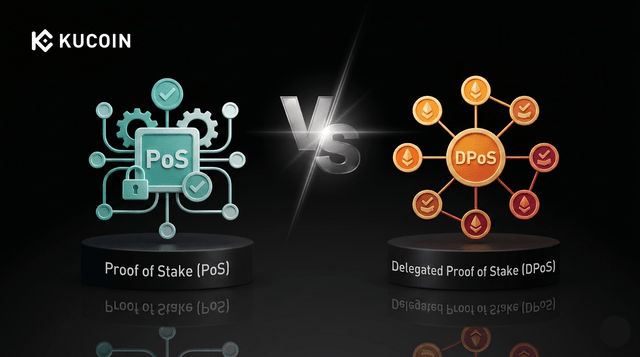
In the 2026 digital asset landscape, consensus mechanisms are the primary filters through which professional traders evaluate a blockchain’s scalability and governance health. While Proof of Stake (PoS) revolutionized the industry by replacing energy-intensive mining with capital-based security, Delegated Proof of Stake (DPoS) introduced a democratic layer designed for high-performance throughput. Understanding the nuances between these two is no longer optional for KuCoin users—it is a fundamental requirement for optimizing yield and risk management.
Key Takeaways
-
Operational Structure: PoS allows any user with sufficient capital to validate transactions, while DPoS uses a voting system to elect a limited number of "Delegates" or "Witnesses" to secure the network.
-
Performance Metrics: DPoS typically offers significantly higher transactions per second (TPS) and lower latency compared to standard PoS, making it a favorite for consumer-facing dApps.
-
Governance Dynamics: DPoS is inherently more political and centralized but offers faster upgrades, whereas PoS tends toward broader decentralization at the cost of slower decision-making.
-
Yield Strategies: Both mechanisms offer passive income via KuCoin Earn, though the risk profiles and reward frequencies differ based on the underlying protocol’s inflation model.
The 2026 Consensus Evolution: Scalability vs. Sovereignty
As we move through 2026, the market has bifurcated into two specific niches. Standard PoS has become the "Gold Standard" for institutional security and settlement layers, where decentralization is the highest priority. Conversely, DPoS has emerged as the backbone of the "App-Chain" era, powering high-speed social media protocols, gaming ecosystems, and real-time financial trading platforms.
For the KuCoin trader, this creates a distinct choice: do you prioritize the decentralized security of a PoS network like Ethereum, or the aggressive performance and governance participation of a DPoS network like EOS or TRON? Both asset classes are readily accessible through the KuCoin Spot Market, but their long-term value drivers are vastly different.
Deep Dive: Delegated Proof of Stake (DPoS)
Core Value Proposition
DPoS is often described as a "Digital Democracy." Instead of every token holder attempting to validate blocks, users "delegate" their voting power to elect a small group of highly efficient nodes. These nodes are responsible for maintaining the ledger.
Feature -> Market Behavior: This restricted number of nodes reduces network "chatter."
Investor Value: Faster finality and lower fees, which often leads to higher network utility and ecosystem growth.
Technical Edge & Economic Model (Tokenomics)
DPoS protocols focus on incentivized performance. If an elected delegate fails to maintain 100% uptime or acts maliciously, the community can instantly vote them out and replace them.
-
Efficiency: DPoS can handle thousands of TPS because the validator set is known and fixed for specific intervals.
-
Rewards: Delegates often share a portion of their block rewards with the voters who elected them, creating a direct feedback loop between the token's value and the network’s performance.
How to Trade/Stake DPoS Assets on KuCoin Lite
For users who prefer a streamlined experience, KuCoin Lite provides a one-tap solution for purchasing major DPoS assets like TRX or EOS. Once acquired, these tokens can be moved to KuCoin Earn to participate in "Soft Staking," where KuCoin handles the delegation process for you, ensuring you receive rewards without the hassle of manual voting.
Deep Dive: Proof of Stake (PoS)
Strategic Advantage
Proof of Stake remains the most trusted mechanism for value storage in the "yield-bearing" asset class. Its strategic advantage is low-trust requirement. Unlike DPoS, where you must trust a delegate to perform, PoS allows you to run your own validator (if capital allows) or join a pool where the rules are strictly enforced by the protocol’s code.
Ecosystem Growth & 2026 Outlook
In 2026, PoS moved toward "Liquid Staking Tokens" (LSTs). This allows users to stake their assets and receive a derivative token in return, which can be traded on the KuCoin Spot Market. This effectively eliminates the liquidity trade-off that previously plagued staked assets.
Maximizing Returns with KuCoin Earn
KuCoin Earn serves as a premier hub for PoS assets like ETH, SOL, and ADA.
-
Flexible Staking: Earn daily rewards while maintaining the ability to withdraw your funds within a short period.
-
Fixed Staking: Lock your assets for higher APRs, often used by long-term investors to hedge against market volatility through guaranteed token accumulation.
Comparison Analysis: DPoS vs. PoS
| Feature | Delegated Proof of Stake (DPoS) | Proof of Stake (PoS) |
| Validator Selection | Elected via Community Voting | Based on Token Quantity & Duration |
| Transaction Speed | High: Optimized for Sub-second Finality | Moderate: Focuses on Broad Consensus |
| Decentralization | Lower (Fixed set of 21–101 nodes) | Higher (Thousands of independent nodes) |
| Security Risk | Centralized Collusion or Bribery | 51% Governance/Capital Attack |
| Typical ROI | Higher (Due to Performance Incentives) | Stable (Reflects Network Inflation) |
Trading Insights: Which Fits Your Portfolio?
The "High-Performance" Trader (DPoS Focus)
If you believe that the future of blockchain lies in mass-market adoption and "killer apps" like social media and gaming, DPoS assets are your primary vehicle. Monitor these assets via KuCoin's real-time charts to spot momentum shifts.
The "Sovereign Wealth" Investor (PoS Focus)
If your goal is to hold a digital asset that acts as a "World Computer" or a decentralized reserve, lean toward PoS. These networks are more resistant to censorship and regulatory pressure due to their massive, globally distributed validator sets.
Conclusion & Strategic Guidance
The choice between DPoS and PoS is a choice between Speed and Stability. DPoS is the engine of the decentralized application world, offering the throughput necessary for a global user base. PoS is the foundation of decentralized finance, offering the security and censorship resistance required for high-value settlement.
FAQs for DPoS vs. PoS
-
Is DPoS more centralized than PoS?
Yes, technically. DPoS limits the number of people who can actually write to blockchain (Delegates). However, advocates argue that the voting process is more decentralized because even small holders have a say in who leads the network.
-
Which consensus mechanism offers higher staking rewards?
Generally, DPoS assets offer higher APRs because the delegates compete for votes by offering better reward-sharing ratios. However, PoS assets like those found on KuCoin Earn often have lower inflation, meaning the value of your rewards may be more stable over time.
-
Can I lose my tokens if a Delegate is slashed in DPoS?
In many DPoS models, if a delegate is slashed for bad behavior, the voters' principal remains safe, but they may lose out on future rewards. In PoS, "slashing" can sometimes impact the staked principal, making it vital to choose reputable validators or use KuCoin's managed staking services.
-
What is the "Nothing at Stake" problem in PoS?
This is a theoretical vulnerability where validators could support multiple blockchain forks simultaneously because it costs nothing to do so. Modern PoS protocols (and DPoS) have solved this through "slashing" mechanisms that penalize validators for double-signing.
-
How do I switch from DPoS to PoS assets?
You can execute this trade instantly via the KuCoin Spot Market. For instance, you could sell your TRX (DPoS) for USDT and immediately buy ETH (PoS) to rebalance your portfolio based on your current market outlook.
Further Reading:


