
What is the Difference Between DAG vs. Blockchain?
Key Takeaways
-
Structural Topology: Blockchains rely on a linear, sequential chain of blocks, whereas DAGs utilize a web-like graph that enables asynchronous transaction processing.
-
Scalability and Throughput: DAG architectures generally solve the bottleneck issues of traditional blockchains by allowing parallel validation, leading to higher transactions per second (TPS).
-
Economic Efficiency: Because DAGs remove the competitive "block-mining" race, they often feature significantly lower transaction costs and reduced energy consumption.
-
Market Utility: Understanding the underlying ledger type is critical for evaluating a protocol's suitability for high-frequency use cases like IoT, micro-payments, and high-performance DeFi.
In the quest for the "Holy Grail" of decentralized infrastructure—perfectly balancing security, decentralization, and scalability—two primary architectural paradigms have emerged. While the term "blockchain" has become synonymous with distributed ledgers, it represents only one specific way to organize data. The rising prominence of DAG (Directed Acyclic Graph) technology offers a radical alternative to the traditional linear chain.
For participants in the crypto markets, the debate of DAG vs. Blockchain is not merely academic. The structural DNA of a network dictates its capacity for mass adoption, its cost-effectiveness, and its resilience against congestion. By moving away from "blocks" and toward a "graph," developers are unlocking new possibilities for the next generation of decentralized applications (dApps).
Overviews: Defining the Architectures
To grasp the functional differences, we must first visualize how data moves through these two systems.
What is Blockchain?
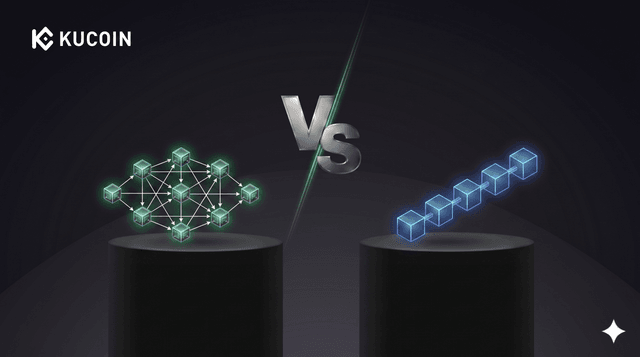
A blockchain is a linear database where data is grouped into "blocks." These blocks are cryptographically linked in a chronological sequence. Each block contains a batch of transactions, a timestamp, and a reference to the previous block. This creates a single, immutable path of history. Because every node must agree on the state of the entire chain in a serial manner, the network faces a physical limit on how many blocks can be produced within a specific timeframe.
What is a DAG (Directed Acyclic Graph)?
A Directed Acyclic Graph is a non-linear data structure. Unlike a blockchain, which requires transactions to be bundled into blocks, a DAG allows individual transactions to be linked directly to one another.
-
Directed: Data flows in a specific direction (from old to new).
-
Acyclic: The path cannot loop back to a previous point, preventing "double-spending" or infinite loops.
In a DAG, there are no "blocks" in the traditional sense. Instead, each new transaction acts as a validator for previous ones, creating a sophisticated web of interconnected data points.
Key Difference: Parallelism vs. Sequentiality
The most profound difference between DAG and Blockchain lies in how they handle execution and consensus.
-
Sequential Block Processing
Traditional blockchains are sequential. Only one block can be added to the chain at a time. If two miners find a block simultaneously, the network must eventually discard one (the "orphan block") to maintain a single line of truth. This design inherently limits throughput because the network’s speed is tied to the block-time interval.
-
Parallel Transaction Validation
DAGs operate on the principle of parallelism. Multiple transactions can be processed and validated simultaneously across different branches of the graph. As more users join a DAG-based network and initiate transactions, the network's validation capacity actually increases. This "collaborative" consensus model bypasses the bottleneck of waiting for the next block to be mined.
-
Fee Structures and Incentives
In a blockchain, users compete for limited space within a block by paying higher gas fees. During periods of high demand, fees can become prohibitive. Because DAGs remove the concept of "block space," the competition for inclusion is diminished. This often results in near-zero fees, which is a frequent topic in the KuCoin blog when discussing the feasibility of micro-transactions in the Internet of Things (IoT) sector.
Pros and Cons: A Technical Comparison
| Feature | Blockchain (Sequential) | DAG (Parallel Graph) |
| Throughput | Limited by block size and time. | High Scalability: Grows with network activity. |
| Finality | Probabilistic or deterministic (minutes). | Sub-second: Often near-instant. |
| Transaction Fees | Can be high during congestion. | Minimal to zero: No miners to pay. |
| Security Maturity | Extremely high; battle-tested. | Emerging; requires high node density to prevent attacks. |
| Energy Usage | High (especially in PoW). | Eco-friendly: Low computational overhead. |
Use Cases: Selecting the Right Foundation
When developers choose between DAG vs. Blockchain, they are usually prioritizing specific outcomes for their users.
-
DeFi and Institutional Finance: Traditional blockchains remain the go-to for high-value financial settlements. The linear history and robust consensus provide the "hard" security required for multi-billion dollar protocols where absolute immutability is the priority.
-
Internet of Things (IoT): DAGs are uniquely suited for machine-to-machine economies. Since IoT devices often send tiny amounts of data frequently, the zero-fee and high-throughput nature of a DAG is essential.
-
High-Frequency Social Media: Decentralized social platforms require millions of low-value interactions (likes, shares, comments). A DAG-based infrastructure allows these interactions to happen in real-time without saddling users with gas costs.
Monitoring official announcements regarding ecosystem grants can often reveal which architecture a specific industry niche is gravitating toward.
Trading Insights: Why Architecture Matters
For traders, the "DAG vs. Blockchain" distinction is a fundamental indicator of a token’s utility. A protocol built on a DAG might be a strong contender for a supply-chain or micro-payment narrative, whereas a highly secure, decentralized blockchain L1 might be positioned as a "digital gold" or a core settlement layer for the global economy.
Evaluating the technological "moat" of an asset on the KuCoin ecosystem involves looking at how the network handles stress. Chains that suffer from fee spikes during congestion are often monolithic blockchains, while networks that maintain stability through high volume often utilize DAG or parallel execution principles.
Conclusion
The evolution of decentralized ledgers is moving away from a "one-size-fits-all" approach. Blockchains provide the unparalleled security and sequential order needed for high-stakes finance. Directed Acyclic Graphs offer the fluid, parallel, and low-cost environment necessary for a world of billions of connected devices and high-frequency digital interactions.
As the industry matures, we are seeing the rise of BlockDAG architectures—hybrid systems that attempt to combine the batch-security of blockchains with the parallel efficiency of DAGs. For anyone navigating the decentralized frontier, mastering the nuances of these structural foundations is the key to identifying long-term value in an ever-shifting landscape.
FAQs
Is DAG more decentralized than Blockchain?
Not necessarily. Decentralization depends on the distribution of nodes and the consensus mechanism, not just the data structure. Some DAGs use "coordinators" in their early stages, which can make them more centralized than mature blockchains.
Why do some DAGs have no transaction fees?
In many DAG models, to send a transaction, you must first validate two previous transactions. Since the users themselves provide the "work" to secure the network, there is no need to pay external miners or validators a fee to include your transaction.
Can DAGs support smart contracts?
Yes. Modern DAG-based protocols have developed virtual machines capable of executing complex smart contract logic, though the asynchronous nature of a graph requires different development approaches compared to the EVM.
What is the "Scalability Trilemma"?
It is the theory that a blockchain can only achieve two of three properties: decentralization, security, and scalability. DAGs are primarily designed to solve the scalability portion of this trilemma.
How can I trade DAG-based tokens?
Many prominent assets utilizing DAG or BlockDAG technology are available for trading. You can find these by exploring the specialized L1 categories on the KuCoin platform.
Join 30 million global users on the world’s leading crypto exchange by signing up for your free account now. Register Now!
Further reading


