
What is the Difference Between Crypto Index Funds and Portfolio Diversification?
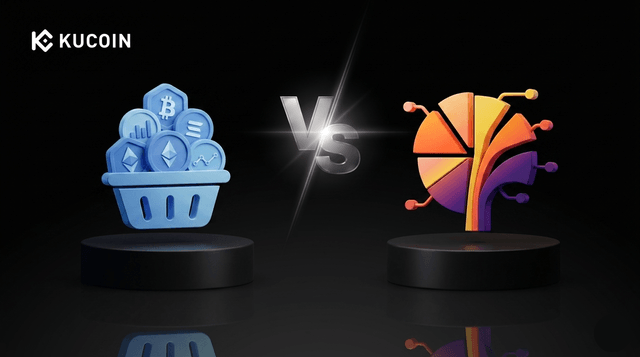
Key Takeaways
-
Execution: Crypto Index Funds are "hands-off" passive vehicles that track a basket of assets, while Portfolio Diversification is an "active" manual strategy of selecting individual tokens.
-
Rebalancing: Index funds often feature automated rebalancing to maintain weightings; manual diversification requires the trader to execute trades on the KuCoin Spot Market.
-
Risk Profile: Index funds mitigate "single-coin risk" through broad exposure, whereas manual diversification allows for high-conviction bets on specific sectors like AI or DePIN.
-
Cost Efficiency: Index funds may carry management fees but save on individual transaction costs; manual diversification incurs trading fees for every adjustment.
Market Context: The Institutionalization of Crypto Management in 2026
As we navigate the 2026 fiscal year, the cryptocurrency market has transitioned from speculative "meme" cycles to a sophisticated, sector-driven economy. With the integration of institutional liquidity, the volatility of "Blue Chip" assets like BTC and ETH has stabilized, while the long-tail of altcoins has become increasingly fragmented.
For traders using KuCoin Lite, the primary challenge is no longer just "picking a winner," but managing correlation. In a market where decentralized physical infrastructure (DePIN) might move independently of Layer 2 scaling solutions, the choice between a unified index and a bespoke portfolio determines your capture of "Alpha" (market-beating returns) versus "Beta" (market-tracking returns).
Deep Dive: Crypto Index Funds
Crypto Index Funds are financial instruments designed to mirror the performance of a specific group of digital assets.Think of them as the "S&P 500" of the blockchain world.
Core Value Proposition
The primary value of an index fund is simplicity through automation. Instead of maintaining twenty different wallets or monitoring dozens of charts, an investor gains exposure to the entire growth of the crypto sector (or a sub-sector) through a single entry point. This eliminates the psychological burden of "timing the market" for individual tokens.
Technical Edge & Economic Model
Modern crypto indices are governed by smart contracts or centralized rebalancing algorithms. They typically use a Market-Cap Weighted model, where larger assets like Bitcoin represent a higher percentage of the fund.
-
Automated Rebalancing: If a specific token in the index surges, the fund automatically sells a portion to lock in profits and redistributes it to maintain the target ratio.
-
Low Slippage: By bundling assets, these funds often provide a smoother equity curve compared to the jagged volatility of individual small-cap tokens.
How to Access Index-Like Exposure on KuCoin Lite
While traditional ETFs exist, KuCoin Lite provides a streamlined interface for beginners to gain broad exposure. By utilizing the "Convert" feature or participating in specific thematic bundles within the ecosystem, users can move from USDT into a diversified basket of top-tier assets in seconds, bypassing the complexity of the professional trading interface.
Deep Dive: Portfolio Diversification
Portfolio diversification is the active strategy of spreading capital across various assets to reduce the impact of any single asset's poor performance.
Strategic Advantage
Unlike an index, manual diversification offers precision and agility. A sophisticated trader on KuCoin can choose to overweight a portfolio toward "High-Growth" sectors (such as AI-driven oracles) while underweighting stagnant legacy projects.
-
Customization: You aren't forced to hold "dead weight" tokens that might be included in a broad index.
-
Yield Stackability: Manually held assets can be individually deployed into KuCoin Earn to generate passive yield, a feature sometimes restricted within rigid index fund structures.
Ecosystem Growth & 2026 Outlook
In 2026, diversification has moved beyond just "Bitcoin and Altcoins." It now involves diversifying across Utility Categories:
-
Store of Value: BTC.
-
Smart Contract Platforms: ETH, SOL.
-
Niche Sectors: Gaming (GameFi), Privacy, and RWA (Real World Assets).
Maximizing Returns with KuCoin Earn
The true "Alpha" in manual diversification comes from the KuCoin Earn suite. While an index fund sits in your wallet, a diversified portfolio allows you to:
-
Stake POS tokens (like ETH or DOT) for 4–12% APR.
-
Utilize "Dual Investment" products for higher yields during sideways markets.
-
Deploy idle USDT into "Savings" to earn interest while waiting for a dip in a specific target token.
Comparison Analysis: Indexing vs. Diversification
| Feature | Crypto Index Fund | Manual Portfolio Diversification |
| Effort Level | Passive (Set and forget) | Active (Requires research/monitoring) |
| Control | Low (Fixed asset selection) | High (Total control over tokens) |
| Rebalancing | Automatic | Manual (via KuCoin Spot Market) |
| Fees | Management fees + underlying costs | Trading fees (Maker/Taker) |
| Yield Potential | Market Average (Beta) | Potential to outperform (Alpha) |
| Complexity | Low (One-click) | Medium to High |
Trading Insights: Which Fits Your Profile?
The "Time-Poor" Professional (Index Funds)
If you have a full-time career and cannot spend 10 hours a week analyzing "Tokenomics" or "Total Value Locked" (TVL), index-style exposure is superior. It ensures you don't miss out on the 2026 bull run while protecting you from the total collapse of a single experimental project.
The "Sector Specialist" (Diversification)
If you have a deep understanding of specific niches—for example, if you believe "Zero-Knowledge Proofs" will dominate 2026—manual diversification allows you to concentrate your capital. You can use the KuCoin Spot Market to build a "ZK-heavy" portfolio that an index fund would simply dilute.
Conclusion & Strategic Guidance
The choice between a Crypto Index Fund and Portfolio Diversification depends entirely on your Time vs. Knowledge trade-off.
Index funds are the ultimate tool for wealth preservation and steady growth, capturing the general upward trajectory of the digital asset class. However, for those seeking to maximize the unique opportunities of the 2026 market—such as high-yield staking and sector-specific surges—manual diversification via KuCoin Earn and the Spot Market remains the gold standard for active traders.
FAQs for Crypto Indexing and Diversification
Is a Crypto Index Fund safer than holding Bitcoin?
Generally, yes. While Bitcoin is the "Gold" of crypto, an index fund includes Bitcoin plus other stable high-cap assets. This diversification protects you if Bitcoin’s dominance drops while other sectors (like DeFi or AI) are rallying.
How often should I rebalance my diversified portfolio on KuCoin?
In the 2026 market, a quarterly (every 3 months) or semi-annual rebalance is usually sufficient. Frequent trading can lead to excessive fees and tax events. You can use KuCoin's Trading Bots to automate this process.
Do I need a large amount of capital to diversify?
No. Thanks to the high liquidity on the KuCoin Spot Market, you can purchase fractional shares of tokens. You can build a diversified portfolio across 10 different assets with as little as $100.
Are there management fees for Crypto Index Funds?
Yes, most index providers charge an expense ratio (often 0.5% to 2% annually). When you diversify manually on KuCoin, you pay no management fees, only the standard trading commission when you buy or sell.
Can I earn interest on an Index Fund?
It depends on the product. Some "Interest-Bearing" indices exist, but typically, you get higher yields by manually placing your diversified assets into KuCoin Earn products like Staking or Savings.
Further Reading:


