
What is the Difference Between Centralized Custody and Self-Custody for Institutions?
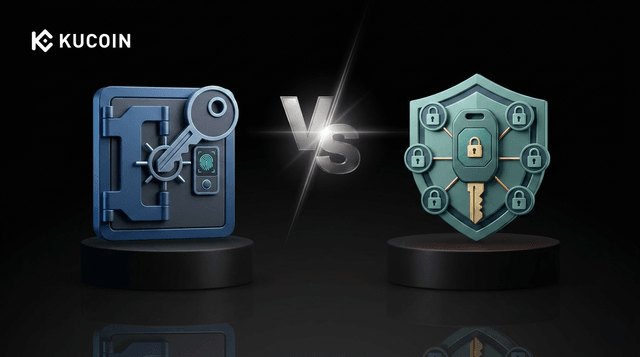
The institutionalization of digital assets in 2026 has reached a critical inflection point. As capital allocators move beyond speculative trading into structural integration, the debate between Centralized Custody for Institutions and Self-Custody for Institutions has become the primary focal point for risk management committees. For the sophisticated trader on KuCoin, these two models represent more than just where keys are stored; they define the speed of execution, capital efficiency, and the legal framework of asset ownership.
Whether you are a high-net-worth individual or managing a corporate treasury, choosing the right custody stack is the first step in protecting your digital alpha.
Key Takeaways
-
Centralized Custody offers institutional-grade insurance, regulatory compliance, and seamless integration with trading venues like KuCoin for immediate liquidity.
-
Self-Custody provides maximum sovereignty and removes third-party counterparty risk, but requires significant internal technical infrastructure and rigorous key management protocols.
-
Risk Profile: Centralized custody focuses on mitigating "external" theft and operational errors, while self-custody focuses on mitigating "institutional" capture and platform insolvency.
The 2026 Institutional Storage Landscape
By 2026, the crypto market has matured into a bifurcated ecosystem. On the one hand, we see the rise of "Qualified Custodians"—centralized entities that provide a fiduciary shield for institutional assets. These entities are essential for regulated funds that must, by law, separate the functions of investment management and asset custody.
On the other hand, the advancement of Multi-Party Computation (MPC) and Hardware Security Modules (HSM) has made self-custody viable for large-scale organizations. Institutional self-custody is no longer about a single person holding a 24-word seed phrase; it is a distributed, multi-signature governance process.
Deep Dive: Centralized Custody for Institutions (The Fiduciary Shield)
Core Value Proposition
Centralized custody of institutions is built on the premise of outsourced responsibility. The feature of "Third-Party Oversight" leads to a market behavior of "Regulated Stability," which ultimately provides the investor value of Insurance and Compliance. For many institutional mandates, especially those governed by MiCA in Europe or the SEC in the US, centralized custody is not an option—it is a requirement.
Technical Edge & Economic Model
Centralized custodians utilize proprietary "Cold-Storage-as-a-Service" models. By aggregating massive amounts of capital, they can negotiate lower insurance premiums and provide "Off-Exchange Settlement" options.
-
Key Benefit: Reduced slippage. Institutions can trade assets on the KuCoin Spot Market while the actual settlement occurs between the custodian and the exchange's institutional arm, minimizing the time assets spend in "hot" environments.
Deep Dive: Self-Custody for Institutions (The Sovereign Fortress)
Strategic Advantage
Self-custody for institutions is defined by Absolute Sovereignty. The core feature here is "Private Key Control," which leads to the market behavior of "Counterparty Immunity." The investor value is the Elimination of Third-Party Risk. If a centralized entity faces regulatory freezes or insolvency, a self-custodying institution remains unaffected, as they hold the mathematical proof of ownership on-chain.
Ecosystem Growth & 2026 Outlook
In 2026, the strategic advantage of self-custody has shifted toward DeFi Composability. Institutions using MPC-based self-custody can interact directly with smart contracts, allowing them to participate in DAO governance or liquidity provisioning without waiting for a custodian’s manual approval. This "Strategic Agility" is becoming the preferred choice for crypto-native hedge funds and venture capital firms.
Comparison Analysis: Security, Liquidity, and ROI
| Dimension | Centralized Custody (Institutional) | Self-Custody (Institutional) |
| Primary Security | Insurance & Legal Recourse | Mathematics (MPC/Multi-sig) |
| Counterparty Risk | Dependent on Custodian Solvency | Virtually Zero |
| Trading Liquidity | High (Direct Exchange Integration) | Moderate (Requires Transfer Latency) |
| ROI Potential | High (Access to VIP Fee Tiers) | Highest (Direct DeFi & Staking) |
| Regulatory Fit | Complies with Fiduciary Mandates | Highly Complex Regulatory Reporting |
| Operational Effort | Low (Outsourced) | High (Requires Internal Security Team) |
Trading Insights: Which fits your Portfolio?
-
The "Regulated Fund" Profile
If you are managing third-party capital (LPs) and require a SOC-compliant audit trail, Centralized Custody is your mandatory foundation.
-
Strategy: Keep 90% of assets with a qualified custodian and use the KuCoin Spot Market for active rebalancing and hedging.
-
The "Crypto-Native Treasury" Profile
For companies that hold Bitcoin or Ethereum on their balance sheet and prioritize long-term "HODLing" without counterparty risk, Self-Custody is the superior choice.
-
The "Hybrid Aggregator"
Most successful institutions in 2026 use a hybrid model. They keep "Core Holdings" in self-custody (the Fortress) and "Trading Capital" in centralized custody (the Shield) on KuCoin for immediate execution.
Conclusion & Strategic Guidance
The choice between centralized and self-custody is a deliberate trade-off between convenience and absolute control. Centralized custody provides the legal and operational safety net required by the traditional financial world. Conversely, self-custody provides censorship-resistant sovereignty that defines the blockchain revolution.
As an institutional participant, your goal is to maximize the utility of your assets without compromising your risk mandates. By leveraging KuCoin Institutional's advanced trading infrastructure alongside robust internal key management, you can build a resilient corporate framework. Allocating assets wisely across both custody paths ensures your capital remains highly efficient, secure, and ready for market opportunities.
FAQs for Centralized vs Self-Custody
-
What is the "MPC" technology used in institutional self-custody?
MPC (Multi-Party Computation) allows a private key to be split into "shards" distributed among multiple parties. No single person ever holds the full key, eliminating the "single point of failure" risk common in early self-custody models.
-
Can institutions get insurance for self-custodied assets?
Yes, but it is significantly more expensive and complex than centralized custody insurance. It requires a third-party security audit of the institution’s internal protocols and hardware infrastructure.
-
How does the "Travel Rule" affect institutional custody in 2026?
Regardless of custody type, institutions must comply with the Travel Rule, which requires the exchange of originator and beneficiary information for transactions over a certain threshold. KuCoin provides the infrastructure to handle these disclosures seamlessly.
-
Why would an institution choose centralized custody over self-custody?
The primary reason is Liability. In a centralized model, if a hack occurs, the custodian’s insurance and balance sheet cover the loss. In self-custody, the institution’s management is directly liable for any loss of funds due to technical error or theft.
Sign up for KuCoin today to buy, sell, and manage your entire crypto portfolio in one simple dashboard. Register Now!
Further Reading:


