
What is the difference between Account Abstraction vs. Traditional Wallets (EOA)?
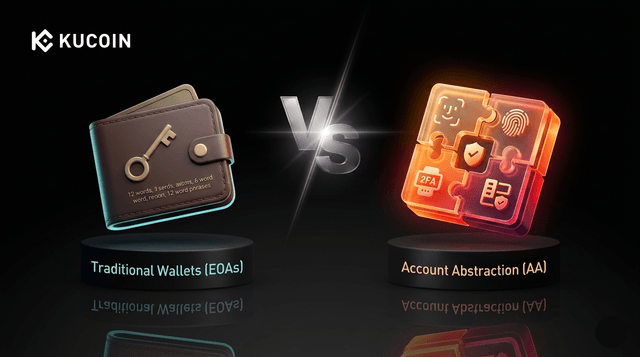
Key Takeaways
-
Programmable Control: Unlike EOAs which are limited by a single private key, Account Abstraction (AA) treats wallets as smart contracts, enabling custom logic for security and automation.
-
Mass Adoption Catalyst: AA eliminates the need for seed phrases and native gas tokens, lowering the entry barrier for millions of new users in the crypto markets.
-
Operational Efficiency: Features like transaction batching and gas sponsorship (Paymasters) significantly reduce friction for DeFi traders and dApp developers.
The evolution of Web3 is fundamentally a journey toward better abstraction. In the early era of blockchain, users were forced to act as their own banks, managing cryptographic keys and manual gas calculations through Externally Owned Accounts (EOAs). While EOA provided a foundation for self-custody, its rigid structure has long been the primary friction point for both developers and traders.
Enter Account Abstraction (AA). By turning user accounts into programmable smart contracts, AA decouples the "signer" from the "account," unlocking a suite of features from social recovery to gasless transactions that were previously impossible. For any serious participant in the KuCoin ecosystem, understanding this shift is essential for navigating the next generation of decentralized finance.
Overviews: Defining EOA and Account Abstraction
What is a Traditional Wallet (EOA)?
An Externally Owned Account (EOA) is the standard wallet type most users interact with today (e.g., a basic MetaMask or hardware wallet address). It consists of a public address and a private key.
-
The Rule: The private key is the ultimate authority. If you have the key, you own the assets. If you lose the key, the assets are gone forever.
-
The Limitation: Every transaction must be signed by that specific key and paid for with the network's native token (like ETH or KCS).
What is Account Abstraction (AA)?
Account Abstraction—formally standardized through ERC-4337—transforms the user account from a static key-pair into a programmable Smart Contract Account (SCA).
-
The Shift: Instead of the blockchain protocol hard-coding the "how" of transaction validation, the developer can code it into the contract.
-
The Infrastructure: It introduces a "UserOperation" mempool where transactions are bundled by Bundlers and executed via an EntryPoint contract.
Key Differences: Developer Experience (DX) and Trading Utility
The transition from EOA to AA is often compared to moving from a physical key-lock to a smart-home security system. Below are the technical and practical pivot points:
-
Security Paradigm: Seed Phrases vs. Social Recovery
In an EOA, the seed phrase is the single point of failure. AA introduces Social Recovery and Multi-signature (Multisig) logic natively. If a user loses access, a set of pre-defined "guardians" (other wallets, hardware keys, or even email-based services) can authorize a key rotation without the assets ever moving.
-
Gas Management: Native Tokens vs. Paymasters
Traditional wallets require users to hold the native token of every chain they use. Account Abstraction introduces Paymasters, allowing:
-
Gas Sponsorship: dApps can pay for the user's gas to simplify onboarding.
-
ERC-20 Gas Payments: Users can pay gas fees using stablecoins like USDT or USDC instead of volatile native assets.
-
Transaction Logic: Serial vs. Batched
EOAs process transactions one by one. If you want to swap a token on a DEX, you must sign an "Approve" transaction, wait, and then sign the "Swap" transaction. AA allows Transaction Batching, combining these into a single atomic signature, saving time and reducing gas costs. For traders looking for the latest announcements on network efficiency, AA-enabled batching is a game-changer.
Pros and Cons
| Feature | Traditional EOA Wallet | Account Abstraction (Smart Account) |
| Ease of Setup | Low (Must backup seed phrase) | High (Email/Social login possible) |
| Cost to Create | Zero (Off-chain generation) | Medium (On-chain deployment fee) |
| Safety | High risk (No recovery) | High (Programmable limits & recovery) |
| Flexibility | None (One key fits all) | Infinite (Custom logic, session keys) |
| Gas Options | Native token only | Any token or sponsored |
Use Cases in the Modern Ecosystem
-
Institutional Custody: Entities can set up complex "Time-locks" and "Spending Limits," ensuring that no single compromised key can drain a treasury.
-
Gaming (GameFi): Developers use Session Keys to allow players to interact with a game for a set period without repeatedly signing transactions, creating a seamless "Web2-like" experience.
-
DeFi Power Users: Advanced traders can use AA to automate complex strategies, such as "auto-compounding" rewards or "stop-loss" triggers that execute directly from their smart wallet.
For those using the KuCoin Lite version or the full professional interface, the backend integration of AA simplifies the bridging and swapping processes that once required deep technical knowledge. Stay updated on these integrations through the KuCoin Blog.
Conclusion
Account Abstraction is not just a wallet upgrade; it is a fundamental shift in how humans interact with the blockchain. By moving the complexity of the "account" into the code, we remove the "crypto" from "cryptocurrency" for the end-user. While EOAs will likely remain as the "root of trust" for many, Smart Contract Accounts will become the primary interface for daily transactions, gaming, and complex DeFi.
As the industry moves, the chains and platforms that successfully abstract away the friction of private keys and gas fees will lead in user acquisition and retention.
FAQs
Can I turn my existing EOA into an AA wallet?
While you cannot "convert" a static EOA into a contract, new protocols like EIP-7702 are being developed to allow EOAs to temporarily delegate their authority to a smart contract, effectively giving them "AA powers" without changing the address.
Is Account Abstraction less secure because it uses code?
"Code is Law," and while code can have bugs, AA allows for Multi-factor Authentication (MFA) and Hardware Enclave integration (like using your phone's FaceID). This often results in a higher net security for the average user compared to a paper seed phrase.
Do I need to pay for a "Bundler" when using AA?
The cost of the Bundler is typically included in your transaction fee. In many cases, dApps will use a Paymaster to cover these costs for you to improve the onboarding experience.
Why do I see a deployment fee when I first use a smart wallet?
Because a smart wallet is a contract on the blockchain, it must be "deployed" once to the network. This involves a one-time gas fee to write the contract code to the chain's state.
How does AA impact my trading on KuCoin?
AA allows for more complex "intent-based" trading. Instead of you executing every step, you can sign a single "intent" (e.g., "Swap 100 USDT for KCS if the price hits X"), and a specialized solver can execute it for you via AA infrastructure.
Join 30 million global users on the world’s leading crypto exchange by signing up for your free account now. Register Now!
Further reading


