
What is Leverage Trading and How Does It in Crypto Work?
For traders looking to maximize their exposure to market movements without committing massive amounts of capital, one concept stands above the rest. But what is leverage trading and how does it in crypto work exactly? In the fast-paced world of digital assets, leverage acts as a high-powered engine that can accelerate your portfolio's growth, provided you understand how to navigate its inherent risks. This guide provides an expert deep dive into the mechanics of leveraged positions and how to utilize them within a robust trading ecosystem.
Key Takeaways
-
Definition: Leverage trading involves borrowing funds from an exchange to open a larger position than your actual account balance allows.
-
Amplification: It multiplies both potential profits and potential losses, making it a "double-edged sword".
-
Margin Requirement: Traders must provide "collateral" (initial margin) to secure the borrowed funds.
-
Liquidation Risk: If the market moves against you beyond a certain point, the exchange will close your position to prevent further losses of borrowed capital.
The Mechanics of Power: Understanding Borrowed Capital
To truly answer what is leverage trading and how it works in crypto, we must look at the relationship between your equity and the exchange's lending pool. When you trade with leverage, you are effectively using a small amount of your own money to control a much larger financial stake.
How Leverage Ratios Work
Leverage is expressed as a ratio, such as 5x, 10x, or even 100x. This number dictates how much your buying power is multiplied.
-
10x Leverage: A $1,000 deposit allows you to hold a $10,000 position.
-
20x Leverage: That same $1,000 deposit grants you control over $20,000 worth of assets.
The Role of Initial and Maintenance Margin
-
Initial Margin: This is the minimum amount of capital required to open a leveraged position.
-
Maintenance Margin: This is the minimum amount of equity you must maintain in your account to keep the position open. If your account value falls below this threshold due to price movements, you face a "margin call" or immediate liquidation.
Why Use Leverage in the Crypto Market?
Traders don't just use leverage for the sake of "gambling"; it is a strategic tool used for specific financial outcomes.
-
Capital Efficiency
Leverage allows you to diversify your portfolio across multiple assets even if you have a limited starting balance. Instead of putting $10,000 into a single asset, you can use $2,000 at 5x leverage to gain the same exposure, leaving the remaining $8,000 free for other opportunities on the KuCoin platform.
-
Profiting from Small Price Movements
The crypto market is famous for its volatility, but there are periods of consolidation. Leverage allows traders to make meaningful gains even during a 1% or 2% price move, which would otherwise offer negligible returns in a standard spot trade.
-
Hedging Strategies
Advanced traders often use leverage to "short" an asset they already hold. By opening a leveraged short position, they can offset potential losses in their long-term holdings if the market takes a temporary downturn.
For those who find the professional interface complex, the KuCoin Lite version offers a streamlined way to interact with these concepts, providing a simplified view of how leverage impacts your trades without the clutter of advanced technical charts.
Navigating the Risks: The Reality of Liquidity and Volatility
While the upside is alluring, you must understand the "how it works" in reverse. Because you are trading with borrowed money, your tolerance for price fluctuations is significantly reduced.
The Liquidation Threshold
In a 10x leveraged trade, a mere 10% move in the wrong direction will wipe out your entire initial margin. In a 100x trade, a 1% move is enough to cause liquidation. This is why understanding what is leverage trading and how it works in crypto requires a deep respect for risk management.
Slippage and Funding Fees
When trading with high leverage on the KuCoin exchange, traders must also account for:
-
Slippage: The difference between the expected price of a trade and the price at which the trade is actually executed.
-
Funding Rates: In futures trading, long and short positions pay each other periodic fees based on the market's deviation from the spot price.
Leveraging Within the KuCoin Ecosystem
KuCoin provides one of the most comprehensive environments for leveraged trading in the industry. The ecosystem is designed to cater to both risk-averse beginners and aggressive professionals.
Margin Trading vs. Futures
-
Spot Margin: Borrow funds directly within the spot market to buy or sell assets.
-
Futures Trading: Use high leverage (up to 100x) on standardized contracts that track the price of an underlying asset.
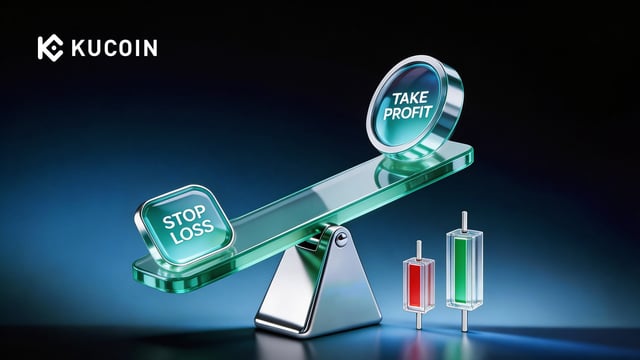
The KuCoin Trading Terminal offers advanced order types, such as "Stop-Loss" and "Take-Profit," which are non-negotiable when using leverage. These tools act as automated safety nets, closing your position at predetermined levels to prevent catastrophic losses.
Furthermore, the KuCoin Lite version helps bridge the gap for newer users, offering an intuitive "Fast Buy" or "Swap" feature that utilizes the deep liquidity of the main exchange while simplifying the complexities of margin ratios.
Conclusion: Mastering the Double-Edged Sword
Understanding what is leverage trading and how it works in crypto is a pivotal moment in any trader's education. It transforms the market from a simple store of value into a dynamic landscape where capital can be mobilized with extreme efficiency. However, the key to longevity in crypto is not how much leverage you can use, but how much you should use.
How does leverage trading work in crypto? It works by giving you a powerful tool to amplify your market condition. By using the robust tools provided by the KuCoin ecosystem, you can harness this power while maintaining the discipline needed to survive and thrive.
Ready to test your strategies? Sign up for a KuCoin account today and explore our industry-leading margin and futures products. Whether you are using the pro-terminal or the KuCoin Lite version, you are tapping into a world-class trading engine.
FAQs for Leverage
How does leverage trading work in crypto for a beginner?
For a beginner, it's best to think of leverage as a "booster." If you have $100 and use 5x leverage, you are trading as if you have $500. If the price goes up 10%, you make $50 (a 50% return on your $100). However, if the price drops 20%, your entire $100 is lost (liquidation).
What is 20x leverage on $10?
If you apply 20x leverage to $10, you are controlling a position worth $200. While this allows for significant gains from a small amount of money, it also means that a 5% drop in the asset's price will trigger a liquidation of your $10.
How much is $100 with 10x leverage?
With 10x leverage, your $100 collateral allows you to open a position worth $1,000. In this scenario, every 1% move in the market price results in a 10% change in your initial $100 investment.
What does 100x leverage mean in crypto?
100x leverage is the highest level of amplification typically offered. It means that for every $1 of collateral, you control $100 of the asset. This level of leverage is extremely risky, as a price movement of only 1% against your position will lead to immediate liquidation.
Is leverage trading the same as gambling?
Not necessarily. While high leverage without a plan can resemble gambling, professional traders use it as a tool for capital efficiency and risk management. Success depends on using technical analysis, setting stop-losses, and understanding the KuCoin ecosystem's mechanics.
See why millions of traders choose the People’s Exchange—create your KuCoin account in under 60 seconds. Sign Up Now!
Further Reading: Crypto Exchange | Bitcoin Exchange | Bitcoin Trading | KuCoin


