
What is Soft Fork in crypto?
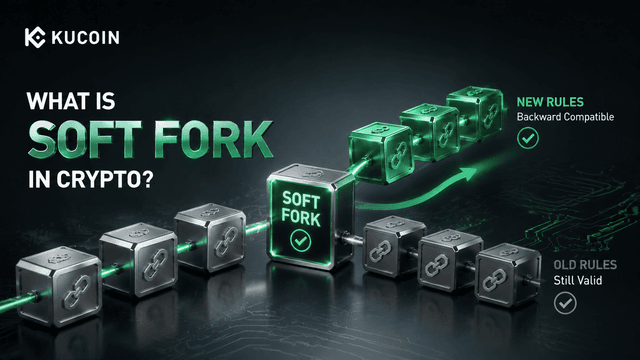
In the fast-moving world of blockchain technology, staying stagnant is not an option. Networks must constantly evolve to improve security, privacy, and speed. However, unlike a radical "Hard Fork" that splits a road in two, a Soft Fork is a more subtle, graceful way to upgrade a system.
But what is a soft fork in crypto, and why is it often preferred by developers for major network improvements? Whether you are a long-term investor or a curious newcomer, understanding how these "backward-compatible" updates work is key to following the roadmap of your favorite cryptocurrencies.
In this guide, we will break down the mechanics of soft forks, how they differ from hard forks, and why they are essential for maintaining a unified blockchain community.
Key Takeaways
-
Definition: A soft fork is a software upgrade for a blockchain that is backward-compatible, meaning non-upgraded nodes can still interact with the network.
-
Tighter Rules: Soft forks typically work by making the rules more restrictive what was previously valid remains valid, but new requirements are added.
-
No New Coin: Unlike a contentious hard fork, a soft fork does not result in a chain split or the creation of a new cryptocurrency.
-
Consensus-Driven: For a soft fork to succeed, a majority of the network's hash power (miners or validators) must signal support for the new rules.
What is Soft Fork? The "Backward-Compatible" Upgrade
A Soft Fork is an update to a blockchain protocol where only upgraded nodes see the new rules as valid. Crucially, because the new rules are a subset of the old rules, nodes that have not yet updated their software can still see, verify, and add new blocks to the blockchain as long as they don't break the new, tighter rules.
Think of it like a software update for a document reader (like Word). If the new version (Soft Fork) allows for "Bold Text," users with the old version can still open and read the document; they just might not see the bold formatting. The system remains unified and functional for everyone.
How a Soft Fork Works
-
Rule Tightening: Developers introduce a change that restricts what is allowed. For example, reducing the maximum block size.
-
Miner Signaling: Miners or validators "vote" by including a specific signal in the blocks they produce.
-
Activation: Once a threshold (e.g., 90% of blocks) is met, the soft fork activates.
-
Coexistence: Old nodes continue to function alongside new nodes, though they may eventually want to upgrade to access new features.
Soft Fork vs. Hard Fork: At a Glance
Understanding the difference is a top SEO requirement, as users frequently compare the two.
| Feature | Soft Fork | Hard Fork |
| Compatibility | Backward-Compatible (Old nodes work) | Incompatible (All must upgrade) |
| Network Split | Extremely unlikely | Possible (Chain split) |
| New Asset | No new coin created | Can result in a new coin (e.g., BCH) |
| Implementation | Easier to deploy safely | Requires total community consensus |
| Analogy | A new "Add-on" or "Plugin" | A completely new Operating System |
Why Use a Soft Fork?
Soft forks are the preferred method for many blockchain developers because they maintain network integrity and avoid the drama of a community split.
-
Implementing New Features
Many of Bitcoin's most significant upgrades were soft forks.
-
SegWit (2017): Optimized how data is stored in a block to increase transaction speed.
-
Taproot (2021): Improved privacy and smart contract capabilities on the Bitcoin network.
-
Enhancing Security
If a protocol needs to tighten its security requirements (for example, making digital signatures more complex), a soft fork can enforce these stricter rules without forcing every single user to update their wallet or node immediately.
-
Maintaining "Network Effects"
The value of a blockchain often comes from its size and unity. Soft forks ensure that the community stays on a single chain, preventing the dilution of liquidity and hash power that can happen during a contentious hard fork.
Summary
To answer "what is soft fork," think of it as the gentle evolution of a blockchain. It allows for innovation and better performance while ensuring that the network remains one cohesive unit. For the average user, a soft fork is usually "invisible"—your funds stay safe, no new coins appear, and the network simply gets better behind the scenes.
FAQs
-
Do I need to do anything during a soft fork?
For most retail investors and wallet users, the answer is no. Since the update is backward-compatible, your funds remain accessible. However, if you want to use the new features (like lower fees with SegWit), you may eventually need to move your funds to a new address type supported by the upgrade.
-
Can a soft fork fail?
Yes. If the majority of miners do not signal support for the change, the soft fork will not activate. This is why "User-Activated Soft Forks" (UASF) are often discussed as a way for the community to push back against miners.
-
Does a soft fork change the price of a crypto?
Like any upgrade, a successful soft fork can be seen as a "bullish" signal because it proves the project is actively improving. However, because it doesn't create "free" new coins (like a hard fork split), the price action is usually based on long-term utility rather than short-term speculation.
-
What is the most famous soft fork?
Segregated Witness (SegWit) is the most famous. It resolved a long-standing "malleability" issue in Bitcoin and paved the way for Layer 2 solutions like the Lightning Network.


